
Board Under Mattress: A 2026 Guide to Better Sleep and Support

That gentle dip in your mattress can quickly turn a good night's sleep into a restless one. If you're wondering whether a board under your mattress is the simple fix you need, you're asking the right question. It's a common-sense solution we see a lot with our customers in Galax and Hillsville, especially for our Value Seeker neighbors looking for an affordable way to get a little more life out of their bed.
Should You Put a Board Under Your Mattress
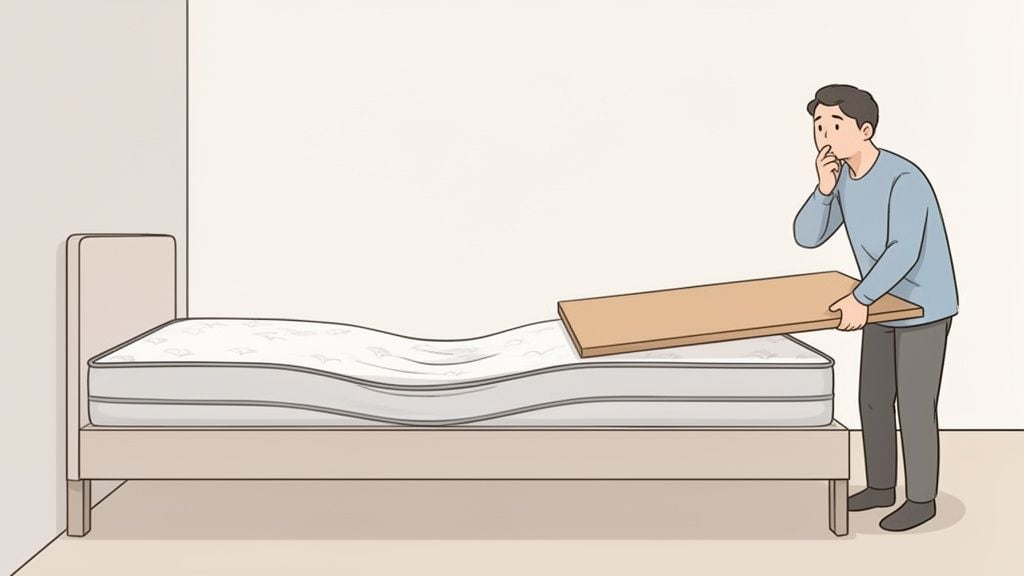
Here at Guynn Furniture, our family has been helping folks across Southwestern Virginia and Northern North Carolina get comfortable since 1902. We've seen just about every home comfort trick in the book, and placing a board under a mattress is one of the most enduring.
It’s often seen as a quick-fix for a mattress that's starting to show its age, and honestly, sometimes it works wonders. But we’ve always believed in giving our neighbors the straight story. This trick can be a great temporary patch, but it can also mask a bigger problem. Our goal is to give you an honest look at the pros and cons so you can decide if it's a smart temporary move or a sign that it’s time to invest in a more permanent upgrade for your sleep sanctuary.
When to Consider a Board
So, when does adding a support board actually make sense? In our experience, it's a solid idea in a few specific situations:
- Your box spring is old and losing support: An older, worn-out box spring is often the real reason for that dip in your mattress. A board provides the flat, rigid surface your mattress was designed for.
- Your bed frame has wide-set slats: If the slats on your bed frame are more than 3-4 inches apart, your mattress can start to sag between them. A board bridges those gaps, creating an even foundation.
- You simply prefer an extra-firm feel: There's no right or wrong when it comes to comfort. If you just like a harder sleeping surface, a board will definitely deliver that extra rigidity.
It’s crucial to know if you're dealing with a foundation problem or if the mattress itself has broken down. If the box spring or bed frame is the culprit, a board can be a great fix. For more on that, you might find our guide helpful that explains why you really do need a box spring for your bed.
Quick Diagnostic for Your Bed Support Issues
Still not sure what's causing your restless nights? We put together this simple chart to help our friends in Independence and the surrounding areas figure out what's going on with their bed.
| Symptom You Are Noticing | Most Likely Cause | Our Recommended Solution |
|---|---|---|
| The mattress dips, but only in the middle. | A worn-out or broken box spring or foundation. | Placing a board can be a good temporary solution, but a new, supportive foundation is the best long-term fix. |
| The entire bed feels soft, with visible sagging. | The mattress support layers have broken down. | This is a sign the mattress itself is at the end of its life. It's time to explore a new mattress from brands like Sealy or Therapedic. |
| You notice "hills and valleys" across the mattress. | The slats on your bed frame are too far apart. | A solid board or a bunkie board is an excellent fix to create a stable, even surface for your mattress. |
| The bed is noisy and creaks when you move. | Loose joints in the bed frame or a failing box spring. | First, tighten all bolts on the bed frame. If the creaking persists, the box spring is likely the culprit and needs replacement. |
Use this as a starting point. By pinpointing the symptom, you can get a much clearer idea of whether a simple board will do the trick or if it’s time to address a different part of your sleep setup.
The Old-School Trick for Better Mattress Support
Putting a board under a mattress is hardly a new idea. It’s a trick homeowners have used for generations to get a little more life out of their beds, and it’s a tradition that still makes a lot of sense to our neighbors here in Southwestern Virginia. For folks who appreciate the kind of lasting value we’ve stood for at Guynn Furniture since 1902, it’s all about protecting your investment.
The need for a solid, flat base has been around as long as mattresses have. What worked for a simple bed a hundred years ago isn't quite the same as what today's high-tech mattresses need, but the core principle holds true. A firm, even surface is still your best defense against premature sagging.
From Innersprings to Modern Mattresses
This practice of adding a board dates all the way back to the early 20th century, right when innerspring mattresses started showing up in homes. Families and mattress makers quickly figured out that a solid foundation was key to getting the best performance and longest life out of them. It's actually how we eventually got things like modern bunkie boards.
That commonsense wisdom is just as important today. It doesn't matter if you have a classic innerspring or one of the newer models from brands we trust like Sealy or Therapedic. A solid base is what stops those annoying dips and valleys from forming, which are often the culprit behind restless nights and back pain.
Here at Guynn, we’ve always seen it as more than just selling furniture. It’s about passing down the practical wisdom we’ve gathered over generations, a value we've held dear while serving our community for over a century.
Using a board under your mattress is a simple nod to that long history of smart, practical home solutions. It’s part of that timeless quest for a comfortable, supportive night’s sleep.
But while it’s a great trick, it’s also important to know how it works with modern mattress designs. The support a brand-new memory foam mattress needs, for instance, is a world away from an older innerspring model. We've always made it our mission to give our customers in Galax, Independence, and Hillsville honest, straightforward advice so you can get the most from your mattress, no surprises included. It’s just part of our no-pressure way of doing things.
How to Select and Prepare Your Mattress Board
So, you’ve decided a board under your mattress is the right move for you. Smart. But getting the details right is what separates a great temporary fix from a new headache. As your neighbors in all things home comfort, we want to give our fellow DIY-ers the practical advice that makes a project a success from the start.
The first, and most critical, choice is your material. Think of it as the foundation of your foundation—you need something strong and reliable that won't create new problems down the road.
Choosing the Best Material and Thickness
We always recommend going with a single, solid sheet of plywood. It creates a perfectly flat, uniform surface with no gaps for your mattress to sink into.
When it comes to thickness, you're looking for the sweet spot between 1/2-inch and 3/4-inch. This range is tough enough to stop any bowing under your weight but isn’t so bulky that it dramatically changes the height of your bed.
A couple of tips from our years of experience:
- Steer clear of particle board or OSB (oriented strand board). We've seen it happen—these materials just can't handle the constant pressure. They tend to crumble or break down, leaving you with a bigger mess than you started with.
- Give the plywood a good look-over at the store. You want a sheet that’s as flat as possible, without any major warping or big knots that could poke or create an uneven surface for your mattress.
This simple board solution is actually a key part of the story of how mattresses have evolved over time.
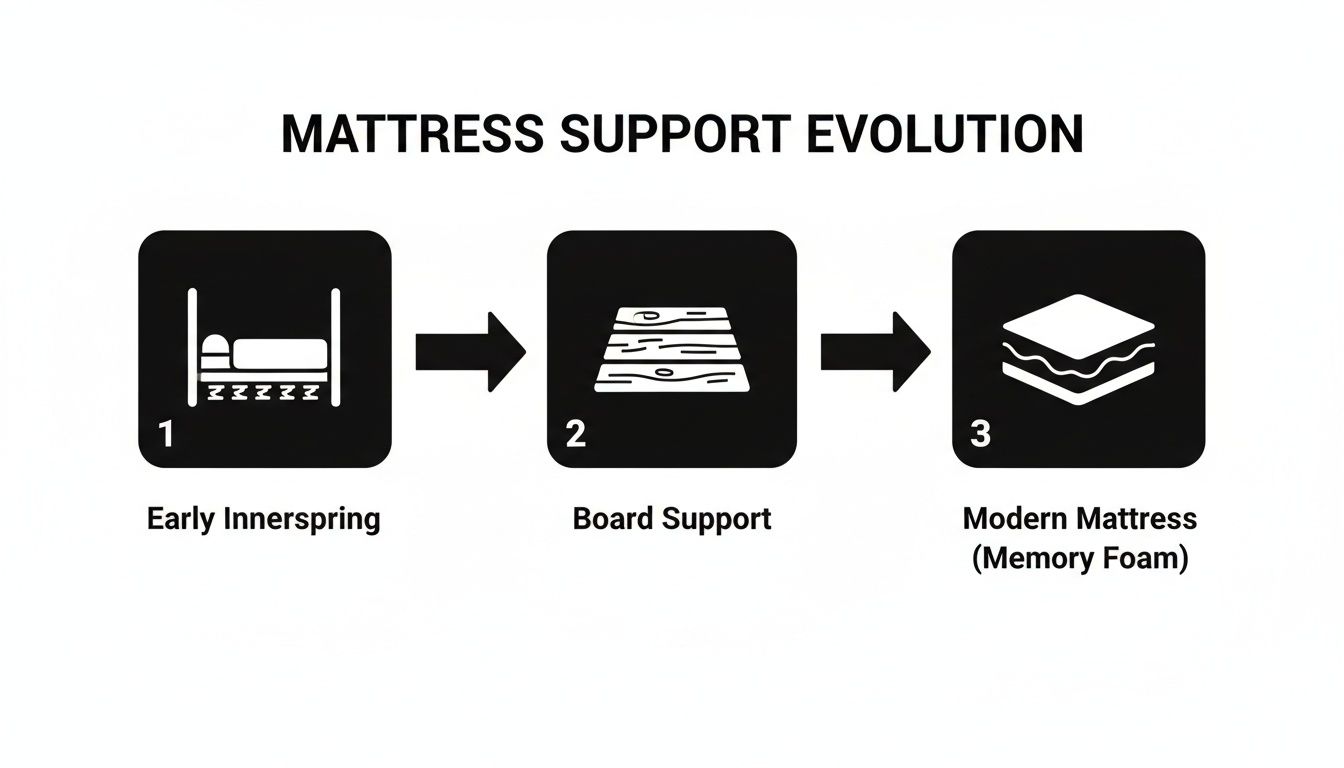
As you can see, a solid support was the bridge from those old, bouncy beds to the advanced, self-sufficient mattresses we enjoy today.
Measuring and Cutting Your Board
Getting the measurements just right is everything, whether you have a queen-size Ashley bed or a king-size frame from Bassett. You need to measure the inside lip of your bed frame—the exact area where your mattress or box spring rests. For a little extra help on getting precise numbers, check out our guide on how to measure furniture.
Pro-Tip: Once you have your numbers, subtract a quarter-inch from both the length and the width. This little trick of the trade makes placing and removing the board a breeze. It also helps with air circulation around the edges.
Most hardware stores around Hillsville and Galax will happily cut a sheet of plywood down to your specs, which saves a ton of work. If you find your bed frame needs a few tweaks to fit the board, or you're thinking about a more custom job, knowing how to find a good handyman is always a good card to have up your sleeve.
Before you call it a day, there's one last, crucial step. Run your hand carefully along all the edges and corners of your new board. If you feel any roughness or splintering, a quick once-over with some sandpaper is all it takes.
This small detail is a big deal—it prevents the board from snagging, tearing, or prematurely wearing out your mattress fabric. A few minutes of prep can go a long way in protecting your investment.
Understanding Mattress Compatibility and Warranty Risks
Before you slide a board under your mattress, there’s a critical detail we need to talk about—and it's one that can save you a lot of headaches down the road: your mattress warranty. Our family has been helping folks in Galax, Hillsville, and across Southwestern Virginia find their perfect sleep setup since 1902. Protecting your investment is just as important to us as your comfort.
Different mattresses have very specific support needs. A modern memory foam or hybrid mattress from a brand like Sealy or Therapedic is engineered with a completely different foundation in mind than a traditional innerspring. When you add a solid, non-breathable board, you might be accidentally voiding your warranty.
Mattress Types and Board Compatibility
The big issue here is airflow. Modern foams and gels are designed to breathe, which helps regulate your temperature and keeps moisture from building up. A solid board blocks that circulation. Some manufacturers will argue this can cause the materials to break down or even lead to mildew—and those are issues that are almost never covered by a warranty.
On the other hand, older innerspring mattresses are generally more forgiving. Their structure doesn't depend on airflow from underneath, so a solid board is far less likely to cause a problem. Understanding the real differences between options like hybrid vs. innerspring mattresses is key to making sure you're giving your bed the right kind of support.
Our Honest Advice: Always, always check your mattress warranty before you change its support system. Most manufacturers are very clear about what kind of foundation is required, often specifying things like slat spacing (e.g., no more than 3 inches apart) and the exact type of base needed.
Protecting Your Investment
So, what does this all mean for you? We just want you to have the right information to make a decision that protects both your comfort and your wallet. Here’s a quick rundown to help guide you:
- Memory Foam & Hybrid Mattresses: Proceed with caution. A solid piece of plywood can trap heat and moisture, which is bad news for these materials. You’d be much better off considering a modern alternative like a bunkie board, which is designed to give solid support while still being compatible.
- Latex Mattresses: Just like memory foam, latex needs to breathe. A solid board is generally not a good idea, as it can interfere with the material’s natural cooling abilities and long-term durability.
- Traditional Innerspring Mattresses: These are usually the best candidates for a board. It’s an effective way to firm up the feel and make up for a tired box spring, typically without causing any warranty trouble.
If you're ever on the fence, we're here to help. You can always ask our team for advice or check out our general information on Guynn Furniture & Mattress warranties to get a better sense of what's typically covered. Our goal is to make sure you love your mattress for years to come.
Modern Alternatives for Long-Term Support
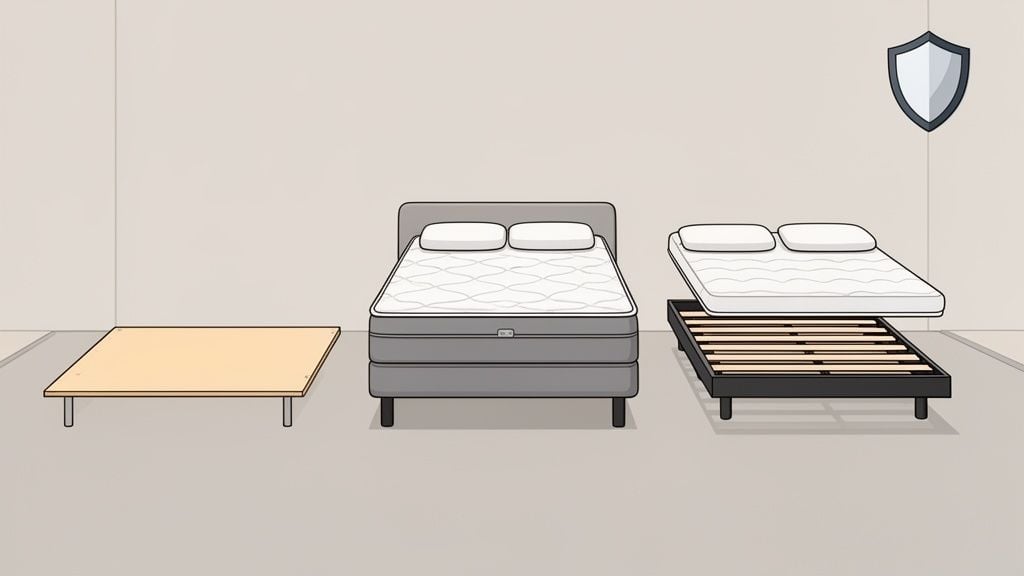
A board under the mattress is a clever short-term fix, but let's be honest—it's usually a band-aid for a bigger problem with your bed's foundation. It’s a sign that your mattress isn't getting the consistent, solid support it needs to perform its best.
To really protect your mattress investment and get the kind of deep, restful sleep you deserve, you’ll want to look at modern solutions designed for today's beds. In our showrooms across Galax, Independence, and Hillsville, we help our neighbors find these exact upgrades every single day.
The search for better sleep support is as old as time. It’s a fascinating journey from ancient Egyptians building raised platforms to get off the cold ground to the precision-engineered options we have today. This long history shows just how fundamental a good base is to a good night's sleep.
Bunkie Boards: The Modern Plywood
If you love the solid, firm feel a piece of plywood provides but want something that won't risk your mattress warranty, the bunkie board is your answer.
Think of it as the official, purpose-built version of a DIY board. These are slim, upholstered platforms, usually about 2 inches thick, made to give you a solid surface without adding a lot of height. They’re the perfect partner for modern mattresses from brands like Sealy and Therapedic.
A bunkie board offers a few major advantages:
- Uniform Support: It creates a perfectly flat, rigid surface that stops your mattress from sagging between wide slats.
- Low Profile: The slim design is ideal for platform beds or kids' beds where you want to keep the mattress from sitting too high.
- Warranty Safe: Because they're specifically designed for this job, using a bunkie board keeps your mattress warranty intact.
For our neighbors in the region who need a fast solution, we keep a large stock of bunkie boards ready for immediate, free in-home delivery and setup within 60 miles.
Foundations and Adjustable Bases
For the ultimate upgrade in both support and personalized comfort, nothing beats a modern foundation or an adjustable base. What many of us still call "box springs" are now true foundations—rigid, unyielding platforms built to properly support today's advanced foam and hybrid mattresses.
A new foundation is often the most effective way to restore the feel of your bed. It ensures your mattress performs exactly as the manufacturer intended, providing consistent support from edge to edge and extending its usable life.
Adjustable bases take things a step further, letting you customize your sleep position for incredible comfort. Being able to elevate your head or feet can do wonders for everything from snoring and acid reflux to improving circulation. We have a whole guide on how adjustable bases can help alleviate health concerns if you want to learn more.
Deciding between these options can feel overwhelming, but that’s what we’re here for. Our expert design staff, including Debra Williams, can walk you through the choices and help you find the perfect match for your bed and mattress, ensuring you get the lasting support your family deserves.
Your Guide to Lasting Comfort in Southwestern Virginia
Finding the right support for a good night's sleep is a journey, and we're glad we could be a part of yours. Since 1902, Guynn Furniture & Mattress has been a fixture in the community, helping families in Galax, Independence, Hillsville, and across Southwestern Virginia and Northern North Carolina find real comfort.
Sometimes, a simple fix like a board under your mattress is all you need. Other times, the best solution is a beautiful new bedroom set from a brand you trust, like La-Z-Boy or Ashley. Whatever your path, our promise has always been the same: to offer honest advice in a no-pressure atmosphere. We get that this is a personal decision, and we're here to help you figure it out.
If you're weighing all your options, it can be helpful to learn more about the best mattress stores near you and what truly sets a good one apart from the rest.
Our commitment is to help your family find true comfort. We stand by our Low Price Promise and offer flexible financing to make your dream home affordable.
And with our free in-home delivery and setup within 60 miles, bringing that comfort home has never been easier. We invite you to stop by our showrooms and experience the Guynn difference for yourself.
A Few Common Questions About Mattress Support
Here in our showrooms, we get to chat with our neighbors from all over Southwestern Virginia and Northern North Carolina. When it comes to getting the most out of a mattress, a few questions always seem to pop up. Let's dive into some of the most common ones we hear.
Will Putting a Board Under My Mattress Really Make It Feel Firmer?
In short, yes. A solid board under your mattress will almost always make the sleep surface feel firmer.
By adding that rigid layer, you're getting rid of the give or flex that you'd find in an older, worn-out box spring or a bed frame with slats that are too far apart. It’s a trick we’ve seen many folks in Galax and Hillsville use to add a little more life to a mattress that’s just starting to feel a bit soft or saggy.
Keep in mind, though, this is more of a bandage than a cure. A board adds support under the mattress, but it can’t bring back the worn-out foam and support layers inside the mattress itself.
Is It Okay to Put a Board Under a Memory Foam Mattress?
This is where you need to be careful. Most memory foam and hybrid mattress brands, including ones we trust like Sealy and Therapedic, are very specific about their support needs. They require a solid foundation or slats spaced no more than 2 to 3 inches apart.
Why? It’s all about proper support and, just as importantly, airflow. A solid piece of plywood can completely block air from circulating. This can lead to heat and moisture getting trapped under your mattress, which is not only bad for the foam but could also void your warranty. Before you go this route, we highly recommend checking your warranty details or just giving us a call. We can help you find a better-suited solution, like a bunkie board.
What's the Right Thickness for a Mattress Support Board?
If you’re going the DIY route, aim for a thickness between one-half inch (1/2") and three-quarters of an inch (3/4").
That range is the sweet spot—it’s sturdy enough to give you solid support and prevent bowing, but it won’t raise the height of your bed too dramatically. For the best results, use a single, solid piece of smooth, sanded plywood. This gives your mattress an even surface to rest on without any risk of snagging the fabric.
Visit our showrooms in Galax, Independence, or Hillsville to test the comfort for yourself. Schedule a consultation with our design team to start planning your dream room today. Or browse our selection online at guynnfurniture.net.