How to Mix Furniture Styles for a Cohesive Home


Mixing furniture styles is the secret sauce to creating a home that feels warm, inviting, and genuinely collected over time—not like it was pulled from a single page in a catalog. It’s about blending that cherished antique you inherited with a brand-new, comfortable piece that fits your life today. This approach is what gives your home a soul.
Creating a Home That Truly Feels Like You
Welcome, neighbor! Let’s talk about how to create a home that tells your family's story. The idea of mixing furniture styles might sound a little intimidating, but we're here to show you that you don't need to be locked into one rigid 'look.' Since 1902, our family at Guynn Furniture has watched our neighbors across Galax, Independence, Hillsville, and the wider Southwestern Virginia and Northern North Carolina region beautifully blend their heritage with new ideas. It's a tradition.
Think of it like pairing that beloved side table from your grandmother with a brand-new, ridiculously comfy La-Z-Boy recliner. It’s that exact mix of old and new, history and comfort, that makes a house feel like your home. Forget the pressure for perfection; this is supposed to be fun, achievable, and deeply rewarding.
Why Mixing Styles Works So Well
Let's be honest, a room where every single piece matches can feel a bit impersonal, almost like a showroom floor. When you mix styles, you’re really letting your personality shine through. It’s a design approach that celebrates who you are.
Here’s why it’s so popular:
- It Tells Your Story: Every piece, whether it's a modern Ashley sofa or a vintage find, adds a chapter to your family's narrative.
- It’s Budget-Friendly: You get to keep and highlight the furniture you already own and love. Our Low Price Promise also ensures that any new additions you bring in are incredibly affordable.
- It’s Timeless: A collected look never really goes out of style because it was never tied to a single, fleeting trend in the first place.
Your home should be a reflection of your journey. By thoughtfully combining different furniture styles, you create a space that is not just decorated, but curated by you, for you.
Getting Started on Your Design Journey
The first step is the easiest: just look around your home. What pieces do you truly love? What does your family actually need from a room? To mix things confidently, it helps to understand what you're working with. Learning how to go about identifying antique furniture styles can be a huge help, as it gives you a language for their distinct characteristics. This knowledge is empowering.
From there, you can start dreaming about what new items will complement your cherished pieces. Maybe you’re looking for a sturdy Bassett bedroom set to ground some delicate heirlooms, or a plush Sealy or Therapedic mattress for that gorgeous vintage bed frame you found. We have a huge in-stock selection ready for immediate delivery, which means you can start creating your dream space without the long waits.
For a little more inspiration, our general furniture style guide is a great place to get familiar with different aesthetics before you begin.
Finding Your Foundation With The 80/20 Rule
Every beautifully eclectic room we’ve ever seen has one thing in common: a solid foundation. This is where a simple but powerful guideline, the 80/20 rule, becomes your best friend. It’s a method our design team uses all the time for families across Southwestern Virginia and Northern North Carolina to create a cohesive look without tipping into chaos.
Think of it like this: 80% of your room is dedicated to one dominant style. This is your anchor, the look that sets the overall mood and makes the space feel intentional.
The other 20% is where the magic happens. This is your accent style, used to inject personality, visual interest, and just the right amount of surprise. It’s what keeps a room from feeling one-note or like it came straight from a catalog page.
Choosing Your Dominant Style
Your dominant style—the 80%—should reflect the main feeling you want the room to have. Are you aiming for a cozy, traditional space that’s perfect for family gatherings? A classic, comfortable sectional from a brand like Ashley or a timeless dining set from Bassett can be a fantastic anchor.
For a traditional living room, this 80% might look like:
- A substantial sofa with rolled arms.
- A classic wooden coffee table.
- An armchair that complements the sofa’s style.
These bigger, foundational pieces establish the room’s core character. For our neighbors who value things that last—something we’ve appreciated since opening our doors in 1902—picking high-quality anchors is the most important first step.
Introducing Your Accent Style
Once your foundation is in place, you can start layering in your accent pieces (the 20%). This is your chance to add a dash of modern sleekness, a bit of rustic charm, or even a hint of vintage flair. The key is to choose pieces that contrast with your dominant style in a way that feels deliberate and exciting.
If your living room is mostly traditional, your 20% could include:
- A pair of sleek, modern end tables with metal legs.
- A contemporary floor lamp with a clean, simple design.
- An abstract piece of art on the wall.
This is all about weaving your personal story into the space, blending cherished heirlooms with new comforts to create a home that is uniquely yours.
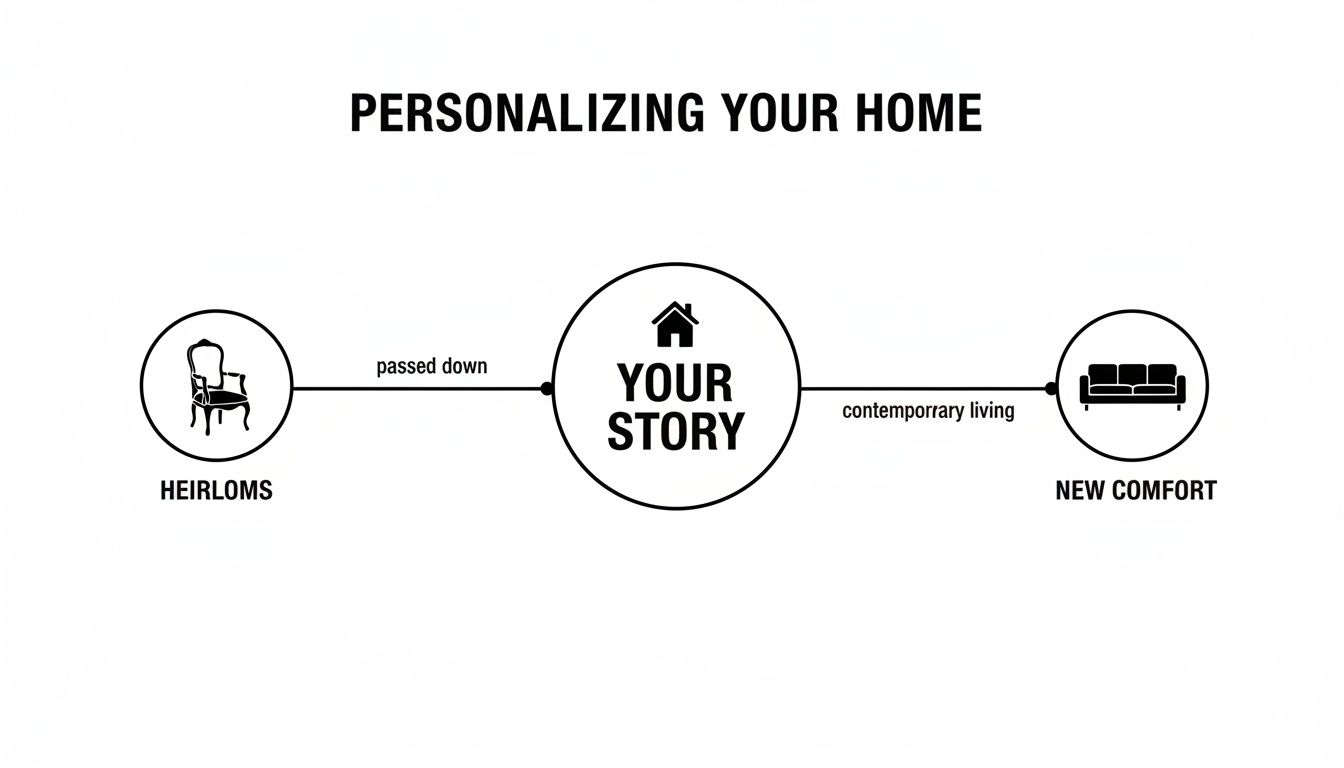
For anyone in Hillsville or Galax starting a remodel, this rule offers a clear, manageable starting point. It takes the guesswork out of the process. Instead of feeling overwhelmed, you can focus on finding that perfect foundational set and then enjoy the hunt for unique accent pieces. Still deciding on your core style? Our guide on contemporary vs traditional design styles can help you pinpoint your 80%.
The 80/20 rule isn't about rigid math; it's about balance. Your dominant style provides the calm, and your accent style brings the character.
This approach works in any room. Picture a rustic farmhouse dining table paired with sleek, modern chairs. The table is the 80%, setting a warm, inviting tone, while the chairs (the 20%) add that unexpected, contemporary edge. It’s this thoughtful contrast that creates a truly memorable and personal space. And with our large in-stock selection, you can find both your anchor and accent pieces for immediate delivery.
Visualizing Your 80/20 Furniture Style Mix
To help you see this rule in action, here are a few ways a dominant furniture style can be paired with a complementary accent style to create a balanced, eclectic look.
| Dominant Style (Your 80%) | Accent Style (Your 20%) | Example from Guynn's Showroom |
|---|---|---|
| Traditional Farmhouse | Modern Industrial | A solid wood dining table with black metal chairs. |
| Mid-Century Modern | Bohemian | A clean-lined sofa with textured, patterned pillows and a jute rug. |
| Classic Traditional | Sleek Contemporary | A rolled-arm sofa with glass and chrome end tables. |
| Coastal | Rustic | A light-colored linen sectional with a distressed wood coffee table. |
These pairings show how just a few carefully chosen pieces can add layers of interest and prevent your room from feeling predictable. It’s all about creating a conversation between different styles.
Using Color and Texture to Unify Your Space
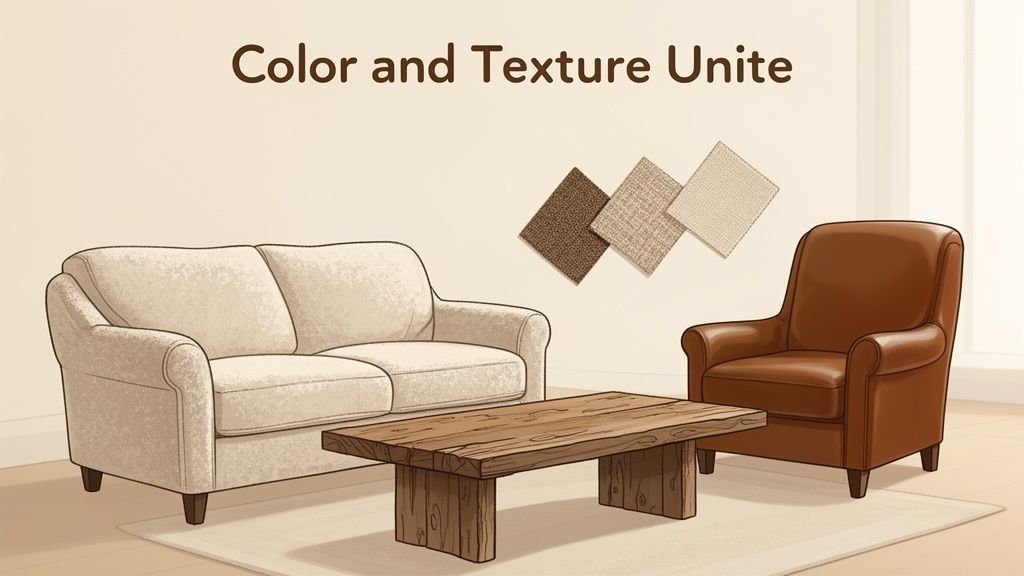
Once you’ve settled on your dominant and accent styles, how do you make sure they actually look like they belong together? This is where the real magic happens. Color, texture, and finishes are the common threads that weave your different pieces into a single, beautiful story.
Think of these elements as the secret ingredients to successfully mixing furniture styles. When pieces from different eras or aesthetics share a similar color story, they instantly feel connected. This doesn't mean everything has to be the same shade. It’s about creating a cohesive palette that flows through the room.
Find Your Unifying Color Palette
A consistent color palette is your most powerful tool. It’s the visual glue that holds a room together. The trick is to choose three to five colors and repeat them in varying amounts throughout the space.
Your palette could look something like this:
- A primary neutral: This could be a warm gray, a soft beige, or a classic cream that covers large areas like your walls or a big sectional.
- A secondary color: This shade should complement your neutral. Let it show up on accent chairs, an area rug, or drapery.
- An accent pop: Use this bolder color sparingly on throw pillows, art, or small decorative objects to add a dash of personality.
For instance, a modern gray sofa and a traditional wooden armchair can feel like part of the same family if they both feature throw pillows in the same shade of navy blue. It's a simple trick, but that repetition creates an immediate sense of harmony. For more guidance, you should check out our guide on creating the perfect color palette.
The Power of Repeated Textures
Texture adds depth and a tactile quality that makes a room feel cozy and inviting. Just like with color, repeating textures helps to unify a space. Imagine the soft chenille of a La-Z-Boy recliner, the smooth coolness of a leather Ashley sofa, and the rustic grain of a wooden coffee table.
These textures are all very different, but you can create a connection by repeating just one of them elsewhere. Got a rugged wooden coffee table? Echo that texture with wooden picture frames on the wall or a rustic decorative bowl on a side table. This subtle repetition creates a rhythm for the eye to follow, making the mix of styles feel intentional and polished.
A great way to start is by choosing a "hero" texture—like a plush velvet or a natural linen—and sprinkling it throughout the room on pillows, throws, or even an upholstered ottoman. This creates a cohesive sensory experience.
How to Mix Wood and Metal Finishes
One of the most common worries we hear in our Galax showroom is about matching wood and metal finishes. The good news? You don't have to! In fact, mixing finishes adds a layer of richness that matching sets often lack.
The trick is to create a connection through undertones. For wood finishes, try to stick with either all warm undertones (like oak, cherry, and mahogany) or all cool undertones (like ash, maple, or gray-washed woods). This ensures they complement each other rather than clash.
The same principle applies to metals. You can absolutely mix brass, nickel, and black metal in the same room. Just make sure there's a dominant metal, and use the others as accents. For example, your main light fixtures might be black metal, while your cabinet pulls and lamp bases could be a warm brass.
Ultimately, your home's color and texture are extensions of your style. Beyond your furniture, understanding how to apply color strategically, such as by choosing the right interior paint colors, can further unify your space and beautifully complement your mixed styles.
Mastering Scale and Proportion in Your Rooms
Have you ever walked into a room and felt like something was just… off, even if you couldn't put your finger on it? Nine times out of ten, the culprit is scale and proportion. Getting these two elements right is one of the most critical parts of mixing furniture styles, and honestly, it’s what separates a beautifully curated room from a chaotic one.
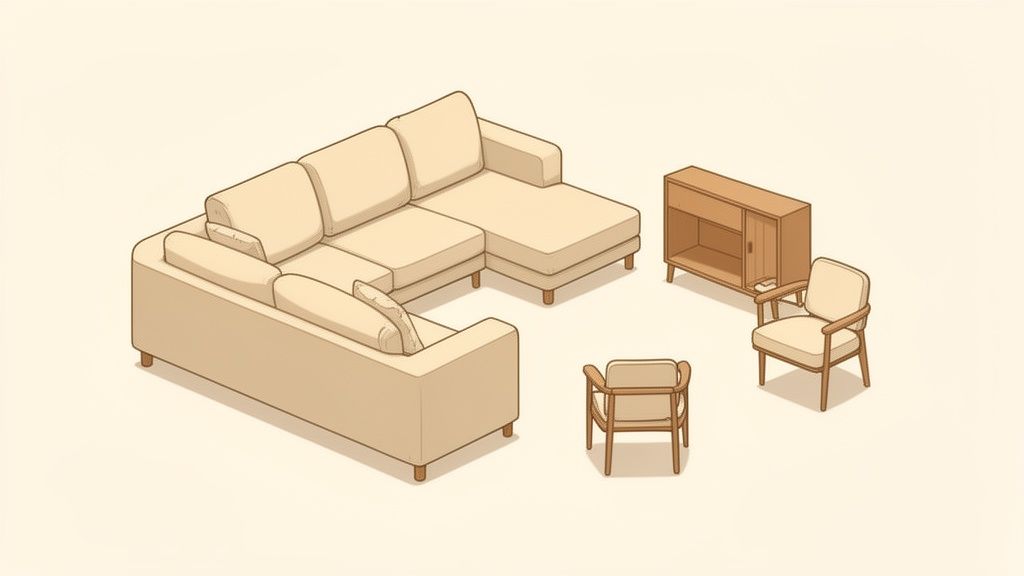
Let’s break it down. Scale is how the size of one object relates to another. Think: is that tiny end table completely dwarfed by your grand, overstuffed sectional? Proportion, on the other hand, is about how an object's size relates to the room itself. A massive armoire might look incredible in a living room with vaulted ceilings but will feel like a giant in a small bedroom.
Varying Heights for Visual Interest
One of the most common mistakes we see is a room where everything is the same height. It creates a flat, boring horizon line. A truly dynamic room encourages your eye to travel up and down, taking in the whole space.
Imagine a living room with a low-profile modern sofa. Instead of pairing it with equally low end tables, try a taller, elegant floor lamp on one side and a higher-backed accent chair on the other. That simple mix of heights adds instant dimension and a touch of sophistication.
Here are a few quick ways to play with height:
- Mix high and low profiles: Pair a low, sleek media console with a couple of taller bookcases framing it.
- Use lighting as a tool: An arcing floor lamp next to a lower armchair is a classic designer trick for a reason.
- Layer with art and mirrors: Hang a large mirror or piece of art above a shorter credenza to draw the eye upward and make the ceilings feel higher.
Give Your Furniture Room to Breathe
When you’re excited about new furniture, the temptation is to fill every square inch of the room. Resist! One of the best things you can do for your room's sense of scale is to embrace "negative space"—or as we like to call it, breathing room.
Overcrowding a room makes it feel cluttered and much smaller than it is, no matter what styles you’re mixing. Every major piece of furniture deserves a little clear space around it to be fully appreciated. And this doesn't mean shoving everything against the walls. Pulling your sofa even a few inches off the wall can dramatically open up the space.
A well-proportioned room just feels right. It’s calm and balanced. The goal isn’t to see how much furniture you can fit, but how beautifully the pieces you choose fit together in the space.
For our friends in Galax and Hillsville working with all sorts of room shapes and sizes, your tape measure is your best friend. Before you fall in love with a piece, make sure it’s a good fit. If you need a refresher, our guide on how to measure a room for furniture breaks it down into simple steps.
Balancing Visual Weight
Visual weight has nothing to do with how many pounds an item weighs; it’s about how heavy it looks. A dark, solid wood coffee table has far more visual weight than a glass and metal one of the same size. A bulky, dark-colored sofa feels heavier than a light-colored one up on slim legs.
When you're mixing furniture styles, balancing this visual weight is the secret sauce. If you have a visually heavy anchor piece, like a big, comfy La-Z-Boy sectional, you need to balance it with lighter pieces. Think accent chairs with exposed legs, open-shelf bookcases, or a coffee table with a glass top. This keeps any single piece from dominating the room and creates that harmonious feel you’re after.
At Guynn Furniture, we live and breathe this stuff. As a La-Z-Boy Showcase dealer, we absolutely love the deep comfort their pieces offer. Our expert design staff can show you exactly how to pair that cozy recliner or substantial sofa with more streamlined pieces from brands like Bassett or Ashley for a look that feels perfectly balanced and curated just for you.
Common Decorating Mistakes and How to Avoid Them
We’ve all been there. You find a piece you absolutely love, bring it home, and… it just feels off. Learning to mix furniture styles is a creative process, and a few missteps along the way are part of the journey. Think of them as learning experiences that make the final result that much better.
Our expert design staff, including our very own Debra Williams, has spent years helping families across Southwestern Virginia and Northern North Carolina work through these exact challenges. The goal isn't to create a perfect, museum-like room; it's to build a space that feels genuinely you.
Too Much of a Good Thing
One of the most common pitfalls is having too many "statement" pieces in one room. When every single item is trying to be the star—an ornate Victorian chair, a bold patterned rug, a chunky rustic coffee table, and a sleek modern lamp—they end up competing for attention. Instead of a curated look, you get chaos.
The fix is to let your anchor pieces, that 80% of your room, set a calm and cohesive stage. Then, let your accent items, the remaining 20%, be the ones that truly shine. This creates a natural balance and lets your favorite unique finds pop without overwhelming the space.
Forgetting the Unifying Thread
Another frequent issue is a room that lacks a common thread to tie all the different styles together. You might have a fantastic collection of pieces, but if they don't share a common color, texture, or finish, the room can feel disjointed and random—more like a collection of individual items than a unified design.
This is where you lean on those unifying elements we talked about:
- A Consistent Color Palette: Weave a few key colors throughout the room in your textiles, art, and decor to create visual harmony.
- Shared Textures: Echo a specific texture, like the warmth of a wood grain or the softness of linen, in a few different places to build a sense of connection.
- Complementary Finishes: Try to stick with either warm or cool undertones for your wood and metal finishes. This ensures they feel like they belong in the same family.
Having a plan is the secret to avoiding that "consignment shop" look. When you intentionally weave a common thread through your design, even the most diverse styles feel like they belong together.
Ignoring Scale and Proportion
As we touched on earlier, getting the scale wrong can throw off the entire feel of a room. Pairing a tiny, delicate side table with a massive, overstuffed La-Z-Boy sectional just makes both pieces look awkward. In the same way, cramming oversized furniture into a small room will make it feel cramped and unbalanced.
Always measure! Consider how a piece of furniture looks next to the other items in the room, but also how it fits within the room itself. A few minutes with a tape measure can save you from a major headache later. For more practical advice on this, our guide to the dos and don'ts of furniture shopping is a fantastic resource.
At Guynn Furniture, we know that building a beautifully collected home doesn't happen overnight. For our neighbors in Galax, Hillsville, and Independence, we offer flexible financing options. This way, you can invest in the right pieces over time, ensuring every new addition is a thoughtful one you'll love for years—without straining your budget.
Bringing Your Vision to Life with Guynn Furniture
Turning inspiration into a real, livable space is the best part of any design project. Hopefully, this guide has given you the confidence to start mixing and matching furniture styles to create a home that truly tells your family’s story. From Galax to Hillsville and all across Southwestern Virginia and Northern North Carolina, our family at Guynn is here to partner with you in that process.
Since 1902, our promise has been simple: help our neighbors create comfortable, beautiful homes.
Mixing styles is just an extension of that promise. It's about blending the pieces you already cherish with new, quality furniture that fits how your family lives today. Let’s quickly run through the key ideas again.
Your Path to a Beautifully Mixed Home
- Trust the 80/20 Rule: Anchor the room with a dominant style (your 80%), then inject personality with an accent style (your 20%).
- Find Your Common Thread: Use a consistent color palette and repeat textures to tie different pieces together, making them feel like they belong in the same room.
- Master Scale and Proportion: Make sure your furniture is sized right for the room and for the other pieces around it. This is crucial for a balanced, harmonious look.
- Avoid Common Pitfalls: Steer clear of having too many competing "star" pieces or forgetting that all-important unifying element we talked about.
Our expert design staff, including our own Debra Williams, is always ready to offer personalized guidance. Whether you need help choosing a foundational piece from our La-Z-Boy Showcase or finding the perfect accent from our Ashley or Bassett collections, we provide a no-pressure atmosphere for you to explore.
The most beautiful homes are the ones that feel authentic. They are a collection of memories, comforts, and personal style gathered over a lifetime. Your home is your story—we’re just here to help you furnish it.
Ready to take the next step? Our large in-stock selection means you won't have to wait to start creating. Plus, with our free in-home delivery and setup within 60 miles, bringing your vision to life has never been easier.
Questions We Hear All the Time About Mixing Furniture
In our showrooms, we get a lot of great questions from folks around Galax, Independence, and the neighboring communities. Mixing furniture styles is exciting, but it’s completely natural to have a few uncertainties. We figured we’d answer some of the most common queries we hear to help you get started with confidence.
Think of this as a friendly chat—just some straightforward, practical advice from our family to yours.
How Many Styles Can I Actually Mix in One Room?
This is a fantastic and very common question. While there's no hard-and-fast rule, we find that sticking to two or three styles is the sweet spot for a look that feels curated, not chaotic.
A great way to approach this is with the 80/20 rule. Let one style dominate the space (your 80%), like a comfortable, traditional living room set from Bassett. Then, sprinkle in a secondary style as your accent (the 20%), maybe with a few modern, streamlined end tables. A third style could be just a single, special piece—like that one-of-a-kind vintage armchair that tells a story.
Do All My Wood Tones Need to Match?
Definitely not! In fact, a room where the wood tones are all slightly different often feels richer and more authentic. You just need to know the secret: pay attention to the undertones.
- Warm Tones: Woods like oak, cherry, and mahogany have red, yellow, or orange undertones. They play beautifully together.
- Cool Tones: Woods with gray, blue, or even pinkish undertones, like ash or some maples, create a serene, harmonious look when grouped.
When you keep the undertones in the same family, you can absolutely mix a dark walnut table with a lighter oak chair, and they’ll feel like they belong together.
The goal isn't a perfect match. It's about creating a conversation between your pieces. A little variety adds the depth and character that makes a house feel like a home.
What if I Have an Heirloom That Doesn't Fit My Style?
We hear this all the time. You’ve got a beautiful, sentimental piece from your grandmother, but it just feels out of place with your more modern furniture. Don’t tuck it away in the attic—there are some wonderful ways to make it shine.
The trick is to give that heirloom a modern context. Place that antique wooden chest under a bold piece of contemporary abstract art. Or, surround a traditional dining table with sleek, modern chairs. This contrast is what makes the design so interesting. It turns your heirloom into a celebrated focal point instead of an awkward outlier, building a bridge between the old and the new.
Our expert design staff, including Debra Williams, loves helping solve these exact puzzles. Since 1902, we’ve helped families across Southwestern Virginia and Northern North Carolina blend their cherished histories with their current lifestyles. With a huge selection of in-stock furniture from brands like La-Z-Boy, Sealy, and Ashley, we can find the perfect new pieces to complement the treasures you already own—and we’ll deliver and set them up for free within 60 miles.
Ready to start your own design journey? The friendly team at Guynn Furniture & Mattress is here to help you create a home that feels perfectly you. Visit our showrooms in Galax, Independence, or Hillsville to test the comfort for yourself. You can also browse our selection online at guynnfurniture.net or schedule a consultation with our design team to start planning your dream room today.