Best Mattress for Pressure Relief: Expert Guide

Some mornings tell you the truth before your first cup of coffee.
You swing your legs over the side of the bed, stand up, and feel that familiar pinch in your shoulder, hip, or lower back. Maybe it fades after a hot shower. Maybe it follows you through the day. A lot of folks in Galax, Independence, Hillsville, and across Southwestern Virginia and Northern North Carolina start looking for the best mattress for pressure relief because of that exact routine.
The hard part is that mattress shopping can feel confusing fast. One website says soft is best. Another says firm. One person swears by memory foam. Another says coils solved everything. If you are sore, tired, and trying not to waste money, that kind of advice is enough to make anyone put off the decision.
We have helped families sort through that confusion since 1902, and one thing has stayed true through all those years. A mattress should not just feel good for thirty seconds in a showroom. It should help your body settle in, stay supported, and wake up with less strain.
Waking Up to a Better Day Starts the Night Before
A mattress problem does not always feel like a mattress problem at first.
Sometimes it looks like tossing from one side to the other because your hip gets sore. Sometimes it is a numb shoulder at 3 a.m. Sometimes it is that stiff lower back that makes you brace your hands on the dresser while you get your bearings.

Why soreness shows up overnight
When you lie in one position for hours, certain parts of your body carry more weight than others. Often, those spots are the shoulders, hips, and lower back. If the mattress does not spread that weight out well, those areas take the brunt of the load.
A 2021 Cochrane systematic review found that specialized mattresses significantly outperformed standard foam in preventing pressure ulcers caused by sustained pressure, which points to the significant importance of weight redistribution in a sleep surface (Cochrane review via PMC). That same basic principle matters at home, too. Good pressure relief helps reduce concentrated force on the parts of your body that complain the loudest.
Relief is not only about softness
Many shoppers get tripped up at this stage. They assume pressure relief means buying the softest bed in the building.
Not necessarily.
A mattress can feel soft on top and still push your spine out of alignment. Another can feel firmer at first touch but support your curves far better over the course of a full night. That is why true comfort is more than a hand test in the aisle.
If aches and sleep disruption are stacking up, it can also help to look beyond the mattress itself. We often tell neighbors to pair mattress shopping with simple habits that improve sleep quality naturally, like bedtime consistency, room temperature, and evening wind-down routines.
A pressure-relieving mattress does one simple but important job. It spreads your weight so one body part is not doing all the work.
What we see in the showroom
Folks often walk in saying one of three things:
- "My shoulder goes numb." This is common with side sleepers on surfaces that are too firm.
- "My back hurts when I wake up, but gets better as I move." That often points to poor overnight support.
- "I feel like I sink in too far." That can mean the comfort layers are not balanced with enough support underneath.
These are not small complaints. They change how you sleep, how often you move at night, and how you feel the next day. The good news is that once you understand pressure relief, the search gets a whole lot easier.
What Pressure Relief in a Mattress Really Means
Pressure relief sounds technical, but the idea is simple.
Press your hand into soft sand and the weight spreads out across your palm and fingers. Press that same hand onto a wooden tabletop and the pressure hits a few spots much harder. Your body feels the same difference on a mattress.
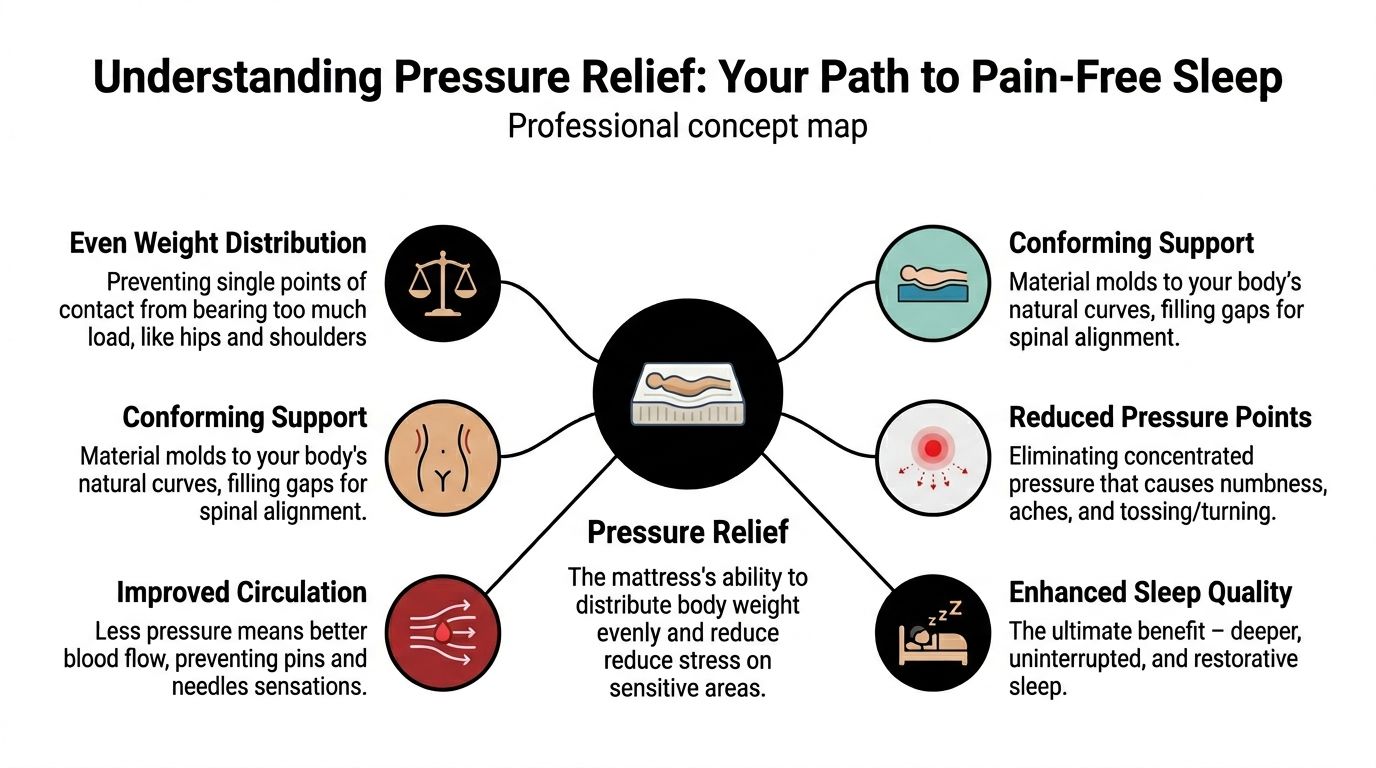
Pressure points are the spots that dig in first
When you lie down, your body is not one flat shape. Some areas stick out farther and carry more force against the bed.
For most sleepers, the common pressure points are:
- Shoulders for side sleepers
- Hips for side and back sleepers
- Lower back when support is uneven
- Knees and heels for some sleepers, especially on firmer surfaces
A mattress with good pressure relief lets those areas sink in enough to avoid sharp force, while still supporting the rest of the body.
Support and pressure relief work together
This is the part many online guides oversimplify.
A mattress should do two jobs at the same time:
- Cushion your pressure points
- Keep your spine in a more neutral position
If it only cushions, you may sink excessively. If it only supports, it may feel hard and create sore spots. The sweet spot is a surface that contours without swallowing you.
That is one reason shoppers often ask about foam. If you want a simple explanation of how that material behaves, our guide on what is memory foam mattress breaks down why foam can cradle the body so differently from a traditional spring bed.
What good pressure relief feels like
You usually notice it in a very ordinary way. You stop fidgeting.
Instead of constantly adjusting your shoulder, tucking a pillow under your hip, or rolling away from discomfort, your body settles. The mattress fills in the gaps around your curves instead of leaving them hanging.
Here are a few signs a mattress is helping:
- Your shoulder relaxes instead of jamming upward
- Your hips feel cushioned, not stuck
- Your lower back feels supported, not arched
- You can lie still longer without numbness or tingling
If a mattress feels plush for one minute but strained after ten, that is not pressure relief. That is a first impression.
Why this matters beyond comfort
When pressure builds too much in one spot, people tend to move around more to escape it. That can break up sleep without you even realizing it. Good pressure relief is not just about feeling cozy. It helps your body stay at ease long enough to rest well.
That is why the best mattress for pressure relief is rarely the one with the flashiest description. It is the one that matches your body shape, your sleep position, and your need for both cushioning and support.
Exploring Mattress Types for Superior Comfort
Not all mattresses relieve pressure the same way. Materials matter. Construction matters. Even two beds that both feel “medium” can behave very differently once you lie there for fifteen minutes.
A helpful way to narrow the search is to compare the main mattress types side by side.
Mattress Type Comparison for Pressure Relief
| Mattress Type | Pressure Relief | Spinal Alignment | Best For | Durability |
|---|---|---|---|---|
| Innerspring | Usually lighter contouring | Can feel supportive, but less adaptive at the shoulders and hips | Shoppers who like a traditional feel and easier movement | Varies by build |
| Memory foam | Strong contouring and close body hug | Good when matched to the right firmness | Side sleepers and people who like a cushioned feel | Can soften over time |
| Latex | More buoyant, gentler contouring | Often supportive with a lifted feel | Sleepers who want responsiveness without deep sink | Generally durable |
| Hybrid | Balanced contour and support | Often strong because comfort layers sit over coils | Combination sleepers, couples, many back and side sleepers | Often strong long-term balance |
Traditional innerspring beds
An old-school innerspring mattress usually has a spring-driven feel with less body contouring. Some people love that because it is easy to move around on and does not feel enveloping.
The drawback is pressure relief. If the comfort layers are thin, the shoulders and hips can push against the surface too directly. That can be fine for some stomach sleepers, but side sleepers often notice discomfort sooner.
Memory foam mattresses
Memory foam became popular for a reason. It molds around the body and can do a nice job of easing force at the hips and shoulders.
For some sleepers, that close contour feels wonderful. For others, it creates two common complaints:
- Too much sink that throws off alignment
- More heat retention than they want
Memory foam can still be a strong option for pressure relief, especially for lighter-weight sleepers or anyone who enjoys that body-hugging feel. But it is not automatically the right answer for everyone.
Latex mattresses
Latex has a different personality. It cushions, but it feels springier and more lifted than memory foam. Instead of a deep hug, you get more of a floating sensation.
That can be great for people who dislike the “stuck” feeling. At the same time, some sleepers with sharper pressure-point needs want more contour than latex usually provides.
Why hybrids get so much attention
Hybrid mattresses combine comfort layers on top with coil support below. Done well, that is a very practical design.
According to Sleep Advisor, hybrid mattresses combine foam comfort layers with coil support systems, and the foam contours to distribute weight while individually wrapped coils respond to localized pressure, helping prevent the “bottoming out” effect common in some all-foam designs (Sleep Advisor hybrid guide).
That is a fancy way of saying this: the top of the bed cushions you, and the deeper structure keeps you from sagging.
If you want a closer look at how that construction works, our page on what is a hybrid mattress gives a plain-language explanation.
The feel of each type
Here is how we usually describe these beds to neighbors in the showroom.
- Innerspring: More on top of the bed than in the bed.
- Memory foam: More contour, more hug, less bounce.
- Latex: Responsive, buoyant, easier to turn on.
- Hybrid: A middle ground that blends cushioning with pushback.
Why many shoppers land on Sealy or Therapedic hybrids
This is often where the theory becomes practical. Sealy and Therapedic models can offer the mix many pressure-relief shoppers need: contouring near the body, support underneath, and easier movement than some all-foam beds.
For local shoppers, Guynn Furniture & Mattress carries Sealy and Therapedic along with other home brands like La-Z-Boy, Ashley, and Bassett in our broader showroom mix, which makes it easier to compare sleep comfort with the rest of your bedroom needs in one trip.
If your current mattress feels either too hard or too mushy, a hybrid is often the first category worth testing.
A simple rule of thumb
If you are unsure where to start, use this rule:
- Want a close hug and less motion transfer? Try foam.
- Want more lift and airflow? Try latex.
- Want a balance of contour, support, and durability? Start with a hybrid.
- Want a very traditional spring feel? Test an innerspring, but pay close attention to shoulder and hip comfort.
The best mattress for pressure relief is not one material for every person. It is the material that solves your specific pressure points without creating new problems somewhere else.
Finding Your Perfect Match for Body Type and Sleep Position
A mattress can be beautifully made and still be wrong for you.
Sleep position and body type change how a bed feels. The same mattress may feel plush to one person, firm to another, and just right to someone in the middle. That is why personal fit matters so much when you are shopping for the best mattress for pressure relief.

Side sleepers need room at the shoulder and hip
Side sleeping puts more body weight onto a smaller area. That means the shoulder and hip usually press in first.
A mattress that is too firm can create that “jammed” feeling in the shoulder. One that is too soft can let the hips sink too far. Many side sleepers do best with a mattress that has enough cushioning on top but still keeps the waist and lower back supported.
In 2026 expert testing, certain hybrid mattresses achieved near-perfect pressure relief scores across sleeping positions by using dual-coil systems and zoned support, which could ease pressure on shoulders and hips by up to 30% more than standard single-coil models (Sleep Foundation best mattress guide). That gives you a clue about what side sleepers should look for. Zoned support can matter.
Back sleepers need gentle contour with lumbar support
Back sleeping spreads weight more evenly, but the lower back still needs support. If the mattress is too firm, the lumbar area can feel unsupported. If it is too soft, the pelvis may dip and pull the spine out of position.
Back sleepers often do well on medium to medium-firm models, especially hybrids that cushion the hips without letting them sink too closely.
Stomach sleepers usually need a steadier surface
Stomach sleeping is where too much softness tends to cause trouble fastest. The midsection can dip, and the lower back may arch.
That does not mean stomach sleepers need a rock-hard mattress. It means they usually need a flatter, more supportive feel with moderate cushioning. If this position leaves you sore through the hips or pelvis, this article on pelvic pain after sleeping on your stomach is a useful read.
Body type changes firmness feel
This part surprises a lot of shoppers.
A lighter-weight sleeper may not sink far enough into a firmer mattress to feel its pressure-relieving layers. A heavier sleeper may press further into the same bed and need stronger support underneath.
In plain terms:
- Lighter sleepers often prefer softer comfort on top so the mattress can contour enough to matter.
- Average-weight sleepers usually have the widest range of choices.
- Heavier sleepers often benefit from stronger coil support, denser materials, and a feel that keeps them lifted rather than caving inward.
Combination sleepers need balance
If you change positions through the night, ease of movement becomes part of pressure relief. You do not want a mattress that hugs so closely you have to fight it every time you turn over.
For many combination sleepers, hybrids excel in this regard. They cushion enough for side sleeping but stay responsive enough for easier movement when you roll onto your back or stomach.
The right mattress should fit the way you sleep, not the way you wish you slept.
One practical shortcut
If you are trying to sort through options before coming in, our guide on which mattress is right for your body type can help you narrow the field.
We also keep a large in-stock selection ready for immediate delivery, which matters when your current mattress is already costing you sleep. Sometimes the best solution is not waiting on a box in the mail. It is finding the right fit and getting relief sooner.
Why Shopping Local Matters for Your Best Night's Sleep
You can read reviews for hours and still not know how a mattress will feel to your shoulder.
That is the biggest weakness of online-only mattress shopping. Pressure relief is physical. You cannot judge it from a product description or a star rating.
You need time on the mattress, not just specs
A bed may sound perfect online and still feel wrong after ten minutes. The reverse happens too. A mattress that sounds plain on paper may be exactly what your hips and back needed.
That is why a showroom matters. You can lie down in your normal position, notice how the edge feels when you sit, and compare one surface against another in real time.
Many online guides also miss the practical needs of seniors and rural households. Mattress Clarity notes that many online guides overlook the specific needs of seniors and those in rural areas, including edge support and worry-free delivery, while local retailers help fill that gap with in-person guidance and services like free in-home setup (Mattress Clarity pressure-point guide).
Local service solves local problems
For many of our neighbors in Southwestern Virginia and Northern North Carolina, mattress shopping is not just about comfort. It is also about logistics.
- Can I get it delivered to my home without a hassle?
- Will someone set it up for me?
- Can I compare different feels in one visit?
- Can I ask questions without getting a sales lecture?
Those questions matter in Galax, Independence, Hillsville, and the surrounding region. They matter even more for older adults, caregivers, and anyone replacing a bed because pain has made waiting hard.
The difference a showroom makes
In a no-pressure atmosphere, you can test what your body responds to. That might be a Sealy with pressure-relieving foam layers, a Therapedic with a steadier feel, or something that surprises you after a side-by-side comparison.
A local store also helps with the parts shoppers rarely enjoy:
- Delivery coordination
- Room setup
- Questions about foundations or adjustable bases
- Comparing value without hopping between five websites
If you are looking for a nearby place to start, our page on local mattress stores near me makes that a little easier.
Value is not just the sticker price
For the value seeker, the cheapest-looking option online is not always the best buy if it misses the mark and leaves you starting over.
We keep things straightforward. Free in-home delivery and setup within 60 miles saves the heavy lifting. Our Low Price Promise means we match local competitors and offer a 30-day price guarantee. Financing options help, too, when you need relief now and want to spread out the cost.
That combination matters because the goal is not just buying a mattress. The goal is getting the right mattress into your home, set up correctly, with fewer headaches.
Tips for Testing a Mattress and Understanding Warranties
A mattress can feel good for thirty seconds and wrong by bedtime. Testing it the right way makes a big difference.
The biggest mistake shoppers make is sitting on the corner, bouncing once, and calling it a day. Pressure relief shows up when your body has time to settle.
How to test a mattress in the showroom
Start with your real sleep habits, not your best guess.
- Lie down in your main sleep position: If you are a side sleeper at home, test on your side first.
- Stay there long enough: Give your shoulders, hips, and lower back time to respond.
- Check movement: Roll from side to back and notice whether the bed helps or fights you.
- Sit on the edge: If you use the edge to get in and out of bed, this matters.
- Notice temperature and feel: Some beds warm up faster than others.
If you want a simple checklist before you visit, our guide on how to choose a mattress is a helpful place to start.
Watch for heat and “stuck” feeling
Memory foam often gets praised for pressure relief, but it can trap heat. Hybrid mattresses often do better with long-term spinal alignment and cooling, which can make them a smarter choice for combination sleepers or anyone who tends to sleep warm, according to ShopSilica’s discussion of pressure-relief mattress tradeoffs (ShopSilica pressure relief article).
This matters in a showroom because heat and response are easy to miss if you rush.
If you sleep warm or change positions often, pay close attention to how quickly the mattress responds when you move.
Warranty terms worth asking about
Warranties sound reassuring, but the details matter.
Ask these questions:
- Is the coverage prorated or non-prorated? Prorated coverage usually means your share of the cost rises over time.
- What counts as a defect? Body impressions and sagging standards vary.
- What foundation is required? The wrong base can void coverage.
- What kind of damage is excluded? Stains and misuse are common exceptions.
A plain rule for peace of mind
A good warranty supports a well-made mattress. It does not replace careful shopping.
Choose the bed that fits your body first. Then read the paperwork. That order saves a lot of frustration.
Your Journey to Pain-Free Sleep Starts Here
The best mattress for pressure relief is personal.
It depends on where your body feels strain, how you sleep, and whether you need more contour, more support, or a better balance of both. For one person, that may be a pressure-relieving foam model. For another, it is a hybrid that cushions the shoulders but keeps the hips from sinking too far.
Our family has helped neighbors furnish their homes since 1902, and we still believe mattress shopping should feel calm, clear, and honest. No jargon. No rush. Just practical help for real people across Galax, Independence, Hillsville, Southwestern Virginia, and nearby Northern North Carolina.
If you are also planning the rest of your room, our expert design staff, including Debra Williams, can help tie comfort and style together with bedroom furniture from trusted names like Ashley, Bassett, and La-Z-Boy.
A better morning often starts with a better surface under you at night.
Your Mattress Questions Answered
How long does it take to break in a new mattress
Most new mattresses need a little time to feel like home.
Foams loosen slightly, covers relax, and your body adjusts to a new support pattern. If your old mattress was sagging or uneven, even a better mattress can feel unfamiliar at first. Give yourself a fair adjustment period before making a snap judgment.
Can a mattress topper fix pressure points
Sometimes, but usually only for a limited problem.
A topper can add surface softness if your mattress is slightly too firm. It cannot fix worn-out support underneath. If the mattress already sags, dips, or throws your spine out of alignment, a topper is more bandage than solution.
How often should you replace a mattress
There is no one-size-fits-all timeline because use, materials, and body type all matter.
A better question is this: does your mattress still support you well? If you wake up sore, notice sagging, feel your pressure points more than before, or sleep better elsewhere, replacement may be worth serious thought.
Is an adjustable base the same as a pressure-relieving mattress
No. They do different jobs.
A pressure-relieving mattress manages how your body interacts with the sleep surface. An adjustable base changes your position by raising or lowering parts of the bed. Some people love combining the two, especially if they want easier entry and exit or a more comfortable reading position, but the base does not replace the need for the right mattress.
What if my partner and I like different feels
That is very common.
Look for a balanced mattress first, especially in a hybrid design. Couples often do well with models that cushion enough for one sleeper without becoming too soft for the other. In-store testing helps a lot here because both people can feel the same mattress before bringing it home.
Should seniors shop differently for pressure relief
Often, yes.
Edge support, ease of movement, delivery, setup, and overall stability matter more when mobility is a concern. A mattress that feels soft and pleasant is not enough if it is hard to get out of or difficult to move on safely.
Visit Guynn Furniture & Mattress to explore supportive mattresses from Sealy and Therapedic in a no-pressure atmosphere. We serve Galax, Independence, Hillsville, and the wider Southwestern Virginia and Northern North Carolina region, with free in-home delivery and setup within 60 miles, a Low Price Promise with local price matching and a 30-day price guarantee, plus financing options and a large in-stock selection for faster delivery. Visit our showrooms in Galax, Independence, or Hillsville to test the comfort for yourself. Schedule a consultation with our design team to start planning your dream room today. Browse our selection online at guynnfurniture.net.