


Mattress Thickness Guide: How to Choose the Right Height


If a taller mattress were always better, why could the same mattress feel supportive to one sleeper and leave another struggling to get comfortable? The missing piece is the whole sleep system: the sleeper's body, the mattress construction, and the finished height of the bed.
Mattress shopping can feel overwhelming, especially when replacing a bed is a significant household expense. A practical mattress thickness guide helps narrow the choices without treating extra inches as proof of better comfort.
Mattress Thickness Ranges and What They Measure
The simplest starting point is a set of practical thickness bands. The Sleep Foundation's mattress thickness guide identifies the following ranges, including the common standard band for adults weighing roughly 130 to 230 pounds, particularly back sleepers.
| Range | Thickness | Typical Fit |
|---|---|---|
| Low-profile | 4 to 8 inches | Less common; confirm support and weight rating |
| Slim | 8 to 10 inches | Lighter sleepers who want a lower profile |
| Standard | 10 to 12 inches | Most average adults, roughly 130 to 230 pounds, especially back sleepers |
| Thick | 12 to 14 inches | Sleepers over 230 pounds and many side sleepers |
| Extra-thick | 14 inches or more | Specialist needs; check entry height and sheet sizes |
Treat these bands as shopping categories; boundary cases overlap. A mattress near a boundary behaves the same whether its label lands in one category or the next, so we use the bands to narrow a search rather than to pass or fail a model.
One distinction trips up many shoppers. Thickness means the mattress's total height from its bottom to the sleeping surface. Firmness describes the resistance a sleeper feels when lying down, a distinction explained in the Sleep Foundation's mattress construction overview. A tall mattress can feel firm, while a lower mattress can feel plush.
What the Height Contains
A mattress combines a support core with comfort and transition materials, and the core does most of the work. A foam mattress builds its base from dense support foam, while an innerspring gets much of its height from the coil unit itself. A mattress construction overview from Mattress Recycling Guy reports average profiles of about 11 inches for foam, 13 inches for innerspring, and 12.5 inches for adjustable air mattresses. Those averages reflect how each design fills its height.
Depth spent on padding and depth spent on support do different jobs. Generous cushioning layered over a weak core still compresses through to a sagging feel, so reading where the inches go matters more than counting them.
The useful questions are therefore about what fills the mattress:
- Support core: What holds the sleeper up after the surface cushions compress?
- Comfort layers: Can the shoulders and hips settle comfortably without excessive sinking?
- Transition materials: Does the sleeper feel a gradual change from cushioning to support?
- Practical fit: Will the complete bed remain easy to enter, and will the bedding fit?
When More Depth Helps
Additional depth can provide space for cushioning around prominent shoulders and hips or accommodate greater compression from a heavier sleeper. The tradeoff is practical: a taller mattress raises the step into bed and can call for deeper-pocket sheets.
Practical rule: Compare the construction and comfort layers first, then compare the inches.
The inches tell you where to start looking. The construction underneath tells you what to expect once you lie down.
Matching Thickness to Your Body and Sleep Position
Two mattresses can measure the same height and behave like completely different beds under the same sleeper. The number on the tag only becomes useful once we pair it with the body lying on it: weight sets how far the layers compress, and sleep position sets where cushioning and support need to do their work.
A back sleeper needs balanced support beneath the torso and pelvis. A side sleeper needs room for the shoulders and hips to settle. A stomach sleeper needs resistance beneath the pelvis so the lower back stays level through the night.
| Sleeper Profile | Thickness to Consider | What to Check |
|---|---|---|
| Back sleeper, about 130 to 230 pounds | 10 to 12 inches | Standard band is usually adequate |
| Side sleeper, any weight | 12 to 14 inches as a starting comparison | Cushioning depth for shoulders and hips |
| Over about 198 pounds (90 kg) | At least 11 inches | Excessive sinking and posture support |
| Over 230 pounds | 12 to 14 inches | Dense support core rated for the load |
| Stomach sleeper | Pelvic support sets the target; inches follow | Pelvic support and resistance to sag |
That weight-based minimum comes from Matelas's mattress thickness buying guide, which recommends at least 28 centimeters, about 11 inches, for people weighing more than 90 kilograms, approximately 198 pounds. Treat it as a shopping recommendation that gives you a starting point for showroom comparisons.
How to Read the Profiles
For a back sleeper, the standard category is a sensible place to begin. The important check is whether the pelvis stays supported while the lower back feels settled.
For a side sleeper, the thicker category is a starting comparison. A lighter person may never compress firm cushioning enough to reach its full depth, so extra inches can go unused. Someone with wider shoulders often benefits more from an adaptive surface than from a taller mattress.
For a heavier sleeper, inspect the upper layers and the support underneath together. A deep plush top can feel welcoming in the first minute yet still let the hips sink out of line when the support core yields too easily.
For a stomach sleeper, judge the mattress by what happens under the pelvis. A lower model that keeps the pelvis supported often works better than a tall one with a yielding surface.
Account for Body Shape Too
Two people at the same weight can carry it very differently. Shoulder width, hip shape, height, and preferred posture all change how far each body presses into the same mattress, which is why the bands above are ranges to compare.
The guide to choosing a mattress for different body types can help organize those variables. Use the table to build a shortlist, then let the construction and a comfortable lying-down test confirm the choice before it reaches your bedroom.
Checking Bed Height and Fit Before You Buy
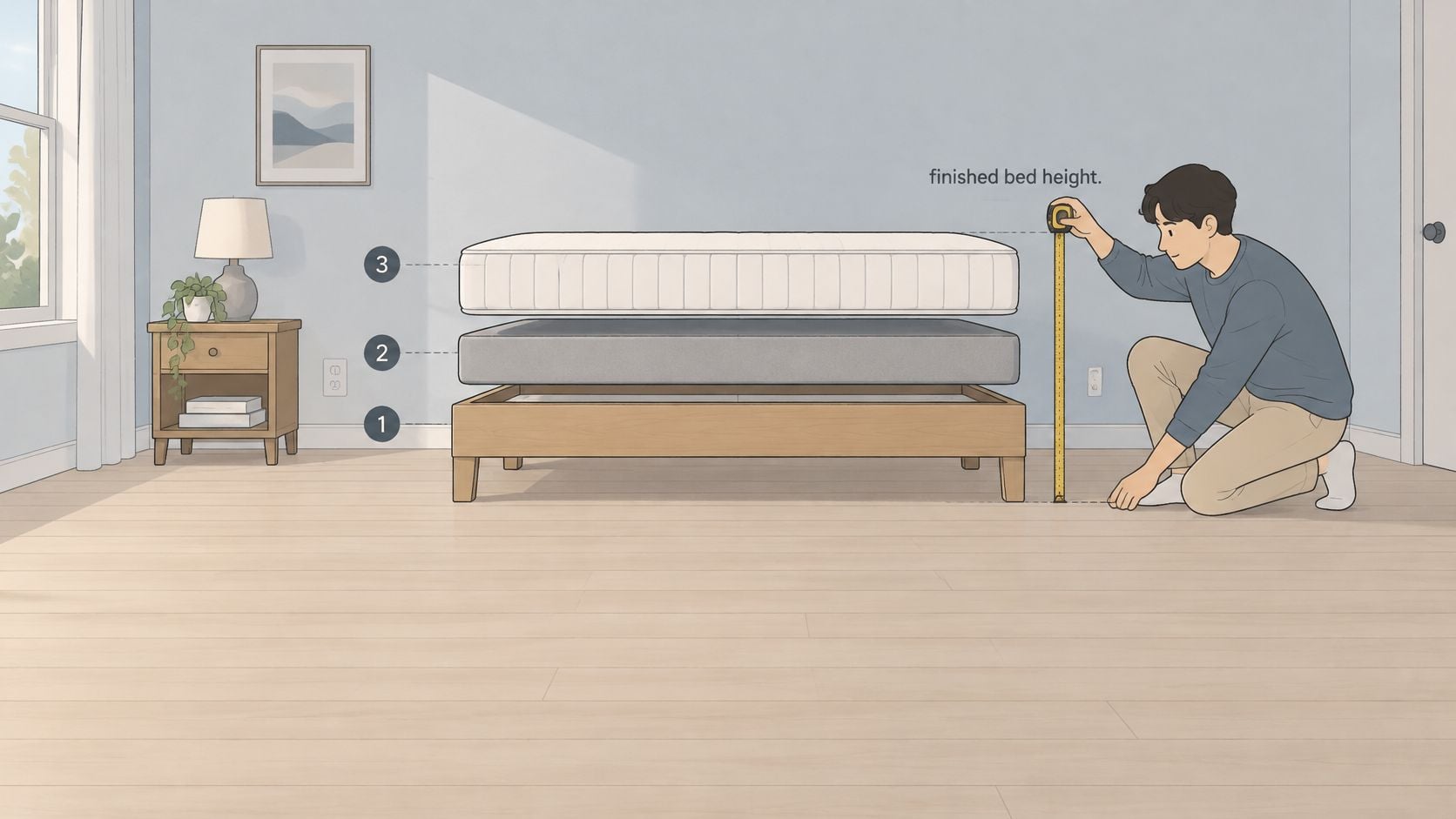
The number on the mattress label isn't the height someone will climb into at home. Finished bed height includes the mattress and everything supporting it, whether that's a platform, foundation, frame, or adjustable base.
A study published in Gerontology and Geriatric Medicine found that greater mattress height generally helped older adults rise, but a 23-inch mattress height remained too high for shorter older adults. The practical lesson is individual fit, not a universal target.
A Measuring Routine That Prevents Surprises
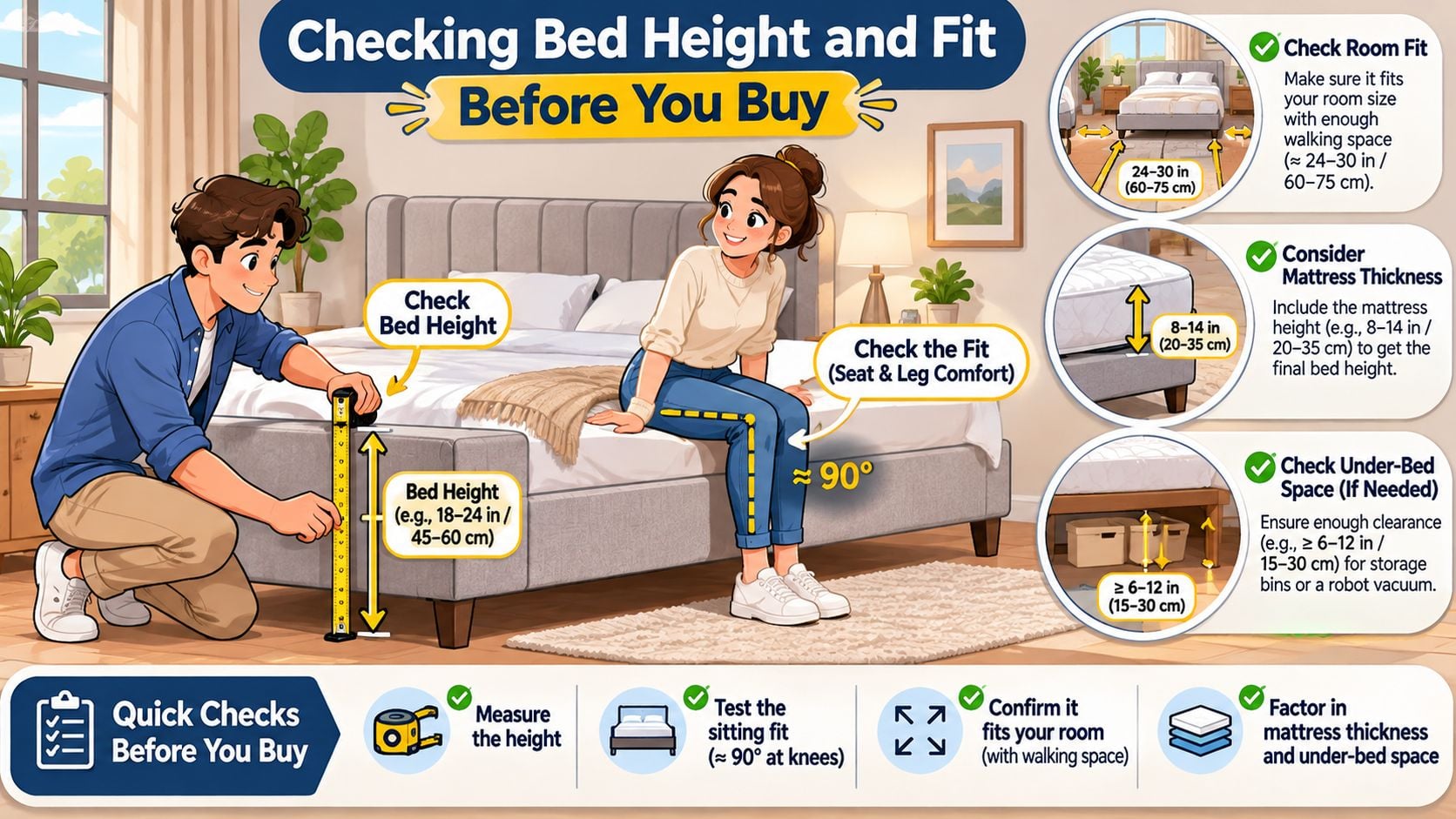
Measure the current sleep surface. Use a tape measure from the floor to the top of the mattress. Record whether that height currently feels comfortable during entry and rising.
Calculate the replacement height correctly. If the existing support stays, subtract the old mattress thickness from the current finished height, then add the new mattress thickness. Don't add the new mattress on top of a measurement that already includes the old one.
Test the seated position. Sit on the edge with both feet flat and knees near a right angle. Account for edge compression, because the sitting surface may be lower than the advertised profile suggests.
Check the mattress-to-frame fit. Measure the usable sleeping area rather than relying on appearance. A mattress-height and fit guide recommends a gap no larger than two fingers between the mattress and frame.
Confirm bedding compatibility. Check the stated pocket depth of fitted sheets and protectors, including any pad or topper that will remain on the bed. Bedding that barely reaches around a corner is a warning to recheck dimensions.
Rehearse getting up. Older adults and people with limited hip or knee mobility should test rising without pulling sharply on nearby furniture. A surface that's too low can demand more effort, while an excessively high surface can leave feet unsupported.
Include the Surrounding Furniture
Storage drawers need room to open, and the bedside table should remain convenient to reach. Tall children's beds deserve an entry-height check too, with any manufacturer restrictions taking priority.
A bed-frame selection guide helps connect mattress choices with the support underneath. A thicker mattress may offer useful cushioning while making entry harder, so both functions need checking before delivery.
Thickness for Short Sleepers, Pets and Platform Beds
A mattress can feel perfectly supportive at midnight and still work against your household the next morning. Shorter adults, older sleepers, children, and homes with pets run into height problems during ordinary waking movements, long before anyone notices a difference in cushioning. Finished height belongs to the whole sleep system, alongside the sleeper's body and the support structure underneath.
A controlled study of bed height and sit-to-stand transfers found that increasing bed height reduced trunk movement demands among older participants. Extra height helps the body up to a point. Past that point, a very tall surface leaves shorter legs without steady footing and turns climbing back in into harder work.
Shorter Sleepers and Limited Mobility
For a shorter adult, the number that matters is the compressed sitting height, where the hips land once the edge gives under body weight. Two mattresses can share the same printed profile yet perch you at very different heights, because a soft perimeter compresses further than a reinforced one. Apply the getting-up rehearsal from the measuring routine at the true finished height planned for your home, frame and foundation included, since added inches underneath change the whole equation.
For someone with limited mobility, check both directions of movement. A bed can be easy to slide out of yet difficult to climb back onto, and the second half of that trip is what matters at 2 a.m.
Choose the finished height that allows controlled movement in and out of bed.
Pets and Raised Setups
Pets need their own assessment, because they read bed height differently than we do. Watch how the animal reaches the surface: a senior dog that hesitates, launches from farther away, or lands hard on the way down is telling you the setup costs effort. If climbing or jumping looks difficult, weigh a lower finished bed, stable steps, or a ramp against the access you want to preserve. A veterinarian can advise when age, pain, or mobility changes complicate the choice.
For platforms and adjustable bases, separate the checks:
- Load compatibility: Confirm that the support structure is rated for the mattress and sleepers.
- Secure placement: Make sure the mattress sits properly without an oversized surrounding gap.
- Base compatibility: Verify that the mattress is approved for the intended adjustable mechanism.
- Storage access: Open drawers and lift storage mechanisms before committing to the arrangement.
The comparison of platform beds and box springs helps clarify which support option fits each arrangement. Keeping storage underneath never requires accepting an uncomfortable climb above it. The right combination suits the household's actual movements, including those of smaller family members and four-legged ones.
How to Test Comfort and Alignment in the Showroom
A quick hand press tells you about the surface, much like poking the toe box of a shoe. The best test is lying down in your usual position and letting your body report back.
A biomechanical review of mattress design and sleep posture found insufficient evidence for universal mattress-thickness thresholds and highlighted the interacting effects of stiffness, thickness, shape, and pillows. A practical test follows from that: lie in your usual sleeping position for 10 to 15 minutes and note where pressure builds. That is also why we test the whole system, body, pillow, and mattress working together.
A Better Comfort Test
Lie as normally as possible. Use your usual sleeping position, including the normal bend of your legs. Bring a familiar pillow if practical, since pillow height changes neck alignment.
Check the pelvis and shoulders. Your body should rest level. A deep dip under the hips or a shoulder hovering above the surface means the support underneath deserves a closer look, and a companion can spot uneven sinking that you cannot feel from inside the position.
Notice pressure buildup. Persistent pressure at a shoulder, hip, or knee is a reason to compare another comfort construction. Adding height alone rarely solves a pressure point.
Roll over and back. Turning takes real effort on some surfaces and almost none on others. If changing sides feels like climbing out of a hammock, the cushioning may be deeper than your body needs.
Compare contrasting profiles. Stay within a similar firmness family so the comparison is meaningful. Ask which layers changed between two models, because at a showroom carrying memory foam, innerspring, and hybrid options such as Guynn Furniture & Mattress, similar outside measurements can hide very different interiors.
Comfort check: A mattress should cushion the body without making the sleeper work to maintain a comfortable position.
Treat the showroom visit as a first reading. At home, your own pillow, foundation, and room temperature join the equation, so during the first week track pressure, ease of turning, and morning comfort. If climbing on and off the bed matters in your home, the guide to mattress edge support explains how perimeter stability shapes that movement.
Three Bedroom Scenarios Where Thickness Changed the Choice
A thick mattress can look like the safe answer in a showroom, the way a tall boot can look warmer before you check the lining. These three bedroom scenarios keep the focus where it belongs: sleeper, construction, and finished bed height working together.
A Heavier Back Sleeper
Say a 250-pound back sleeper assumes the tallest mattress must offer the strongest support. Comparing a 12- to 14-inch model with a firm core against a taller, more yielding option gives a cleaner test: which one keeps the pelvis from dropping and the lower back from working overnight?
If the supported model feels steadier and keeps the spine settled, the lower profile wins on function. The taller display model loses because extra height did not control pelvic sink under that body weight.
A Side Sleeper With Wide Shoulders
Suppose a side sleeper tries a 13-inch innerspring and feels the hips travel too far while the shoulder stays pressed. A 12-inch alternative with more adaptive cushioning can create the better balance: enough give at the shoulder, enough hold under the hip.
Here the shorter mattress works because its layers respond at different rates. The 12-inch model wins because its cushioning matches the shoulder and hip load; layer response did the work.
An Older Sleeper Using an Adjustable Base
An older adult with limited hip mobility is planning around an adjustable base. A hypothetical 10- to 11-inch mattress can make the sit-to-stand path easier than a taller option, provided support and base compatibility still check out.
The decisive test is a controlled sit, stand, and return to bed at the same height as the home setup. A lower profile solves that specific height problem when entry is the constraint; comfort and alignment still set the limit.
A study of 59 healthy participants found no single best configuration: heavier participants aligned more neutrally on firmer mattresses, lower-weight participants tended to align better on softer surfaces, and medium firmness benefited taller participants.
These scenarios put firmness and body-specific support at the center, with thickness acting like one adjustment knob in the whole sleep system. The guide to choosing a mattress for your sleeping style helps organize weight, position, and pressure points so the inches serve the fit.
Pick Your Thickness and Test It in Person
The right thickness is the one that suits the sleeper and the room together. Check three things: whether the mattress's construction supports your body and sleep position, whether the finished bed height works for getting in and out, and whether lying down feels comfortable and balanced.
Guynn Furniture & Mattress has served Galax, Independence, Hillsville, and the wider Southwestern Virginia and Northern North Carolina region since 1902. Its sleep center carries Sealy and Therapedic mattresses in sizes from twin to California king, including split king and split California king. The store recommends memory foam or hybrid mattresses for back support, while comfort and fit still depend on the individual sleeper.
Help With the Whole Bedroom
A mattress changes the height and feel of the whole bed, so consider the frame, bedding, and room layout along with its profile. Design professionals can help customers plan furniture around their space and style. In-stock items can usually be delivered in 3 days or less, and free in-home delivery is available within 60 miles of any location.
Before visiting a showroom, note your current bed's height and measurements, along with your usual sleep position. Try lying on the mattress long enough to check pressure and support, then consider whether its height would feel practical at home. Browse the online catalog or visit a showroom to compare options.
For mattress comparisons and bedroom planning, visit Guynn Furniture & Mattress. Bring your measurements and sleep-position notes so you can focus on a thickness that fits your body, support needs, and finished bed height.