
100 Pima Cotton Sheets: The Complete Buyer’s Guide


Shopping for sheets can feel oddly complicated. One tag says “luxury,” another shouts a huge thread count, and a third promises softness without explaining what that really means for your bed at home. That's where 100 Pima cotton sheets start to make sense, because the better question isn't just how many threads are packed into the fabric, it's what kind of cotton those threads are made from.
Why 100 Pima Cotton Sheets Are Worth the Investment
A shopper can stand in the bedding aisle for ten minutes and still not know what separates one white sheet set from another. One package leans on a big number, another mentions softness, and a third adds a premium label without saying much more. 100 Pima cotton sheets cut through that noise because the 100% label means the sheet set is made from pure Pima fibers, not a blend.
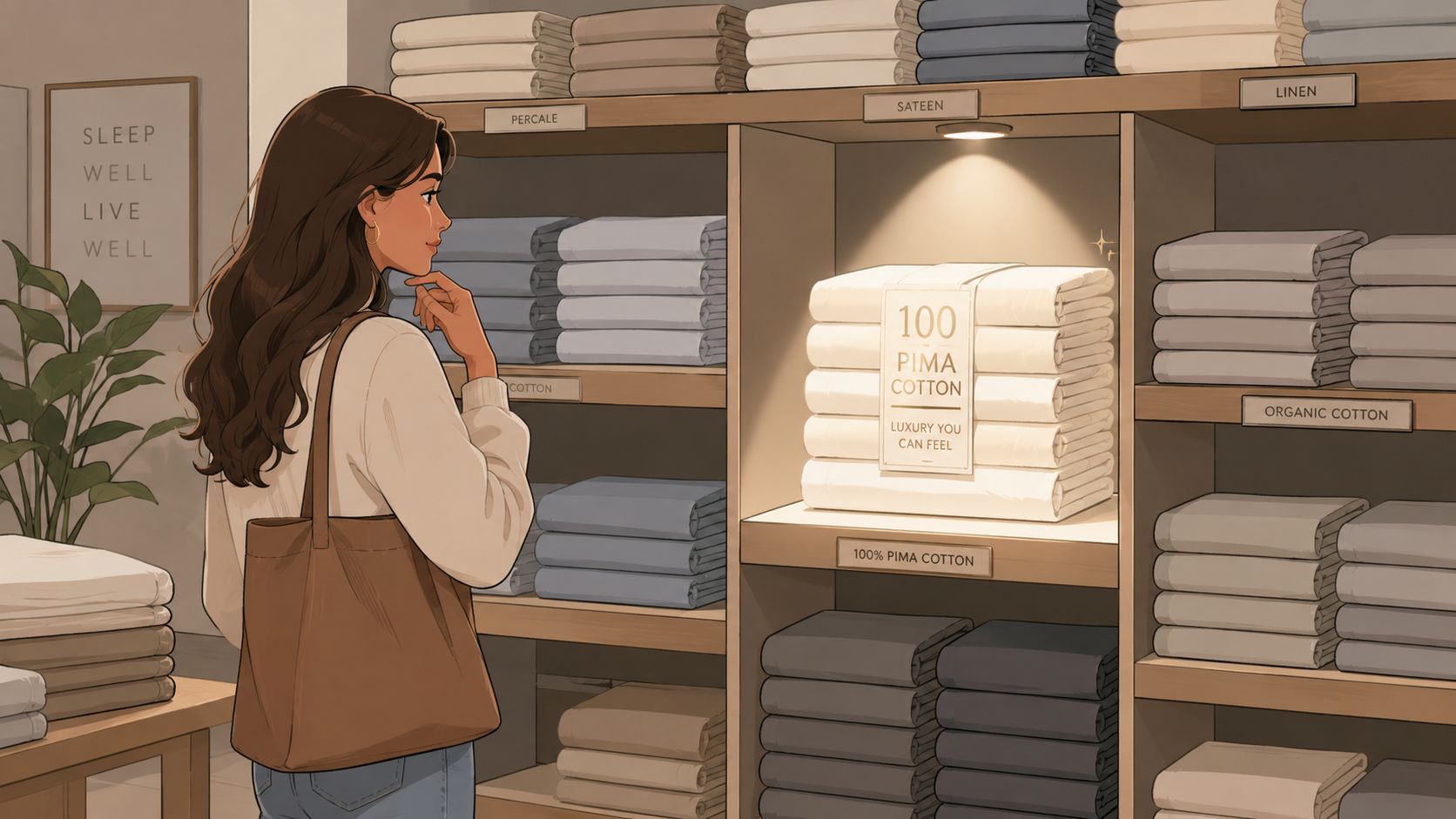
Pima belongs to the extra-long staple cotton family, which matters because longer fibers can be spun into smoother yarns. One industry guide notes that Pima fibers can measure about 1.4 to 2 inches long, compared with conventional cotton fibers at up to about 1.1 inches, and that difference helps explain the smoother hand-feel and durability people notice in everyday use. Authenticity 50's Pima cotton guide
Why pure fiber content matters
When a sheet is 100% Pima cotton, the buyer is paying for the fiber itself, not a marketing story built around mixed materials. That purity is what makes the fabric feel consistent from the first wash onward, especially when the weave is well made and the yarn is spun cleanly.
Practical rule: a good sheet set starts with fiber quality, then weave, then construction. Thread count matters, but it sits behind those first two decisions.
Pima also sits in a more premium corner of the cotton market. One source places roughly 90% of global cotton production in upland cotton and around 10% in the Egyptian/Pima group, while another estimates Pima itself at roughly 3% of global production. Bedding Directory's Pima overview That scarcity helps explain why Pima has long been treated as a higher-value bedding material rather than a plain commodity cotton.
The payoff shows up in the feel of the finished sheet. Longer, stronger fibers tend to create a smoother surface with less pilling and more durability, which is exactly what many families want when they're spending on bedding they expect to keep for years.
What buyers usually notice first
People usually notice three things right away:
- Softer hand-feel: The fabric feels smoother against the skin because fewer short fiber ends poke through the yarn.
- Better everyday wear: The sheet can handle regular washing with less obvious fraying than lower-grade cotton.
- A more polished finish: The bedding looks and drapes like a premium fabric instead of a basic utility sheet.
That combination is why Pima often becomes the choice for shoppers who want a hotel-style bed without chasing flashy numbers. For a broader look at how bedding works with the rest of the room, this guide to creating a sleep sanctuary connects fabric choice with lighting, temperature, and mattress comfort in a simple, useful way.
Understanding Fiber Length and Sheet Durability
Sheet durability starts inside the yarn, not on the package. A shorter fiber breaks into more exposed ends when it is spun, and those ends are what create roughness, pilling, and that tired look some sheets get after a few wash cycles. Pima's longer staple length changes that equation by giving the yarn more continuous fiber to work with.
Why staple length changes the feel
True Pima cotton is an extra-long staple cotton, and authoritative textile references describe its fibers as longer than standard upland cotton. One source says Pima fibers are typically longer than 34 mm, while another places them around 3.5 to 4.1 cm. Sewport's Pima cotton fabric guide The exact presentation varies by source, but the point stays the same, longer fibers spin into finer, smoother yarns.
That smoother yarn matters in daily use. Mexpima's fiber data places Pima's typical fiber length around 36.5 to 38 mm, compared with 25 to 28 mm for upland cotton, and notes bundle strength in the 36 to 42 g/tex range with a 85 to 87% uniformity index. Mexpima's Pima cotton datasheet Those numbers point to more consistent spinning performance, which is part of why a well-made Pima sheet can feel both soft and resilient.
What that means on a real bed
Longer staple cotton usually does three useful things for a sheet set:
- Reduces pilling risk: Fewer short fiber ends are exposed, so the surface stays cleaner-looking longer.
- Improves abrasion resistance: The fabric handles rubbing from sleep, washing, and movement more gracefully.
- Supports tensile strength: The sheet can stand up to daily pulling, tucking, and laundering without feeling fragile.
Durability note: thickness alone doesn't make bedding last. Strong, long fibers in a controlled weave usually matter more than a dramatic thread-count claim.
That's why a moderate-count sheet made from quality Pima can outperform a flashy package built from shorter fibers. The sheet doesn't need to be stuffed with yarn just to feel smooth. It needs good raw material, even spinning, and careful finishing.
A useful comparison point is upholstery, because the same material logic shows up there too. Fiber structure affects how a fabric handles stress, how it ages, and how it feels in use, which is why textile shoppers get better results when they focus on construction details instead of only the headline number. This upholstery materials guide makes that idea easy to see in another part of the home.
Pima vs Supima vs Egyptian Cotton
The labels sound interchangeable at first, and that's where many shoppers get tripped up. They all sit in the extra-long staple cotton family, but the words mean different things. Pima describes a fiber type and species, Supima is a trademarked brand for American-grown Pima that meets specific standards, and Egyptian points to origin.
Cotton Variety Comparison
| Cotton Type | Origin | Key Characteristic |
|---|---|---|
| Pima | Grown in regions including the southwestern United States, Peru, and Australia | Extra-long staple cotton with a smooth hand and strong yarn potential |
| Supima | American-grown Pima under a trademarked certification | Branded long-staple cotton with added identity and quality controls |
| Egyptian Cotton | Egypt and other labeled Egyptian-origin supply chains | Long-staple cotton associated with premium bedding and origin-based marketing |
That table helps separate fiber identity from branding. A shopper can buy excellent 100 Pima cotton sheets without paying for a trademark, as long as the fabric quality, weave, and sourcing are clear. The reverse is also true. A flashy label does not automatically guarantee better sleep.
How to think about the price gap
Industry commentary says generic Pima can retail about 15 to 40% below licensed Supima, while comparable Supima products can run 30 to 80% above equivalent upland cotton items. Bedding Directory's Pima cotton article Those numbers don't mean one option is always better. They do show that branded long-staple cotton has been positioned as a premium segment for a long time.
For many households, the smartest question is not “Which label is fanciest?” It's “What am I paying for?” If the sheet is well made, pure Pima can be an excellent value because the fiber quality is already doing much of the work. If a brand is charging more, the buyer should want a clear reason, such as certification, sourcing transparency, or a construction detail that justifies the premium.
For readers who want to compare another cooling fabric side by side with cotton, the cooling bamboo sheets guide for executives is a useful reference point because it helps frame the feel and temperature conversation without getting lost in marketing language.
The Truth About Thread Count and Weave
Thread count gets too much attention because it's easy to print on a package. It's not useless, but it's also not the first thing to judge in 100 Pima cotton sheets. A well-made Pima sheet can feel excellent at a moderate count because the long fibers already help create a smoother yarn.
What a sensible thread count looks like
Industry guidance often places quality Pima sheets in the 200 to 400 thread-count range, and premium sateen versions often appear in the 300 to 600 range. Authenticity 50's guide to Pima cotton Sleep Foundation also lists Pima cotton in the 200 to 400 range and cotton percale at 200 to 300 thread count, which helps explain why extreme numbers are not the best comparison point for this fabric. Sleep Foundation's best cotton sheets guide
That's the trap. A very high number can sound better even when the yarn quality is lower. A carefully built Pima sheet at a moderate count often offers a better sleep experience than a crowded sheet made from weaker fibers.
Percale or sateen
The weave changes the whole feel of the bed.
- Percale: Crisp, cooler, and more breathable. It suits sleepers who run warm or prefer that fresh hotel-sheet feel.
- Sateen: Smoother, silkier, and a little warmer. It suits people who like a softer drape and a more polished hand-feel.
Simple buying rule: choose the weave for the feel you want, then check whether the thread count supports that weave instead of fighting it.
A popular premium example shows how the spec package comes together in real life. One retail listing highlights a 600-thread-count, 100% Pima cotton, sateen sheet set with all-around elastic and a 17-inch mattress depth. That kind of setup shows how premium bedding is engineered for comfort and fit, not just for a high number on the box. Target's Pima sateen sheet specification
Readers comparing options should also keep mattress depth in view. A fitted sheet that matches the bed properly reduces corner slippage and fabric stress, and that can matter more over time than a brag-worthy count. A smart shopper reads the entire spec, not just the biggest number on the label.
For a more detailed breakdown of what those numbers really mean, this sheet thread count explanation is a straightforward companion piece.
How to Care for Your Pima Cotton Bedding
Pima sheets usually stay beautiful longer when they're treated like a quality textile, not an afterthought. Families often worry about shrinking, wrinkling, or losing softness after a few washes, and those concerns are fair. Good care helps protect the fiber's natural hand-feel and keeps the fabric from wearing out early.
The simplest care routine
A practical routine is easy to follow:
- Wash in cold water: Cooler water is gentler on long-staple cotton and helps limit unnecessary stress on the fibers.
- Use a mild detergent: Harsh detergent can strip the feel out of the fabric over time.
- Skip bleach and harsh stain removers: Strong chemicals can weaken cotton and dull the finish.
- Dry on low heat or line dry: High heat is hard on any cotton, especially when the goal is long-term softness.
These principles match neutral cotton bedding care guidance and are broadly relevant to long-staple cotton fabrics such as Pima. Pure Parima's Egyptian cotton care instructions recommend the same basics, cold water, mild detergent, and avoiding bleach or harsh stain removers. Pure Parima's care guidance The method is simple because the point is preservation, not overhandling the fabric.
How to handle stains without roughing up the fabric
Pima is strong, but it still deserves a gentle approach when spills happen. Blot first, don't scrub. Use a mild cleaner on the spot, then wash the sheet as soon as practical so the stain doesn't set.
For pet owners and families, that matters because aggressive stain treatment can do more damage than the original spill. The safest habit is to keep the cleaning process as light as possible and let the wash do the work. That protects the long fibers that give the fabric its softness and resilience.
Care takeaway: Pima stays nicest when heat and harsh chemicals stay out of the routine.
For households wondering how often bedding should be refreshed, this sheet-changing guide gives a helpful framework for keeping bedding clean without overthinking the schedule.
Finding the Perfect Sheets at Guynn Furniture & Mattress
Reading about fiber length and weave helps, but fabric still needs to be touched. A good sheet can look great online and still feel wrong on the bed if the weave is stiffer, warmer, or smoother than expected. That's why in-person testing matters so much for bedding.
Guynn Furniture & Mattress serves Galax, Independence, Hillsville, and the wider Southwestern Virginia and Northern North Carolina region, and the store's long history, since 1902, gives shoppers a local place to compare comfort in person. The bedding decision gets easier when a family can feel the difference between fabrics instead of guessing from a screen. That same no-pressure approach fits neatly with a home that needs comfort, not confusion.
What a local visit solves
A showroom visit helps with details that photos can't show:
- Feel: The hand of the fabric tells more than a product description can.
- Fit: Pocket depth and mattress compatibility become easier to judge.
- Coordination: Bedding can be matched with the rest of the room instead of chosen in isolation.
Debra Williams and the expert design staff can help coordinate bedding with the broader bedroom look, which is useful when the room needs more than just a new sheet set. That kind of support matters for the remodeler who wants the bed to fit the whole space, not just the mattress.
Price matters too, especially for value-focused shoppers. Guynn's Low Price Promise means local competitors' advertised prices are matched on the spot or refunded within 30 days of purchase, and the store also offers free in-home delivery and setup within 60 miles. For families who want the comfort of premium bedding without the hassle of hauling it home, that kind of service removes a lot of friction.
If the goal is to compare fabrics, check in-stock options, and get practical guidance from a local team, the best next step is simple. Visit the showrooms in person, ask to feel the difference, and let the bedding choice be based on comfort instead of guesswork. Browse the current selection at Guynn Furniture & Mattress, then stop by Galax, Independence, or Hillsville to test the feel for yourself and schedule a design conversation if the room needs a fuller refresh.
Visit our showrooms in Galax, Independence, or Hillsville to test the comfort for yourself. Schedule a consultation with our design team to start planning your dream room today, and browse our selection online at Guynn Furniture & Mattress.