Adjustable Bed Base for Platform Bed: A Compatibility Guide


You're lying in a bed you already like, but the sleep part still isn't quite right. Maybe the frame looks clean and low, maybe the drawers under it are useful, and maybe you've started wondering whether an adjustable base could give you better reading, easier TV time, or just a more comfortable way to prop up after a long day.
That question comes up a lot because platform beds feel finished and sturdy, while adjustable comfort feels like a separate category altogether. The good news is that the two can work together in the right setup, but the bad news is that the wrong pairing can waste money, block motion, or force you to give up storage you expected to keep.
Why You're Asking This Question in the First Place
A platform bed usually feels like the kind of furniture people keep for years. It sits low, looks tidy, and already does the job of supporting the mattress without a box spring. That's exactly why so many shoppers pause before changing it, because replacing a frame they like feels unnecessary if a comfort upgrade might fit inside it.
An adjustable base changes that calculation. It gives the sleeper the ability to raise the head or feet for comfort, reading, or pressure relief, and that's part of why the category has moved far beyond a niche product. Market data shows the adjustable base category is large and still expanding, with the global market projected at USD 6.14 billion by 2031 after reaching USD 4.69 billion in 2026.
Practical rule: the frame question is less about style and more about clearance, support, and what parts of the bed can move without hitting wood or hardware.
That's where confusion starts. A platform frame already holds a mattress, so many people assume any adjustable base should slide in the same way a box spring would. It doesn't work that way, because the motorized frame needs room to articulate and, in some cases, needs the platform to stop pretending it can still act like a closed box.
The simplest way to think about the decision is this. One path keeps the frame and changes the base, one path changes both pieces, and one path starts fresh with a bed built for motion from the beginning. A helpful overview of adjustable comfort is available in Guynn Furniture & Mattress's guide on adjustable bed benefits, and it pairs well with the questions below.
What an Adjustable Base and a Platform Bed Are
A platform bed is a fixed bed frame with built-in support. That support can come from a solid panel or from slats, but the basic idea stays the same, the mattress rests on a rigid surface and does not need a box spring. That is why platform beds are common in rooms where someone wants a low, clean look and a straightforward foundation.
An adjustable base works differently. It is a powered frame with motors that raise the head section, the foot section, or both, and many models include preset positions such as zero-gravity or memory settings. It functions more like a mechanical sleep system than a traditional bed frame, because the mattress sits on sections that move instead of on a flat deck.
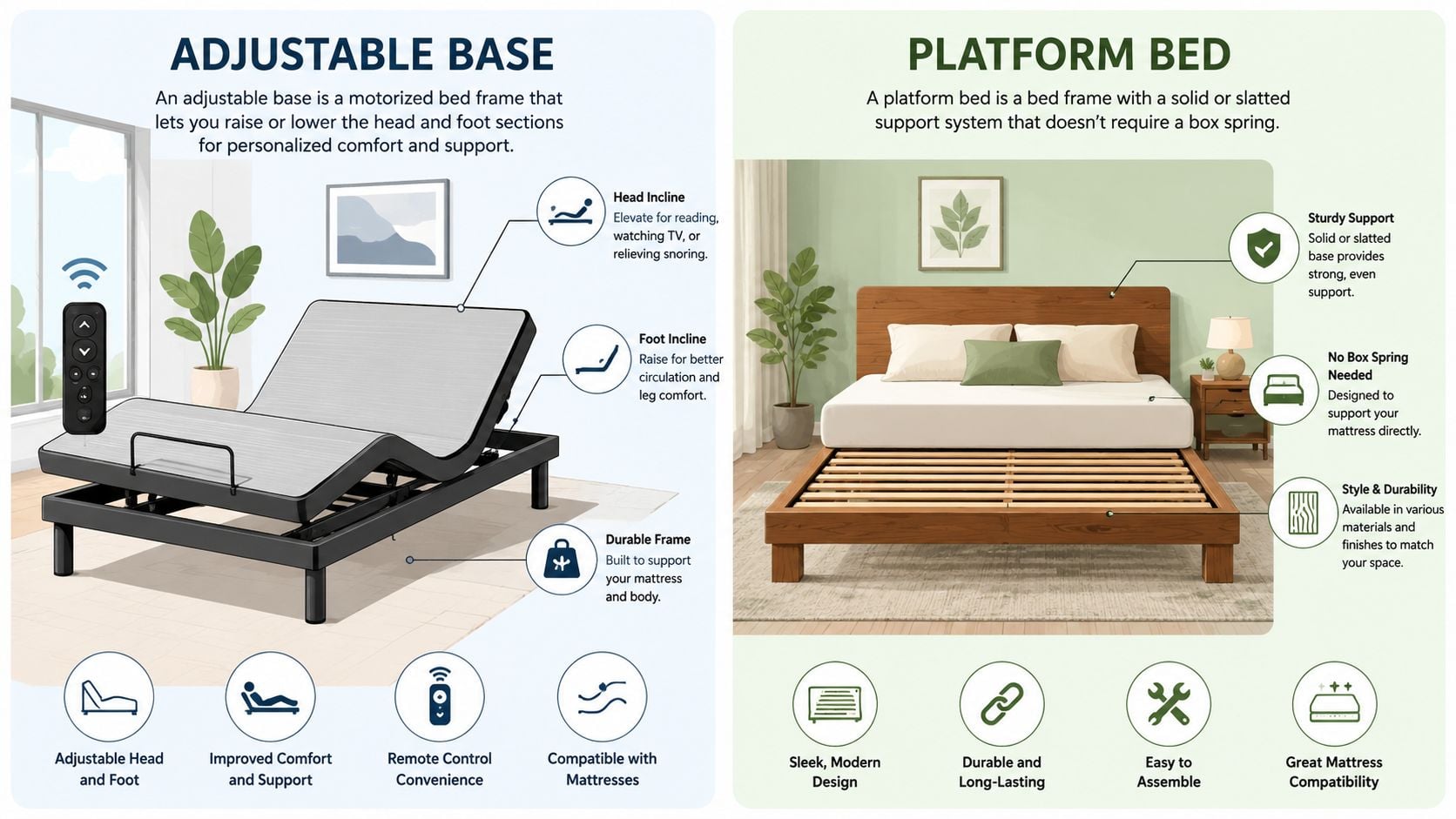
The relationship is easier to picture with a simple comparison. A platform bed behaves like a sturdy tabletop, while an adjustable base acts like a reclining support system under the mattress. If the platform stays out of the way, the base can move as intended. If the platform blocks the moving sections, the setup starts working against itself.
A zero-clearance model is the bridge that makes this pairing possible in many homes, because it is built to sit low and work without traditional legs.
That low profile matters. In practice, zero-clearance bases are often around 2 to 4 inches tall, which helps them fit into or onto a platform-style structure instead of replacing the frame outright. For a broader explanation of why people compare support surfaces, see Guynn Furniture & Mattress's box spring vs foundation guide.
Which Platform Frames Actually Work With an Adjustable Base
Not every platform frame behaves the same way once motion enters the picture. The key question is whether the frame gives the adjustable base room to move, or whether the frame's parts sit in the way of the lift mechanism.
| Platform Frame Compatibility at a Glance | Works With Adjustable Base | Notes |
|---|---|---|
| Open slat platform | Usually yes | Best fit when slats can be removed or when the base sits cleanly on top |
| Solid panel platform | Sometimes | Works best with a zero-clearance base or a removable panel |
| Storage drawer platform | Usually no | Drawers often lose their function because the base occupies the interior space |
| Headboard and footboard platform | Sometimes | Footboard clearance and headboard height need close attention |
The easy fit and the awkward fit
Open slat platforms are often the least complicated option because the slats can sometimes come out and leave room for the base. If the frame has a removable center support and the manufacturer allows it, the adjustable frame can sit inside the bed with enough breathing room to move without scraping.
Solid panel platforms can work too, but only if the adjustable base is designed for zero-clearance use or the panel comes out cleanly. A fixed, immovable panel changes the math, because the base has no place to sit unless it's built to rest flat on top of that surface.
Storage drawer platforms are where many shoppers run into disappointment. Once the adjustable frame takes up the interior space, drawers usually stop being practical, so the buyer has to decide whether motion matters more than hidden storage.
Memory check: if the frame depends on its inside space for drawers or a fixed center beam, the adjustable base usually has to win that space.
Headboards and footboards add another layer. A footboard often needs to come off, and a tall headboard can create clearance trouble when the head section rises. That's why a quick visual check matters, because the frame may look compatible from across the room while still failing when the mattress starts to move.
Measuring Clearance, Height, and Weight the Right Way
A platform can look roomy from the showroom floor and still fail the moment an adjustable base starts moving inside it. The safe way to sort that out is to measure the frame first, then measure the moving parts, then decide whether the bed should be retrofitted or replaced outright.
Start with the interior width and length of the platform frame. That gives you the space the adjustable base has to sit in, which matters more than the outside footprint people usually notice first. Then check the vertical clearance under the headboard, side rails, and footboard, because the head and foot sections need room to rise without scraping wood or fabric.
A simple measurement routine
- Measure the inside first: Record the distance between the side rails and the distance from headboard to footboard.
- Check the motion path: Look at where the head section rises and where the foot section bends so nothing blocks it.
- Confirm the final height: Add the frame, base, and mattress together so the bed doesn't end up too tall to get into comfortably.
- Verify the weight limit: Stay within the manufacturer's stated capacity for the full system, not just one part of it.
The cleanest way to do this is with a tape measure and a sketch of the bed opening. A few minutes spent on how to measure furniture can prevent the common mistake of measuring only the outer frame and assuming the inside will cooperate.
Some setups need roughly 3 to 5 inches of clearance for movement, while height options on certain bases can range from about 6 to 10 inches or 13 to 18 inches depending on the model. That range matters because a bed that looks balanced in the room can still feel awkward if the sleeping surface ends up too high for easy entry and exit.
The smartest measurement is the one that considers the whole stack, frame, base, mattress, and sleeper together.
Weight matters just as much as fit. A base that sits low or inside a platform still has to carry the load safely, so the stated capacity for the full system deserves the same attention as width and height. That is why shoppers should confirm the manufacturer's weight rating before they assume a frame can handle an adjustable base just because it looks sturdy.
Matching the Mattress and Sizing to the Base
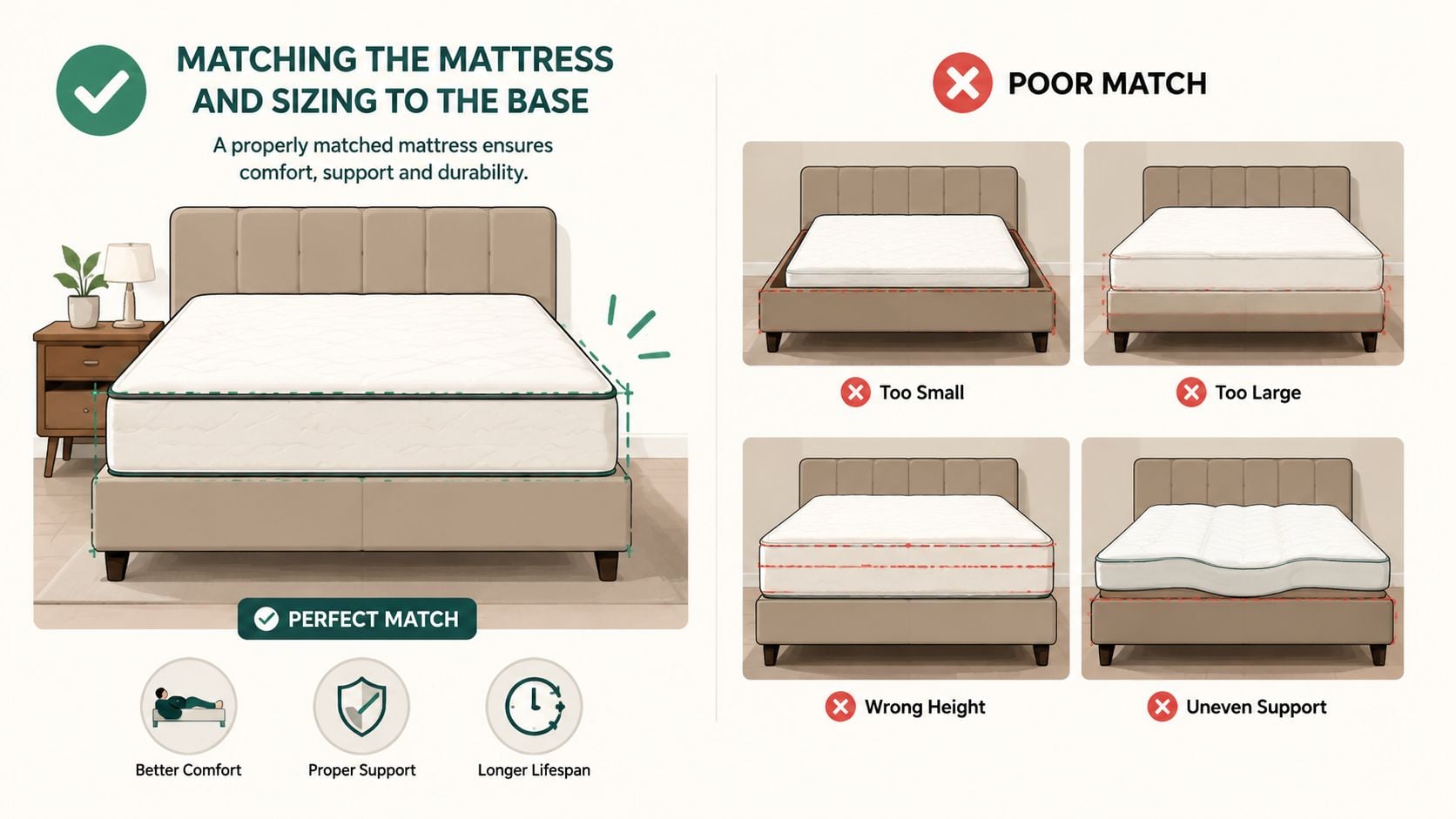
Even the right frame can disappoint if the mattress resists movement. Adjustable bases work best with a mattress that bends with the base instead of fighting it, so the material inside the mattress matters more than many shoppers expect.
Mattress type changes the outcome
Memory foam usually flexes well because it is built to contour. Many hybrids also work because their construction allows the surface to move with the base. Traditional innerspring mattresses are usually much less cooperative, because the coil structure wants to stay flatter instead of following the base as it changes position.
For size planning, the BEDHEAD mattress size guide gives shoppers a clear way to compare footprints before they commit to a frame and mattress combination. A size label by itself does not guarantee a true fit, especially once the mattress has to sit inside a platform opening and move with the base.
The size label can hide small differences
A Queen-size adjustable base may not measure the same across brands. Some adjustable base dimension specifications list a Queen at 60 x 80 x 3.9 inches, while others specify a Queen at 59.5 x 79.5 inches, with a King at 75.5 x 79.5 inches. Those small differences can matter inside a platform frame, especially if the side rails are tight or the footboard sits close.
That is why a King and a split King are not just style choices. A split King can suit two sleepers who want different positions, while a single King keeps the setup simpler. The better choice depends on whether the couple values independent control more than a matched mattress surface and an easier setup.
Fit rule: the size label is only the starting point. The real fit comes from exact footprint, mattress flexibility, and the frame's interior dimensions.
Guynn Furniture & Mattress's how to choose a mattress guide is a useful next step for shoppers who want to pair the right mattress with the right base without guessing.
A Real-World Decision Story From the Showroom Floor
A Galax homeowner walks in with a platform bed she likes because it stays low and gives the room a calm, finished look. Her husband wants the head section raised for comfort, and both of them are trying to avoid a full bedroom overhaul if they can help it.
The first path is a retrofit. She keeps the frame, removes what the base needs her to remove, and uses a zero-clearance model so the motion works. That solves the comfort problem, but it also means the drawers under the bed stop being useful, which is a real trade-off if storage matters.
The second path is replacement. She chooses a frame built to work with an adjustable base, keeps a flexible mattress that can move with it, and gets the cleaner compatibility she didn't have before. This choice usually makes more sense when the current frame is too closed in, because forcing motion into the wrong structure can turn into a maintenance headache later.
The third path is the compromise. She picks a non-storage platform with removable slats, keeps the low look she likes, and adds the adjustable base without giving up the whole room layout. For many households, that middle route hits the sweet spot because it protects the visual style while still making room for motion.
The right answer is rarely “best base.” It's usually “best match for this frame, this mattress, and this room.”
That's where a showroom conversation helps. A shopper can see whether the footboard blocks movement, whether the headboard feels too close once the mattress lifts, and whether the final bed height still feels comfortable to sit on at night. Once those pieces line up, the choice gets much easier.
Your Pre-Purchase Checklist and How to Shop Local
A good buying list keeps the decision calm instead of complicated. The easiest way to shop for an adjustable bed base for platform bed use is to bring a short checklist and answer each question in order.
Start with the frame itself. If it is an open slat frame, a solid panel frame, a storage bed, or a style with a fixed footboard, each one changes how much movement the base has once it is inside the bed.
What to confirm before buying
- Frame type: Open slat, solid panel, storage, or footboard style.
- Interior dimensions: The base must fit with room to move.
- Clearance: Check the space for head and foot articulation.
- Final bed height: Make sure the bed still feels comfortable to get in and out of.
- Mattress flexibility: Confirm that the mattress can bend with the base.
- Storage trade-off: Decide whether drawers or hidden space matter more than motion.
- Size match: Verify Queen, King, or split King dimensions against the frame.
If a shopper is unsure how to compare those measurements at home, the local store can help. A nearby bed specialist can look at the frame style, talk through whether the drawers will still be usable, and show how much room the moving parts need once the base starts to articulate. For people searching for local furniture stores near me, that face-to-face check can save a lot of guesswork.
Guynn Furniture & Mattress has served Galax, Independence, Hillsville, and the wider Southwestern Virginia and Northern North Carolina region since 1902, so the store has seen this question from a lot of different bedrooms and floor plans. The sleep center carries options from trusted mattress brands, and the showroom also includes a large in-stock selection, which matters when a household wants the comfort upgrade soon instead of waiting on a long freight timeline.
If the layout feels tricky, the expert design staff, including Debra Williams, can help with room planning and placement questions. That kind of guidance is useful when a shopper is balancing bed height, traffic flow, and storage needs in the same room. A fixed footboard can close off movement the way a low doorway limits a tall piece of furniture, while an open frame leaves more room for the base to move as intended.
Guynn's Low Price Promise also matters if the purchase is price-sensitive, because the store matches local competitors and offers a 30-day price guarantee. For households that want the setup handled, Free in-home delivery and setup within 60 miles can remove a lot of stress from the process.
Bringing It All Together and What to Do Next
The simplest rule is this. An adjustable base can usually work with a platform bed if the base is zero-clearance, the frame has room for motion, and the mattress is flexible enough to follow the bend. If any one of those pieces fails, the smarter move is often to choose an adjustable-friendly frame instead of forcing the old one to do a job it wasn't built for.
That's especially true when storage drawers, fixed slats, or a tight footboard start getting in the way. A frame that looks perfect in a store can become the wrong choice once the base starts moving, and that's why the decision tree matters more than a quick yes-or-no answer.
Guynn Furniture & Mattress helps neighbors across Southwestern Virginia, Northern North Carolina, and southern West Virginia sort through those choices in a no-pressure atmosphere. Visit the showrooms in Galax, Independence, or Hillsville, or bring the measurements and let the design team walk through the fit with you.
Visit Guynn Furniture & Mattress to see adjustable bases, platform-friendly bedroom options, and in-stock selections you can take home sooner. The team can help compare frame fit, mattress compatibility, and delivery setup so the final bed works in your home, not just on paper.