Dresser vs Chest: Which Bedroom Storage Fits Your Room

Is the piece with more drawers always the one that belongs in the bedroom? Most shoppers start with the tag, then find out the tag is the least useful thing on the furniture. A wide, low case and a tall, narrow case can hold similar clothes and still fail the room for opposite reasons. One eats the wall beside the bed. The other parks socks above a comfortable reach.
For a household in Galax, Independence, Hillsville, or anywhere across Southwestern Virginia and northern North Carolina, the better question is practical. Which shape leaves a clear path, keeps everyday clothes in arm's reach, and can be fastened to the wall before anyone uses it? That is the dresser vs chest decision. Proportion, reach, and the wall come first. The printed name comes last.
Dresser vs Chest at a Glance
A dresser is usually wider and lower. A chest is usually taller and narrower. The two names overlap more than a hangtag admits, and a tall piece sold as a dresser is still a dresser.
| Feature | Dresser | Chest |
|---|---|---|
| Typical shape | Wide and low | Tall and narrow |
| Typical width | About 36 to 72 inches | About 24 to 40 inches |
| Typical height | About 30 to 40 inches | About 40 to 60 inches |
| Drawer layout | Several drawers across the front, often in two or more columns | Drawers stacked in a single column |
| Typical drawer count | 6 to 9 | 4 to 6 |
| Floor footprint | Larger, spread along the wall | Smaller, concentrated vertically |
| Mirror | Often paired with a mirror | Rarely paired with a mirror |
| Top surface | Broad, good for décor and daily items | Narrow, limited use |
| Best fit | Wide walls and a usable top surface | Narrow walls and maximum vertical storage |
How to read the ranges
Those rows are common retail proportions, not a building code. A 54-inch-wide piece with a mirror is a dresser even if the finish name sounds old-fashioned. A 28-inch-wide stack of five drawers is a chest even when the ticket says tall dresser. Safety rules cover both shapes, so stability and the path around the bed matter as much as the silhouette.
Width near the top of the dresser band needs a long, clear wall and still has to miss the swing of a door. A chest toward the top of its height band stores upward, and the top drawer may sit past a comfortable reach for a shorter adult. Drawer counts of 6 to 9 versus 4 to 6 only hint at layout. They don't say how deep a folded sweater will sit.
Showrooms in Galax, Independence, and Hillsville keep both forms on the floor for shoppers across Southwestern Virginia and northern North Carolina. Standing next to the piece beats trusting a thumbnail. A household can see whether the top holds a lamp and whether the handles sit where a child or an older adult can pull them.
Practical rule: Match the row to the wall and to the person who opens the drawers every morning. Ignore the prettier name.
Choose by three checks, not by the word on the label. Room width decides whether a long front blocks a door. Reach height decides whether daily clothes stay in the middle. What belongs on top decides whether a mirror and a small tray need a broad surface. History, usable volume, anchoring, room type, and a tape-measure routine each settle a different part of that choice.
Why Dresser and Chest Labels Blur
The labels blur because the chest came first and "dresser" later became a loose store habit. The Wallace Collection traces the form to French kneehole desks known as bureaux Mazarin. Drawers grew larger and more numerous until they filled the full width and height and the kneehole disappeared. Chests of drawers appeared in the household of Louis XIV in 1695. Early examples generally had three or four drawers, and later designs grew taller or wider.
Today the names describe proportion, not a fixed technical standard. The National Park Service record of Abraham Lincoln's chest of drawers lists a clothing piece for shirts, socks, ties, and other garments at about 45.9 inches high, 40.7 inches wide, and 24.7 inches deep. That historic chest is tall and still does the job of folded storage. Museum language keeps "chest of drawers." American retail uses "dresser" for almost any bedroom drawer piece, mirror or not.

The name tells a shopper about history. The measurements tell the shopper about fit. Compare height, width, and depth with the room before a finish wins the argument.
Storage Capacity, Footprint and Drawer Reach
Drawer count is a weak measure of storage. A six-drawer dresser with shallow trays can hold less folded clothing than a five-drawer chest with deeper boxes. What matters is the inside of each drawer, the floor the case consumes, and who can reach the pull.
Estimate the inside, not the silhouette
The CPSC clothing-storage guidance tells shoppers to measure each drawer's internal width, depth, and height, then multiply those dimensions for a usable volume, and to compare that result with the floor area consumed. Exterior size overstates the space. Drawer boxes, runners, face frames, and internal clearances take inches on every side. A smooth full-extension slide is part of the same check, because a drawer that stops halfway hides the back of the storage.
Say the open wall is only three feet. A 30-inch-wide chest with five drawers can sit there. A 60-inch dresser needs about twice that wall. The dresser's drawers are easier to fill with folded shirts and linens because the clothes lie side by side instead of in a tall pile. The chest wins on enclosed storage per foot of wall. The dresser wins on how someone can see a stack and lift it out.
Reach changes what capacity means
Upper drawers on a tall chest are a poor home for clothes used every day. Children, older adults, and anyone using a walker or wheelchair shouldn't have to stretch for socks. A lower dresser usually puts daily pieces in a comfortable band and leaves a surface for a mirror or a small tray. A chest still earns its place when the wall is short and the top drawers hold seasonal sweaters, not school clothes.
Before two tickets get compared, check four things:
- Internal drawer dimensions: Width, depth, and height of the box, then multiply.
- Full-extension length: How far the drawer travels, and whether the back is reachable.
- Floor footprint: Width times depth on the floor, including any overhang past the legs.
- Reach zone: Which drawers hold clothes used several times a week.
A chest gives more storage per foot of wall. A dresser gives easier access per drawer.
Loaded stability belongs next to volume, which is why anchoring hardware should be confirmed in the carton before the piece comes home. Households tight on wall space can also review bedroom furniture storage features and then measure the actual drawers, not the catalog photo.
Safety, Stability and Anchoring for Every Household
A shorter, wider dresser is not automatically safe, and a narrow chest is not automatically a hazard. Tip-over risk follows the specific unit's height, mass, drawer layout, loaded weight, restraint hardware, and whether anyone installs it.
The U.S. Consumer Product Safety Commission estimates 84,100 clothing-storage-unit tip-over injuries treated in U.S. emergency departments from 2006 to 2021, about 5,300 a year. Children accounted for 72% of those injuries. From January 2000 through April 2022 the agency recorded 234 deaths, including 199 children. Those figures cover the category, not one silhouette. A label that says dresser doesn't opt a household out.
What the current test checks
Covered newly made units are tested on carpet, with loaded drawers, and with multiple drawers open. Testing also simulates a child weighing up to 60 pounds interacting with the furniture, as the CPSC tip-over reminder describes. That is a lab condition. It isn't a substitute for a wall anchor. The same reminder still says to anchor dressers, chests, and other clothing-storage furniture, including older pieces bought before the current standard took effect.
A wide base can still tip if several full drawers come out at once and the back isn't fastened. A tall chest can stand steadily when the restraint is in a stud and the heaviest clothes sit in the lower drawers. Judge the tested, installed product, not the furniture word.
Run this list on the showroom floor:
- Anti-tip restraints and wall anchoring hardware. Confirm a kit is in the carton, not "available online."
- Interlocking drawers. See whether opening one drawer limits the others.
- Drawer opening force. A drawer that glides out with a light tug is easier for a child to open.
- Accessible handle height. Everyday pulls should land where the shortest regular user can reach without a stool.
- Clearance for walkers and wheelchairs. Leave a path when the deepest drawer is fully open.
The anchor goes into the wall before the first shirt goes into a drawer.
A stable case is only half the job. Guynn Furniture & Mattress delivery personnel will not hang items on walls, so the household, or a local installer, fastens the restraint before use. The same habit applies to other tall storage, including a solid wood bookcase that shares the room with the dresser or chest.
Which Piece Suits Your Room and Household
Everyday clothing belongs in the middle zone that is easiest to reach. The highest drawers should hold seasonal items. Fully opened drawers need clearance before anyone buys. "Which stores more?" isn't answered by counting drawer fronts. Clothing type, folding habits, room shape, and reachable height decide it.
The CPSC 2023 annual tip-over report found that chest, bureau, and dresser tip-overs represented 36% of all tip-over fatalities, 79 of 217 deaths, and that 81% of those 79 deaths involved children. Match the piece to the people in the house. Don't ban a shape, and don't chase vertical storage for its own sake.
| Scenario | Better Fit | Deciding Factor |
|---|---|---|
| Narrow bedroom with a wall under 3 feet | Chest | Footprint and vertical capacity |
| Wide wall and a daily top surface needed | Dresser | Broad top for mirror and decor |
| Young children in the home | Lower dresser, anchored to the wall | Lower reach and wider base |
| Older adult or walker user | Dresser | Reach height and drawer clearance |
| Guest room used occasionally | Either, sized to the wall | Measured capacity |
| Tight traffic path or doorway | Chest | Less width into the walkway |
| Mixed household with different reach needs | Either | Everyday clothing in the middle zone |
What each room is really asking
A wall under three feet is a chest wall. Forcing a wide dresser into it steals the path beside the bed. A long wall that needs a mirror and a place for a watch is a dresser wall. Homes with young children are better served by a lower dresser that is anchored, because the pulls sit lower and the base is wider. An older adult, or someone using a walker, gets that same lower piece for a different reason. Reach and open-drawer clearance matter more than a matched set.
A guest room used now and then can take either piece when the wall measurement is honest. A tight doorway favors a chest so the case doesn't jut into the walkway. In a mixed household, either shape works when daily clothes stay in the middle band and high drawers hold off-season items. Footprint, reach, drawer access, anchoring, and room traffic have to be balanced together.
Confirm the choice with a tape, not a guess. Rooms that are already tight are easier to plan with small bedroom storage solutions in mind before a delivery date is set.
How to Measure Before You Buy
Bring a tape, painter's tape, and a pencil. The showroom sample and the bedroom wall are not the same object until the numbers agree.
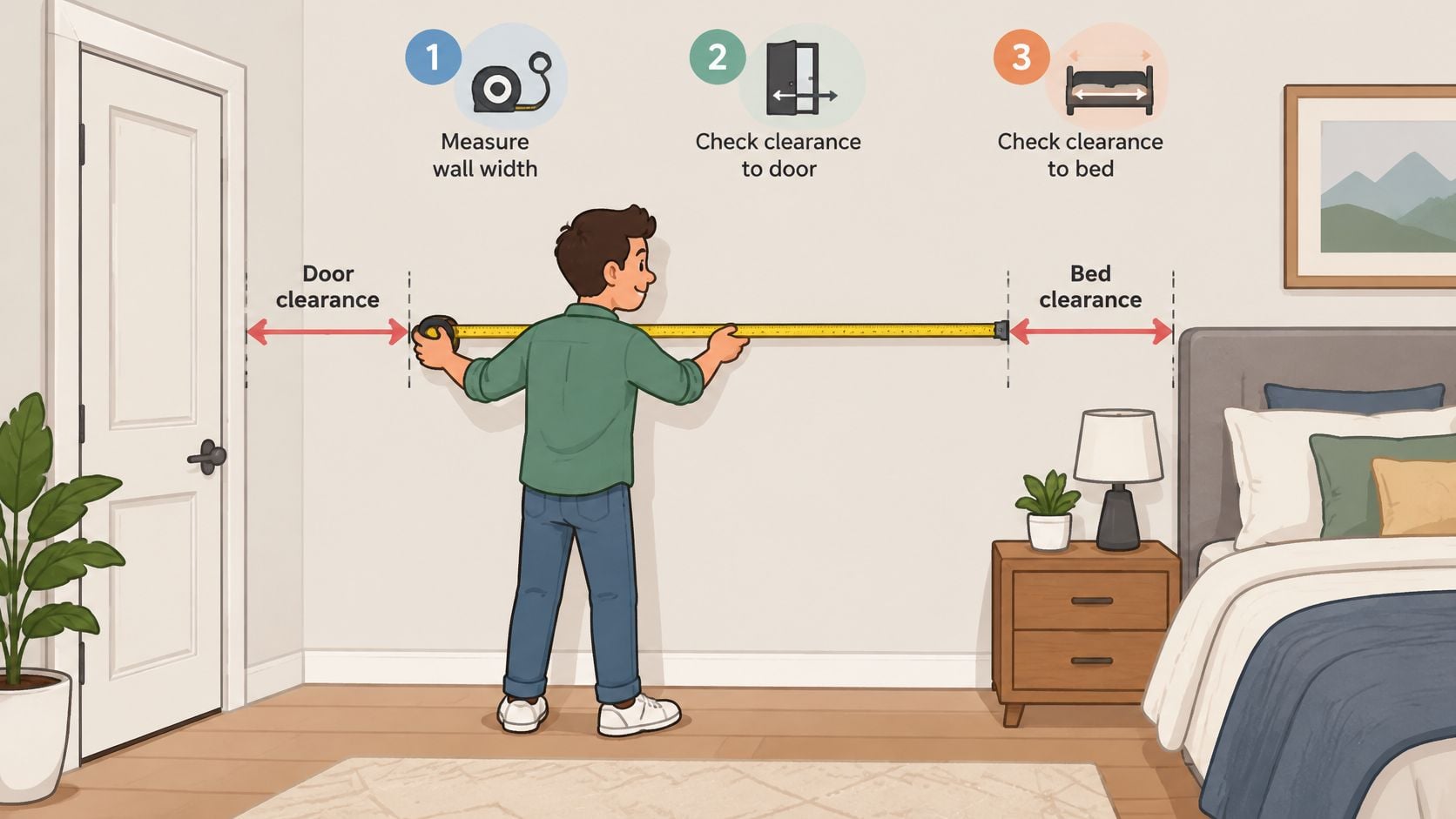
- Wall width and nearby clearance. Measure the open wall, then the gap from that wall to the nearest door, bed, or walkway. Those limits decide which piece can physically fit.
- Painter's tape on the floor. Mark the footprint and walk around it. A rectangle on the carpet shows a blocked path that a product photo hides.
- Internal drawer size. Measure width, depth, and height inside each drawer and multiply. Exterior size overstates storage because the box, the slides, and the face frame consume space.
- Reach zone. Measure from the floor to the top drawer pull and mark where everyday clothing should live. Seasonal items can sit higher without making mornings harder.
- Open-drawer clearance. On the sample, pull the fullest drawer and confirm it misses the bed and the door. A drawer that fits the wall but hits the mattress isn't usable.
- Studs and anchor points. Locate studs or another solid anchor point and plan the hardware before delivery. A restraint only works where the wall can hold it.
- Listing versus the sample. Write the numbers beside the product listing and note every gap in width, depth, or drawer interior. A missing interior dimension is a reason to measure again, not a reason to guess.
When the room is harder than the tape
Customization for bedroom furniture lets a buyer select style, color, and finish once the footprint is settled. Guynn Furniture & Mattress offers Visualize Your Room, which lets a household map the exact layout and test pieces from home before the drive. Design help starts with a showroom conversation. Decorator Debra Williams and the design staff can sort scale against the wall that was just measured.
After that in-store consultation, the design team makes an appointment to visit the home. Measurements and photographs get taken, and the space and color scheme are assessed. A plain tape walkthrough is spelled out in how to measure a room for furniture. Use it before the home visit so the decorator isn't starting from a blank wall.
Choose the Right Piece for Your Bedroom
Let the tape make the call. The room scenarios are a guide, not a rulebook. Measured capacity, a reachable middle zone, and a real anchor plan beat the word on the tag. If the wall is short, take the chest. If someone needs a mirror and a daily surface, take the dresser and fasten it.
At Guynn Furniture & Mattress, design services begin with a decorator in the store who identifies looks that suit needs, style, and budget. Bedroom lines include Ashley, Bassett, Vaughan Bassett, and Elements, so handles, drawer travel, and finish can be checked in person. A large in-stock selection means many cases leave without a special-order wait.
Price, delivery, and a local habit since 1902
The Low Price Promise matches a local competitor's advertised price, with a 30-day price guarantee if that price drops after purchase. Free in-home delivery and setup within 60 miles covers Galax, Independence, Hillsville, and the wider Southwestern Virginia and northern North Carolina region. Items sold here are assembled and set up, and packaging materials are removed. Wall anchors stay with the household, as delivery crews don't fasten hardware to walls. Families have bought household goods from this counter since 1902. The cases are heavier now. Explaining the piece before the sale is the same habit.
A closer look at scale and finish sits in this guide to how to select bedroom furniture.
Visit our showrooms in Galax, Independence, or Hillsville to test the comfort for yourself. Schedule a consultation with our design team to start planning your dream room today. Browse our selection online at guynnfurniture.net.
Guynn Furniture & Mattress keeps dressers and chests shoppers can open, measure, and compare for bedrooms in Galax, Independence, Hillsville, and the surrounding Southwestern Virginia and northern North Carolina area, with free in-home delivery and setup within 60 miles. A design visit can line up reach, wall width, and anchoring with the actual room instead of a furniture label. Visit Guynn Furniture & Mattress and stand the two shapes side by side before the wall gets measured twice.