
Best Drafting Chair: Top Choices for 2026


You might be reading this while perched on a kitchen stool, leaning over a craft table, or trying to make a standing desk work with the office chair you already have. By the end of the day, your shoulders feel tight, your lower back complains, and your feet never seem to land in a comfortable spot.
That’s usually the moment people start looking for the best drafting chair. Not because they want something fancy, but because they need a chair that fits the height of the surface they use every day.
A drafting chair is one of those pieces that makes immediate sense once you sit in the right one. It’s built for higher work surfaces, and that changes everything about comfort. If you're trying to pull together a more functional work area, these home office furniture ideas can help you think through the whole setup.
Finding Comfort at New Heights
Around Southwestern Virginia and Northern North Carolina, a lot of work happens in spaces that weren’t originally designed as full home offices. A kitchen counter becomes a laptop station. A sewing table turns into a side business hub. A standing desk goes into the guest room because that’s the only spot left.
That setup can work. But if your chair sits too low for the surface in front of you, your body has to make up the difference. Individuals lean forward, raise their shoulders, or round their back just to reach what they’re doing. After a few hours, that “make do” setup starts to feel expensive in a different way.
Drafting chairs were made for this exact problem. They’re designed for higher surfaces, and they support your body in a more natural position when a regular office chair just can’t get high enough.
Why this matters at home
At home, comfort isn’t just about work. It affects how long you can focus, how your neck feels at dinner, and whether you dread sitting down at your desk the next morning.
A good drafting chair helps when you:
- Work at a counter-height surface and need to sit without hunching
- Use a standing desk but don’t want to stand all day
- Craft, draw, sew, or build at a taller table
- Share a workspace where flexibility matters
A chair should meet your body where you work. Your body shouldn’t have to bend itself around the wrong chair.
The part that confuses most shoppers
People often assume a drafting chair is just a tall stool with wheels. It isn’t. The best ones are built more like ergonomic office seating, just at a height that makes sense for work done at height.
That means the decision isn’t only about how tall the chair goes. It’s also about where your feet rest, how your lower back is supported, how stable the base feels, and whether the chair still feels good after a long afternoon.
That’s where it helps to slow down and look at the details in plain language.
What Makes a Drafting Chair Different
The easiest way to understand a drafting chair is to compare it to the right kitchen tool. You can flip pancakes with a butter knife if you have to, but it’s awkward, messy, and tiring. A spatula is built for that job.
A drafting chair is the same idea. It’s the right tool for a higher workspace.
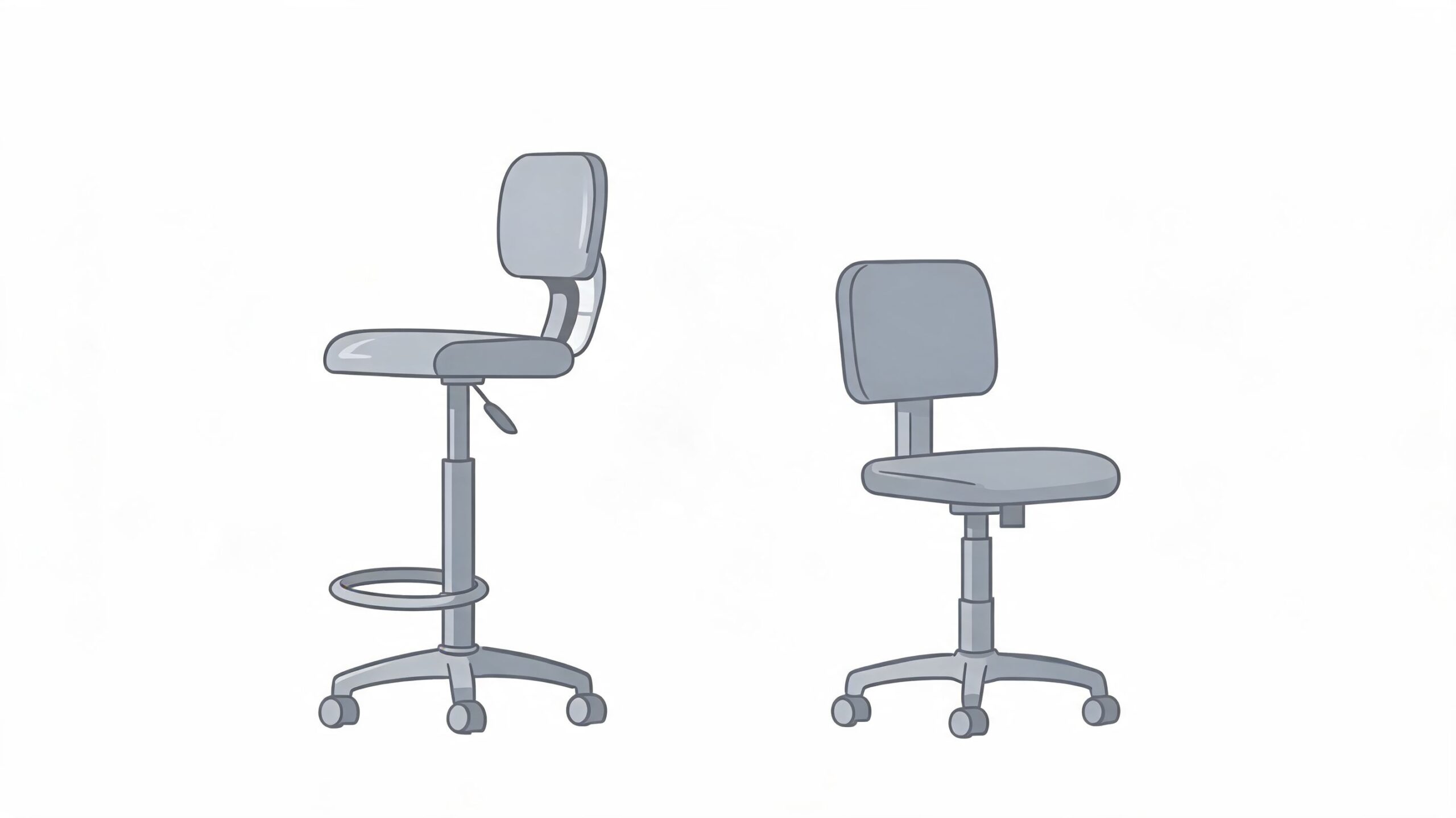
A standard office chair usually works at a traditional desk. A drafting chair is built for counters, raised tables, and standing desks where the seat has to go much higher for your arms and shoulders to line up comfortably.
The height difference is the big one
This is the clearest distinction. Unlike typical office chairs with a seat height range of 18 to 24 inches, drafting chairs commonly adjust from 25 to 35 inches, with some models extending even further, according to BTOD’s drafting chair guide.
That extra height matters because it lets you sit close to your work without stooping. If your chair is too low, your elbows float too far beneath the surface, and your upper body starts doing extra work just to stay engaged.
The foot ring is not optional
The second feature that separates a drafting chair from a regular office chair is the foot ring or footrest. Without it, your legs dangle. That sounds minor until you’ve done it for an hour.
With proper foot support, your body feels more grounded. Your hips stay in a better position, and the chair feels less like a perch and more like real seating.
If you work in a clinical or specialty setting, it can also help to compare specialized drafting stools for medical offices, because those models often show how seat height, cleanable materials, and foot support come together for task-based work.
Why people mix them up with stools
Some drafting chairs do look like stools, especially simpler models. But the best drafting chair for daily use often includes features people already understand from living room and office seating:
- Back support for the lower spine
- Adjustable seat height for different surfaces
- Stable rolling base for easy movement
- Optional arms and tilt for longer sessions
If you’ve ever shopped for comfort in other seating, a lot of the same ideas apply. These things to look for in your new sofa or chair translate more than you might think. The materials, support, and fit still matter. The only difference is that a drafting chair has to do all of that higher off the floor.
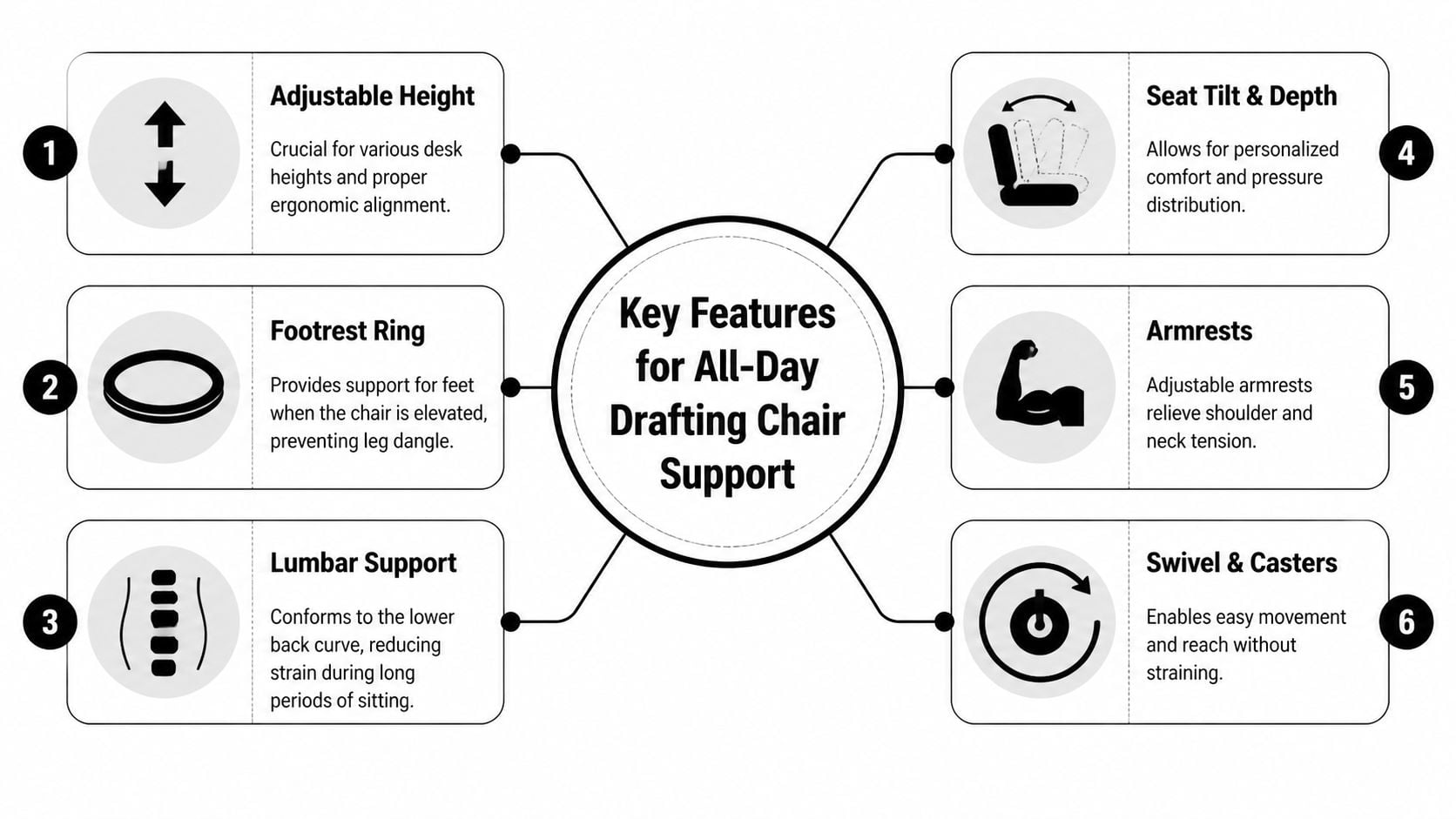
Key Features for All-Day Support
When people search for the best drafting chair, they usually start with height. That makes sense, but height alone won’t carry you through a full workday. The chair also needs to support your back, legs, and movement in a way that feels natural.
This quick visual helps organize the most important pieces.
Start with the parts that affect posture
Some features matter right away because you feel them within minutes of sitting down.
Seat height range
Look for a chair that can reach your work surface without making your shoulders climb upward. A quality drafting chair should have a substantial adjustment range so it can match different counters, desks, or hobby tables.Foot ring placement
The foot ring should let your feet rest comfortably rather than leaving your knees too high or your legs hanging. A well-placed ring helps your body settle into the chair.Lumbar support
This is the curve that supports the lower back. A quality drafting chair with an adjustable backrest and lumbar curve that matches the spine’s natural 30 to 40 degree lordosis can reduce lower back strain by up to 35%, according to Office Chairs Unlimited’s ergonomic drafting chair guide.
Practical rule: If a chair feels fine for five minutes but your lower back starts searching for support after twenty, the backrest probably isn’t doing enough.
Then look at comfort over time
A chair that works for quick tasks may not be the right chair for long sessions. For extended use, the smaller details earn their keep.
| Feature | What it does in real life |
|---|---|
| Seat cushion | Helps reduce pressure when you’re sitting for longer stretches |
| Tilt or recline | Lets your body shift positions instead of staying frozen |
| Seat depth | Keeps the chair from pressing awkwardly behind your knees |
| Armrests | Can reduce shoulder tension if they fit under your work surface |
| Swivel | Makes it easier to reach side items without twisting your back |
A lot of shoppers skip these because they sound secondary. They aren’t. Even a tall chair can feel tiring if it locks you into one stiff position.
If you’d like another perspective on long-hour seating in general, this guide on how to choose the right ergonomic office chair is useful because many of the same comfort principles apply.
Materials change the feel more than you’d expect
The upholstery affects comfort, cleanup, and even how warm the chair feels by mid-afternoon. Fabric and mesh usually feel more at home in a study, bedroom office, or craft room. Smooth performance materials can be easier to wipe down in spaces where paint, glue, flour, or pet hair tend to show up.
That’s one reason material choice shouldn’t be an afterthought. If you want to compare how fabrics, texture, and wear characteristics behave over time, this overview of upholstery materials gives good background.
A short checklist you can actually use
When you sit in a drafting chair, ask yourself:
- Can my feet rest comfortably?
- Does my lower back feel supported without forcing me forward?
- Can I get in and out of the chair easily?
- Does the base feel steady when I shift my weight?
- Would I still want to be sitting here after lunch?
That last question catches a lot. A chair can look smart online and still feel wrong in the body. The best drafting chair isn’t the one with the longest feature list. It’s the one that fits your work height, your build, and your daily routine.
Matching a Chair to Your Life and Home
The right drafting chair depends less on the label and more on how you live. Two people can need a tall chair for completely different reasons, and the features that matter most won’t always be the same.
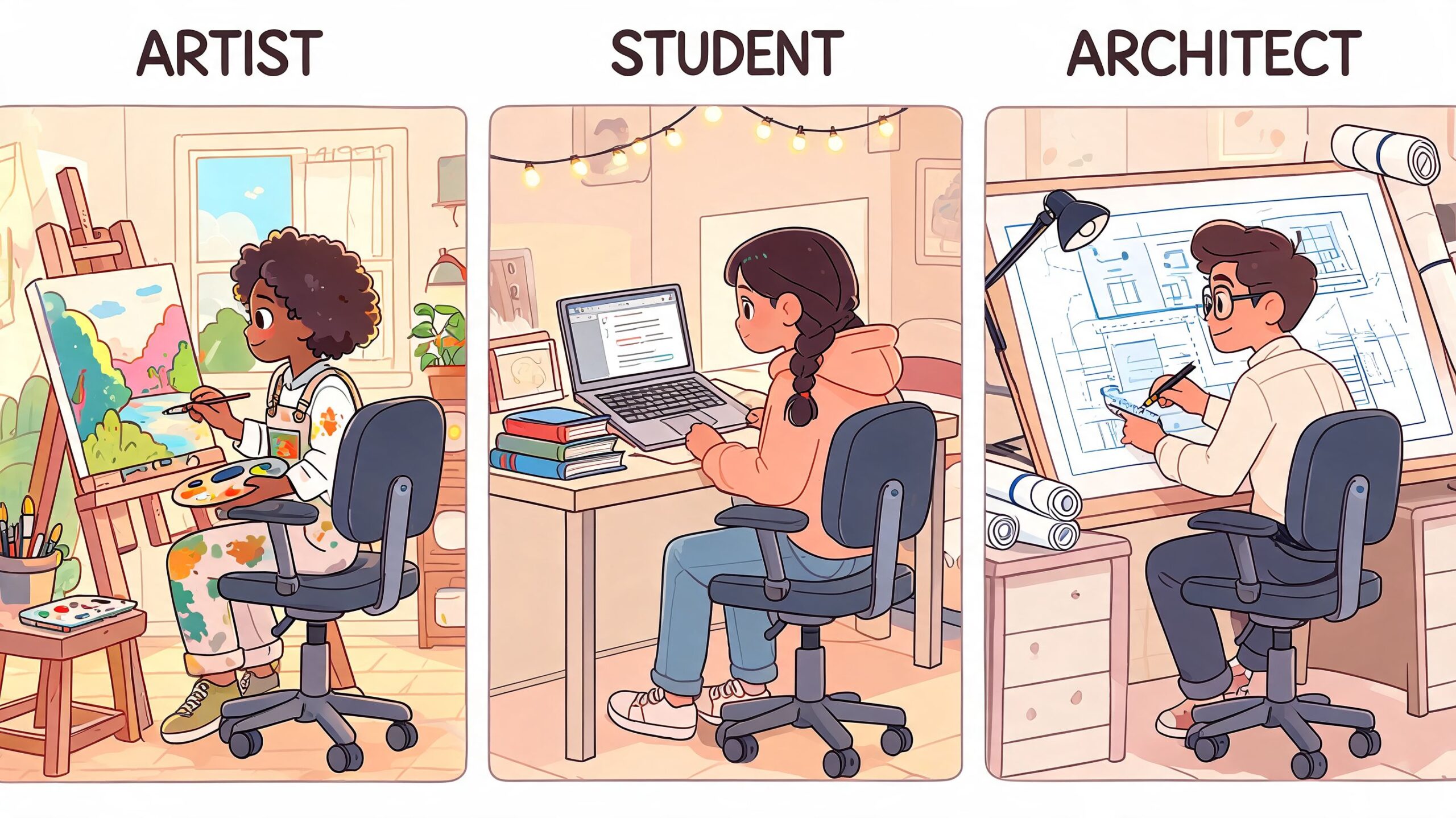
The standing desk user in Hillsville
A lot of folks buy a standing desk with good intentions. Then they discover that standing all day can be just as tiring as sitting all day.
For this person, the best drafting chair usually needs easy height adjustment and a dependable foot ring. The chair should let them move between standing and sitting without fuss. If they have to fight the controls every time, they’ll stop using the chair the way it was meant to be used.
What matters most here:
- Quick height changes
- Stable base when fully raised
- Back support that feels good during shorter sit-down breaks
A bulky chair may not be ideal in this setup if the desk area is tight. Something compact can feel better in a smaller room or shared home office.
The artist or maker in Galax
This person may spend hours sketching, painting, sewing, or working on detailed projects at a taller surface. They don’t always sit in one neat posture. They lean in, reach sideways, spin to grab tools, and shift often.
For them, movement matters as much as support. A swivel base, easy-rolling casters, and a seat that doesn’t feel restrictive can make a big difference. Upholstery also matters if there’s a chance of spills or smudges.
Some work asks you to sit still. Creative work often asks you to move around your chair all day. The chair has to keep up.
Helpful priorities for this type of user:
- Smooth swivel
- Casters that work well on the room’s flooring
- Material that’s practical for cleanup
- Back support that doesn’t get in the way when leaning forward
The family using a kitchen counter workspace
This is common across Southwestern Virginia. The “office” is really part of the kitchen, breakfast nook, or family room. One person pays bills there, another helps with homework, and somebody else uses it for recipes or online shopping.
Here, the chair needs to be practical. Stability matters. Durability matters. And the look matters because the chair is part of a living space, not tucked away in a private office.
A good fit for this household often includes:
| Household need | Chair feature to look for |
|---|---|
| Shared by more than one person | Simple, intuitive adjustments |
| Used at a high counter | Proper drafting height |
| Busy family traffic | Sturdy base and easy entry |
| Visible in the room | Upholstery and style that blend with the home |
In this situation, comfort has to coexist with everyday life. The chair can’t feel overly technical or awkward in the room.
The senior in Independence who values ease and steadiness
For some shoppers, the biggest question isn’t style or even posture first. It’s confidence getting in and out of the chair.
A tall seat can feel intimidating if the base doesn’t feel secure or if the foot support is poorly placed. A more supportive backrest and a predictable, steady feel are often more important than lots of advanced adjustments.
The best drafting chair for this person may be the one that feels easiest to use, not the one with the longest list of features.
What usually helps:
- Firm, stable seating feel
- Clear back support
- Foot support that feels natural
- Smooth movement without feeling slippery
The student doing a little bit of everything
Students and remote learners often use one chair for school, hobbies, and part-time work. Their needs can change from day to day. One afternoon it’s a laptop at a counter. The next it’s drawing or gaming.
That kind of use calls for balance. The chair should be supportive enough for longer sessions but simple enough to work across different tasks. When a chair becomes too specialized, it stops being versatile.
That’s often where people find the sweet spot. Not the flashiest model. Just the one that works well in real life.
Understanding Value and Durability
Price matters. For most families, it has to. But with drafting chairs, the better question is what you’re paying for.
Sometimes a lower-priced chair works fine for occasional use at a craft counter or homework station. If the chair will be used every day, though, durability and support become a bigger part of the value conversation.
What quality looks like in this category
A stronger drafting chair usually shows its quality in the parts you don’t notice at first glance. The lift has to raise higher than a standard office chair. The base has to stay steady at that height. The moving parts have to keep doing their job over time.
When considering durability, look for models with a 275 to 300 pound weight capacity and at least a 3 to 5 year warranty on the pneumatic cylinder, because premium gas lifts are tested to retain 95% of their height precision after 50,000 cycles, according to Perch Chairs and Stools.
How to think about value without getting lost in price tags
A simple way to compare options is to think in three lanes:
Affordable choices
Best for lighter use, occasional projects, or a secondary workspace. These can be practical if you don’t spend long hours in the chair.Mid-range choices
Often the best balance for home use. You usually get better cushioning, more adjustability, and more confidence in the lift and base.Investment-grade choices
Better for daily work, longer sessions, or households where comfort and longevity matter most. These chairs tend to feel better finished and more dependable over time.
The real cost of a chair isn't only the purchase price. It's also how it feels six months later, and whether you still want to sit in it every day.
Construction matters in all kinds of furniture
This is true far beyond office seating. If you’ve ever compared living room furniture, you already know that what’s inside the piece affects how long it lasts. That same thinking applies here.
For a helpful example from another category, this article on understanding 8-way hand-tied construction shows how build quality changes comfort and lifespan. Drafting chairs use different mechanics, of course, but the principle is familiar. Better construction usually means steadier support and fewer headaches later.
If you like to buy furniture once and keep it for years, this guide on how long furniture should last is worth a read too. It helps frame a drafting chair as part of the same long-term comfort decision you’d make for any piece in your home.
Why You Should Always Try Before You Buy
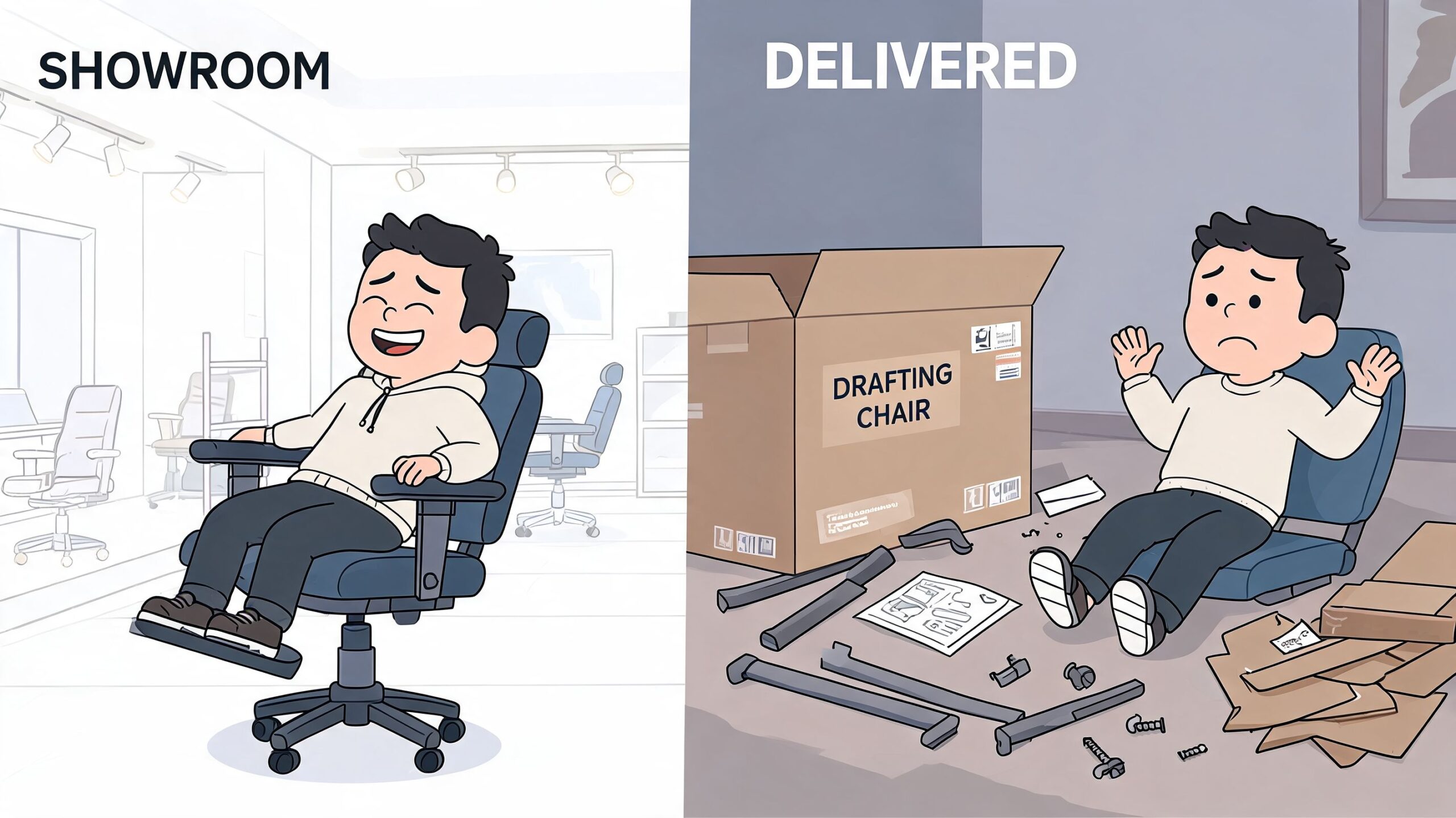
A drafting chair can look perfect in photos and still feel wrong the moment you sit on it. That’s because comfort is personal. The seat may hit your legs differently than expected. The foot ring may sit a little too high. The backrest may support one person beautifully and bother another.
That’s why trying a chair in person matters so much.
What you learn in five minutes of sitting
In person, you can answer questions that specs never fully settle:
- Does the seat feel supportive or hard?
- Can you place your feet naturally?
- Is the height range right for your body, not just your desk?
- Does the chair feel steady when you move?
You also learn whether the chair suits the way you sit. Some people perch forward when they work. Others lean back between tasks. Some need arms. Some find arms get in the way.
Online photos can only take you so far
Online shopping is convenient, and photos are useful for narrowing the field. But they can’t tell you how a chair feels after ten minutes, and they definitely can’t tell you whether assembly, returns, or adjustments will become a nuisance.
If you’re comparing options online first, these tips on using online furniture photos to make smarter buying decisions can help you spot details worth checking before you commit.
A drafting chair isn't a poster or a lamp. It's a piece you live in while you work. It deserves a test drive.
For something as body-specific as raised seating, trying before buying usually saves time, frustration, and the all-too-common “this looked better online” regret.
Your Comfort Is Our Family's Business
The best drafting chair is the one that matches your height, your workspace, and the way you move through the day. For one person, that means a supportive chair beside a standing desk. For another, it means a practical seat at a craft table or kitchen counter. The right answer is personal.
That’s one reason local furniture shopping still matters. You can sit, adjust, compare, and decide without guesswork. For households across Galax, Independence, Hillsville, and the wider Southwestern Virginia and Northern North Carolina region, having a real place to test comfort makes the process simpler.
Families in this region also tend to think beyond one room. A drafting chair may be part of a larger home office refresh, a remodel, or a multipurpose family space. If that’s where you are, it helps to work with people who understand how a single chair fits into the bigger picture of your home.
Since 1902, Guynn Furniture & Mattress has helped neighbors furnish their homes with a warm, no-pressure atmosphere. Along with home office options, shoppers can explore trusted names like La-Z-Boy as a Showcase dealer, plus Ashley, Bassett, Sealy, and Therapedic. If you need help tying a workspace together, Debra Williams and the expert design staff can help you plan a room that feels comfortable and looks right too.
They also make the practical side easier. There’s a large in-stock selection for immediate delivery, a Low Price Promise with local competitor matching and a 30-day price guarantee, plus free in-home delivery and setup within 60 miles for customers throughout the region.
Visit Guynn Furniture & Mattress to explore comfortable, practical seating for your home. Visit our showrooms in Galax, Independence, or Hillsville to test the comfort for yourself. Schedule a consultation with our design team to start planning your dream room today. Browse our selection online at guynnfurniture.net.