Best Dining Room Tables with Storage Underneath

Some dining rooms become the catch-all spot without anyone meaning for that to happen. Mail lands there. School papers pile up. Keys get dropped near the placemats. Then dinner rolls around, and you're clearing the table before you can even set it.
That's why dining room tables with storage underneath make so much sense for real homes. They give you a place to eat, gather, work, and still keep daily clutter close at hand but out of sight. For families in Galax, Independence, Hillsville, and across Southwestern Virginia and Northern North Carolina, that kind of flexibility matters, especially when you're trying to make every square foot work harder.
Furniture shopping can feel like a lot. Size, style, budget, durability, delivery, setup, and whether the piece will still suit your life a few years from now. A practical guide helps. So does working with a local store that's been serving this region since 1902, with a no-pressure atmosphere and people who understand how local families live.
Table of Contents
- Your Guide to a Clutter-Free Dining Room
- More Than Just Storage A Smarter Use of Space
- Finding Your Type Open Shelves Drawers and More
- Measure Twice Buy Once Sizing Your Storage Table
- Built for Family Life Materials and Durability
- Styling Your Dining Table and Storage
- Find Your Perfect Table at Guynn Furniture
Your Guide to a Clutter-Free Dining Room
A dining table should support daily life, not fight against it. If your table has become the place for homework, unopened packages, coloring books, and the random things nobody knows where to put, the problem usually isn't your family. It's that your room needs furniture with more than one job.
A storage table helps by building organization right into the place you already use every day. Instead of adding another cabinet, basket tower, or side piece, you keep common items right under the tabletop. That can mean napkins, chargers, crayons, small games, serving pieces, or the extra placemats you always need but never want sitting out.
Why this matters in everyday life
The biggest benefit is simple. You reclaim the room faster. When everything has a home underneath the table, cleanup gets easier after breakfast, after homework, and after guests head home.
For many households, that changes how the room feels:
- Dinner feels less rushed because you're not clearing a pile first.
- Hosting gets easier because serving pieces are nearby.
- Kids can use the table during the day without turning the whole room upside down.
- Small homes feel calmer because fewer loose items stay in sight.
Practical rule: If the same items keep landing on your dining table, they probably need storage attached to the table itself.
A table that fits your home, not just the showroom
This category works especially well when you want one purchase to solve more than one problem. A table with a drawer might suit a neat, traditional dining room. A base with shelves might suit a busy family kitchen. A bench with hidden storage can help when you need seating and space to stash seasonal linens.
That's also why this type of furniture deserves a slower, thoughtful approach. You're not only choosing a shape or finish. You're choosing how your family will use the room every day.
For neighbors across Southwestern Virginia, that often means balancing comfort, function, and value. It also means looking for a piece that won't feel dated next year and won't create more work than it saves.
More Than Just Storage A Smarter Use of Space
A dining table with storage underneath does more than hide clutter. It can reduce how many other pieces you need in the room and turn one area into a better fit for everyday life.

That matters because more households are actively looking for furniture that works harder. According to home furnishing industry trends on multi-functional dining tables, approximately 35% of households in urban and suburban areas now prioritize multi-functional furniture that maximizes space efficiency.
One table, several jobs
In real homes, the dining area rarely serves one purpose. On Monday it's dinner. On Tuesday it's a school project station. On Friday it's game night. On a holiday weekend, it may become the overflow serving area.
A table with storage underneath supports that kind of use because the supplies for those activities can stay nearby instead of spreading into other rooms. That's especially helpful if your home doesn't have a formal office, a playroom, or a lot of spare cabinets.
Here's where people usually notice the difference:
- Family meals stay more organized when placemats and napkins live in the table.
- Homework time gets easier when pencils, paper, and chargers have a dedicated spot.
- Crafts and hobbies become less of a production because supplies don't need to be hauled out from another room.
- Entertaining feels smoother when serving tools are within reach.
Why it feels like you gained room
The smart part isn't only the storage itself. It's what that storage replaces. If your table can hold everyday dining items, kids' activity supplies, or hosting basics, you may not need an extra cart, cabinet, or organizer nearby.
That's one reason smaller rooms often feel more open after this swap. You're using the footprint you already have instead of adding more furniture around it.
If you're also trying to make the rest of your home work better, this guide on organizing compact children's bedrooms offers useful ideas for the same kind of multi-use thinking. And if your dining area is especially tight, our guide to small-space dining table ideas can help you compare practical options.
A good storage table doesn't just hold things. It removes friction from the way your family uses the room.
Finding Your Type Open Shelves Drawers and More
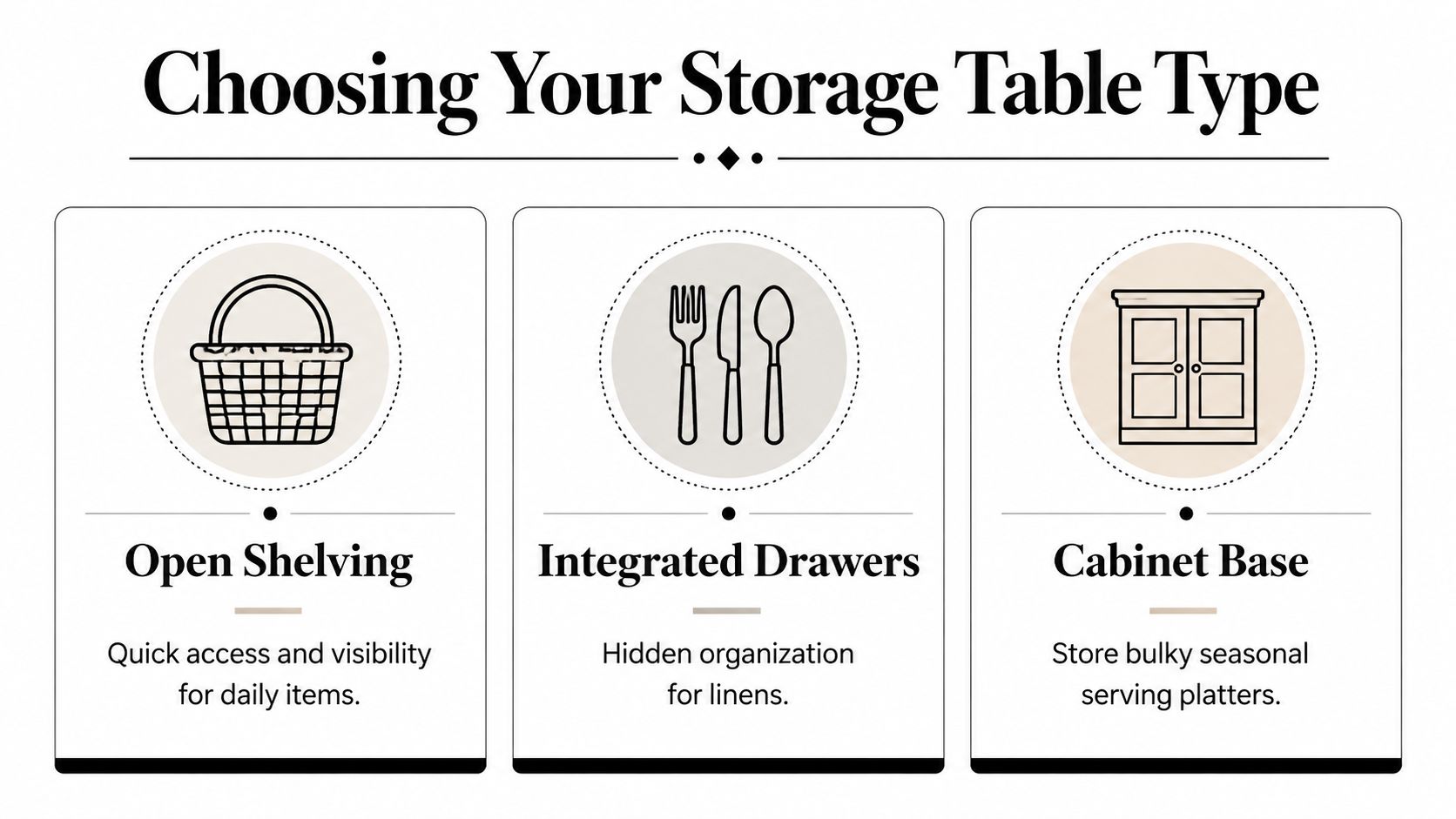
Not all dining room tables with storage underneath solve the same problem. Some are better for fast access. Some are better for hiding visual clutter. Some work best for families who entertain often, while others are ideal for everyday basics.
Modern designs now include more than simple shelves. According to this overview of modern storage table features, today's options can include traditional open shelving, barn doors, rotating cubbies, and counter-height designs that add 6 inches to standard table height, from 30 inches to 36 inches.
A quick side-by-side comparison
| Type | Best for | What to store | Watch for |
|---|---|---|---|
| Open shelving | Everyday access | Baskets, napkins, small games | Items stay visible |
| Integrated drawers | Hidden organization | Flatware, placemats, table linens | Drawer depth varies |
| Cabinet base or doors | Bulkier items | Platters, serving bowls, seasonal pieces | Can feel heavier visually |
| Lift-top or hidden compartments | Flexible storage | Larger pieces, entertaining supplies | Mechanism quality matters |
| Storage bench pairing | Family seating | Kids' items, extra linens, holiday pieces | Bench fit matters |
Open shelving works for grab-and-go homes
Open shelves are the easiest to use day to day. You don't have to pull out a drawer or open a door. That makes them handy for baskets that hold crayons, paper goods, or cloth napkins.
They're also forgiving if your family changes routines often. You can swap out baskets, restyle them, or shift what goes where without much effort. The tradeoff is visibility. If you don't like seeing stored items, open shelving may feel too busy.
Drawers hide the mess better
Drawers tend to suit households that want the dining room to look tidy even when life isn't. If your goal is to keep chargers, candles, serving tools, or table linens out of sight, drawers do that beautifully.
They're also easier to organize into categories. One drawer can hold placemats, another can hold hosting items, and a shallow section can keep small objects from drifting around. If you're comparing features in person, our article on choosing a dining storage piece can help you ask the right questions.
Cabinet bases and enclosed storage feel more furniture-like
Some storage tables have a fuller base with doors or paneled sides. These often look more substantial and can blend well with traditional or farmhouse rooms.
They work best when you need to store awkward or bulky pieces that don't fit nicely in shallow drawers. Serving platters, table runners, and less-used entertaining items are common examples.
If you want the table to look calm from across the room, enclosed storage usually beats open shelving.
Counter-height and specialty designs
Counter-height storage tables appeal to some families because the added height creates more room below. They can also suit casual dining areas where people gather for coffee, paperwork, or standing conversations during get-togethers.
Specialty features like rotating cubbies or hidden compartments can be fun and useful, but they should still feel simple to live with. If the feature is clever but awkward, it won't stay helpful for long.
For shoppers who want to compare styles in person, Ashley and Bassett often represent two different looks people ask for in dining spaces. One may lean more casual, another more polished. Seeing shelf, drawer, and base styles side by side makes the decision much easier than trying to guess from a photo.
Measure Twice Buy Once Sizing Your Storage Table
A storage table can solve clutter, but only if it fits the room comfortably. Many people get stuck, focusing on the tabletop size and forgetting that chairs need room, people need walkways, and drawers or shelves need practical access.

Storage matters here too. According to this dining storage capacity guide, understorage compartments typically provide 4 to 8 cubic feet of storage space depending on design, and tables with two-tier shelving systems or lift-top access provide 60 to 70% usable access to stored items. That means a larger base doesn't automatically mean easier storage. Accessibility matters just as much as volume.
Start with the room, not the table
Measure the part of the room where the table will live. Then think about movement around it when chairs are occupied, not just pushed in.
Use this simple order:
- Measure wall to wall in the dining area.
- Note nearby obstacles like heat vents, door swings, windows, and cabinets.
- Account for chair pull-back space so people can sit down without scraping into other furniture.
- Check storage access so drawers can open and shelves can be reached comfortably.
If you want a good visual method before you shop, this measuring furniture guide is a helpful companion.
Match the storage style to the room shape
A narrow dining room may do better with drawers or a center base because deep open shelves can be harder to reach without crowding the chairs. In a more open room, shelving on both sides might feel perfectly natural.
This is also where scaled planning helps. For households in Southwestern Virginia and Northern North Carolina, Debra Williams and our expert design staff can help map furniture to the room so you're not guessing from a tape measure alone. That's useful when a dining area opens into a kitchen, family room, or hallway and needs to handle traffic from several directions.
A few practical fit checks
Before buying, ask yourself these questions:
- Can chairs slide out easily without bumping a wall or island?
- Will the storage be reachable when people are seated?
- Does the base leave enough foot room for the people who use it most?
- Will the table still work on holidays or when extra guests stop by?
For a deeper look at proportions and room planning, our dining table size guide walks through common fit questions.
The right size table isn't the biggest one that fits. It's the one your family can move around, sit at, and use comfortably every day.
Built for Family Life Materials and Durability
A storage dining table does more work than a standard table. It holds dishes on top, items underneath, and often gets used for everything from homework to holiday meals. That extra function means construction matters.
According to this product analysis of storage table construction, standard dining tables operate with a weight capacity of 400 lbs distributed across the surface, but storage compartments create uneven load paths that require reinforced base construction, such as T-shaped trestle bases.
Why storage tables need stronger engineering
People sometimes assume the storage part is just an add-on under the top. It isn't that simple. Once you add drawers, shelves, or lift mechanisms, the table's weight is distributed differently. If the base isn't designed for that, you may notice wobble, sticking drawers, or gradual misalignment over time.
That's why base design deserves a close look. A well-built trestle or center-supported base usually handles the mixed demands of seating and storage better than a flimsy frame with decorative parts doing structural work.
Material choices in plain language
Different materials can make sense for different households.
- Solid wood often appeals to buyers who want warmth, character, and a more traditional feel. It can age beautifully, especially in homes where the table is meant to stay for many years.
- Veneers over engineered cores can provide a balanced option for families who want a wood look with more approachable pricing and consistent surfaces.
- Engineered wood components can be useful in the right design because they help with uniformity and stability.
- Mixed-material construction can be practical when the design uses each material where it performs best.
What matters most is not the label alone, but how the table is assembled. The slides should feel steady. The top shouldn't flex. The base should feel planted when you lean on the edge.
Family-friendly details worth checking
If you have kids, pets, or frequent guests, inspect the practical details:
- Corners and edges should feel comfortable in a busy room.
- Drawer operation should be smooth, not jerky or loose.
- Base clearance should leave enough room for knees and chair movement.
- Finish maintenance should match your daily habits.
For shoppers comparing durability across family spaces, our guide on kid-friendly and pet-friendly furniture is a useful next step.
Bassett is one example of a brand many shoppers consider when craftsmanship is high on the list, while Ashley often comes up when customers want style and function in a more budget-conscious range. The better choice depends less on the logo and more on how the specific table is built for your household.
Styling Your Dining Table and Storage
A storage table doesn't have to look purely practical. In many rooms, it becomes the visual center of the space because it has more presence than a basic four-leg table. The trick is to style it in a way that still lets the storage do its job.
Keep the top simple and usable
The top should look finished, but not crowded. A low centerpiece, a bowl, or a pair of candles usually works better than a tall arrangement that blocks sightlines or gets in the way during meals.
If the table has a lift-top feature or hidden leaf storage, keep decor light and easy to move. That sounds obvious, but it's a common frustration. If every use of the table requires clearing heavy accessories, the room starts feeling fussy.
A beautiful dining table should still be easy to live with on an ordinary Tuesday night.
Style the storage based on what people can see
Open shelves should look intentional. A few matching baskets can make everyday storage feel neat instead of exposed. You can use one for linens, one for kids' items, and one for games or serving pieces.
Closed drawers give you more freedom. Inside, small dividers or trays can separate flatware, candles, napkin rings, and odds and ends. Outside, the room stays calm because none of that is visible.
Here are a few room-by-room style approaches that work well:
- Rustic spaces often pair nicely with wood tones, woven baskets, and simple pottery.
- Traditional rooms tend to suit drawer-front details, upholstered chairs, and a classic centerpiece.
- Modern spaces usually look best when shelves are edited carefully and accessories stay minimal.
- Family dining areas benefit from soft textures and storage containers that are easy for everyone to use.
Let the table connect with the rest of the room
Many dining rooms come together at this central point. Once the table style is set, you can coordinate the chairs, rug, lighting, and wall decor around it. That's also when expert design help can save time. A dining table may look right on its own but still feel off if the surrounding pieces compete with it.
If you're finishing the room, our guide to dining room accessories that complete the space can help you layer in those last details without overdoing it.
Find Your Perfect Table at Guynn Furniture
A lot of neighbors who walk into our Galax, Independence, or Hillsville stores are trying to fix the same kind of problem. The dining room feels crowded, the table works hard every day, and useful things keep ending up in the wrong places. A table with storage underneath can solve several of those headaches at once, but only if it fits your room, your routine, and your budget.
That is why the last step is less about chasing a certain look and more about choosing a table that earns its spot in your home. A good storage table should serve dinner on Tuesday, hold homework on Wednesday, and still make holiday gatherings feel welcoming.
Around Southwestern Virginia and nearby North Carolina, shoppers usually tell us they want four things. They want furniture that holds up, storage that makes daily life easier, a style that fits the rest of the house, and a buying experience that feels straightforward. Those are sensible priorities. A dining table is a working piece, not just something to admire from across the room.
At Guynn Furniture & Mattress, we have been helping local families furnish their homes since 1902. That long history matters in a practical way. You can come in, pull out the drawers, check the shelf height, compare finishes in person, and talk with someone who understands how a farmhouse in Hillsville may need something different from a newer home in Galax.
We also carry options from brands many customers already know, including Ashley and Bassett. If you need help sorting through sizes, finishes, or matching pieces, our in-store design team can help you lay out the room before you buy. That can save a lot of second-guessing, especially if your dining area also has to work as a homework station, craft zone, or overflow seating space.
A simple final check can keep you from bringing home a table that looks good but works poorly. Ask yourself:
- Will this table support the way our family uses the room?
- Is the storage shaped for the items we want to keep close by?
- Does it leave enough legroom and walking space around the table?
- Will the finish and style still feel right a few years from now?
If those answers are clear, you are usually close to the right choice.
And if you are weighing value, remember to look past the price tag alone. A well-chosen storage table can replace the need for an extra cabinet or catchall piece, which is often easier on both space and budget. Free in-home delivery and setup within 60 miles helps too, especially with heavier dining furniture that is hard to move and assemble on your own.
Visit our showrooms in Galax, Independence, or Hillsville to try tables in person, compare storage features, and get advice from a team that knows this area and how local families live. You can also browse our selection online at Guynn Furniture & Mattress.