Microfiber Sectional Sofa: The Ultimate Buyer’s Guide


Your old sofa usually tells you when it's time. The cushions stay mashed down. The arm shows wear where everyone lands after work. The dog has claimed one corner, the kids have claimed the other, and somewhere along the way the whole room started working around the furniture instead of the furniture working for your home.
That's why so many families end up looking at a microfiber sectional sofa. It promises the three things many families desire at the same time. Comfort, durability, and a price that still leaves room in the budget for the rest of the house. Around Southwestern Virginia and Northern North Carolina, that matters. Homes get lived in hard here. We have movie nights, grandkids over on weekends, muddy shoes by the door, and plenty of houses with tricky layouts that don't make furniture delivery simple.
A good sectional isn't just seating. It's where the family settles in. It's where someone stretches out with a blanket after a long day. It's where guests end up during holidays, whether you planned for it or not. The right one can make a room feel finished. The wrong one can feel too big, too fussy, or impossible to keep clean.
Table of Contents
- Welcome to the Family The Search for the Perfect Sofa
- What Is a Microfiber Sectional Sofa Anyway
- The Real-Life Pros and Cons for Your Home
- How to Size and Configure Your Perfect Sectional
- A Simple Guide to Cleaning and Maintenance
- Styling Your Sectional From Functional to Fabulous
- Finding Your Family's Sofa at Guynn Furniture
Welcome to the Family The Search for the Perfect Sofa
Saturday afternoon in Southwest Virginia usually tells the story. One child is stretched out with a blanket, somebody else is balancing a plate from a pizza run, the dog has claimed the corner cushion, and the old sofa is showing every year of it.
That is how many families start shopping. They are not asking for a fabric name first. They are asking for a sofa that feels comfortable at the end of a long day, fits everybody without crowding the room, and does not turn every spill into a small crisis.
A sectional often solves several problems at once, but around Galax, Hillsville, Independence, and nearby communities, picking one is not only about style. It is also about getting it home and getting it in place. We regularly see older farmhouses with narrow stairwells, brick ranch homes with tighter front entries, and split-level layouts where a sharp turn at the landing can stop a large sofa cold. A piece can look perfect on the sales floor and still be the wrong choice if it will not make it past the doorway.
What families are usually balancing
Sofa shopping usually comes down to a handful of practical trade-offs:
- Comfort for everyday use: It needs to feel good for a quick cup of coffee and for a full evening of movies.
- Durability for busy households: Kids, pets, guests, and daily traffic will test the fabric and cushions fast.
- Fit for the room and the house: The sectional has to suit the floor plan and the path it takes to get there.
- Value for the money: Families want lasting quality without paying for features they do not need.
Fabric choice matters here too. A sectional is a big purchase, and the upholstery affects how it wears, how it cleans up, and how it feels from day one. If you want a better sense of how different materials compare, this guide to upholstery fabric options is a helpful place to start.
One thing big-box stores and online-only sellers often miss is the house itself. In Southwest Virginia, delivery is part of the buying decision. Room planning, measuring doorways, checking stair turns, and choosing a sectional in pieces that can be maneuvered inside can save a family from an expensive mistake.
Microfiber sectionals keep coming up for good reason. They give families a practical fabric, flexible seating, and a lived-in comfort that works well in homes where life happens every day.
What Is a Microfiber Sectional Sofa Anyway
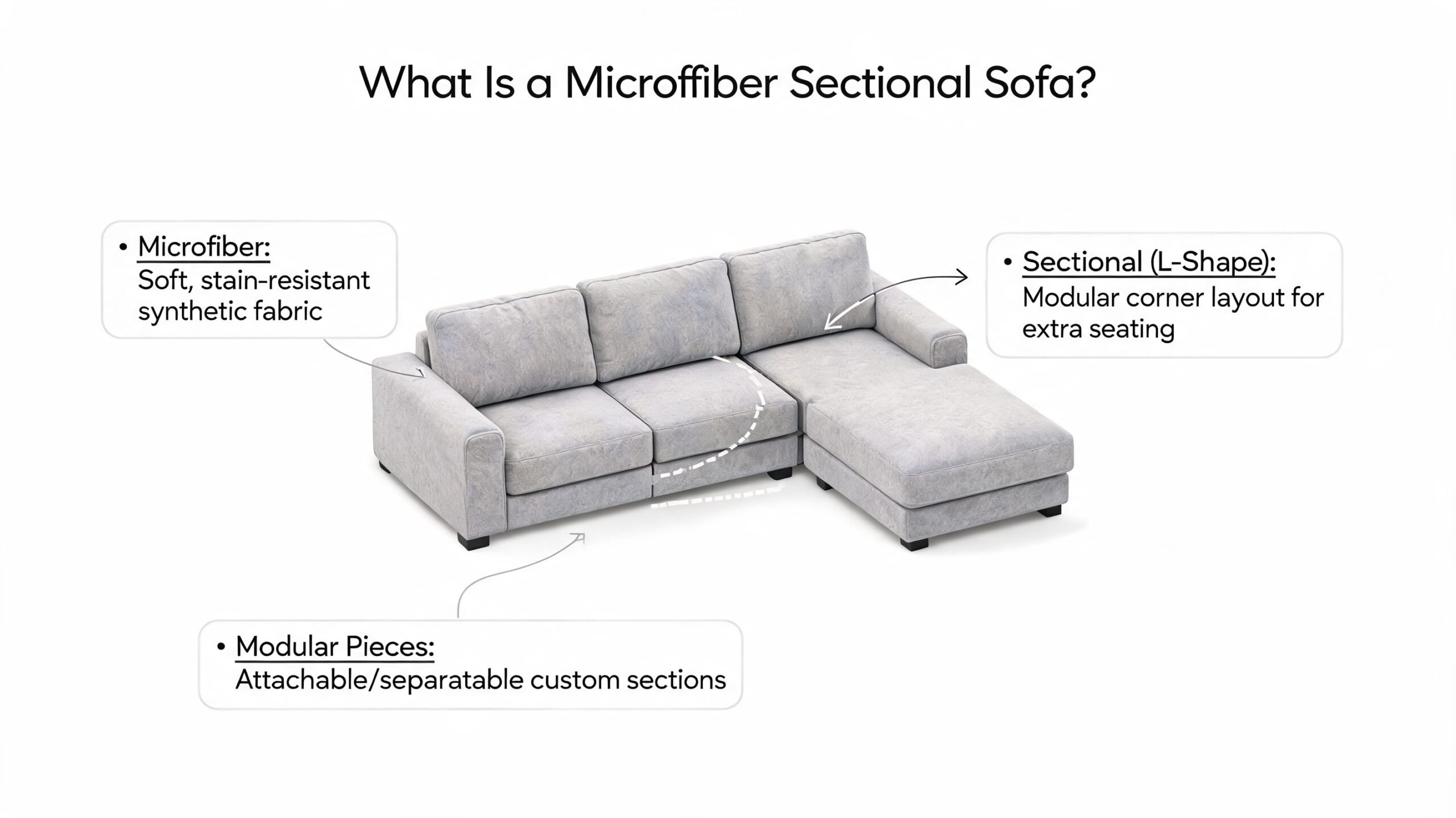
A microfiber sectional sofa combines two useful ideas. One is the fabric. The other is the shape.
Microfiber is built from very fine synthetic fibers, usually polyester, and those fibers are packed into a dense weave. A sectional is a sofa made in multiple connected pieces, which lets it create corners, chaises, or room-defining layouts that a standard straight sofa can't.
Why microfiber feels different
The easiest way to understand microfiber is to think of it as a performance-minded upholstery fabric. It's soft to the touch, but it's engineered for wear.
According to Wayfair's sectional measuring guide, microfiber is made from ultra-fine polyester fibers, typically 1 denier or less per filament. Its weave often uses 300 to 500 filaments per yarn, which helps create a water-repellent surface. That same source notes absorption rates can stay under 0.5% by volume, and quality microfiber can retain over 95% of its color vibrancy after 10,000+ double rubs in abrasion testing.
That's the technical side. The practical side is simpler. Spills tend to sit up longer instead of sinking in right away. Crumbs usually don't bury themselves deep into the fabric. Everyday use doesn't rough it up as quickly as many people expect.
What makes a sectional different from a regular sofa
A sectional changes how a room works. Instead of one long couch and extra chairs trying to fill the rest of the space, the sectional does more of the job on its own.
Common layouts include:
- L-shaped sectionals: Good for corners, open family rooms, and everyday lounging
- Chaise sectionals: Great if one person always stretches out
- Modular sectionals: Better for homes that may need rearranging later
If you're still sorting out upholstery choices, this quick guide to different upholstery fabric types helps make the fabric side easier to compare.
Practical rule: If your living room is where people actually live, not just where company sits twice a year, microfiber and sectional construction make sense together.
Put both ideas together and you get a sofa that's built for use. Not delicate. Not high-maintenance. Not locked into one narrow role.
The Real-Life Pros and Cons for Your Home
A microfiber sectional sofa does a lot well. It also has a few trade-offs that are worth understanding before you bring one home. That honesty matters, because the right sofa isn't the one with the prettiest sales tag. It's the one that still makes sense six months later.

Where microfiber sectionals shine
For a busy household, microfiber earns its reputation in ways people notice quickly.
- Spill response is forgiving: A dense weave gives you a better chance to catch messes before they become stains.
- The hand feel is comfortable: Many families want softness without going to a fabric that snags easily.
- It fits everyday style: Microfiber works in casual family rooms, traditional spaces, and updated remodels.
- It often delivers strong value: You can get a comfortable, family-friendly look without moving into more expensive upholstery categories.
Sectionals also help a room do more with less. One well-chosen piece can replace the need for multiple mismatched seats and can make the room feel more intentional.
Where buyers get disappointed
This is usually where expectations need a little adjusting.
Some microfiber performs beautifully. Some doesn't. According to Target's microfiber sectional category background cited in verified data, only 65% of standard microfiber models maintained colorfastness after 500 abrasion cycles with pet hair simulation. The same verified data notes that reinforced microfiber showed 40% higher satisfaction among pet-owning families.
That lines up with what experienced shoppers eventually learn. “Microfiber” alone isn't enough information. Construction quality still matters.
A few common frustrations show up in real homes:
| Concern | What usually causes it | What helps |
|---|---|---|
| Pet hair shows | Static and darker colors make it more visible | Regular vacuuming and a lint tool |
| Water spots appear | Improper spot cleaning or over-wetting | Follow the cleaning code and blot lightly |
| Seat wear looks uneven | One favorite seat gets all the use | Rotate cushions when possible |
| Sofa feels bulky | Wrong configuration for the room | Choose layout based on traffic flow, not just seat count |
If you have kids, pets, or both, this guide to kid-friendly and pet-friendly furniture is a useful next step.
Don't buy the word “microfiber.” Buy the whole sofa. Fabric quality, cushion support, frame construction, and layout all matter together.
A good microfiber sectional is practical and easy to live with. A poor one can still pill, wear unevenly, or look tired too soon. The material gives you advantages, but it doesn't erase the importance of choosing well.
How to Size and Configure Your Perfect Sectional
People often measure the wall and stop there. That's how they end up with a sofa that technically fits the room but doesn't fit the home.
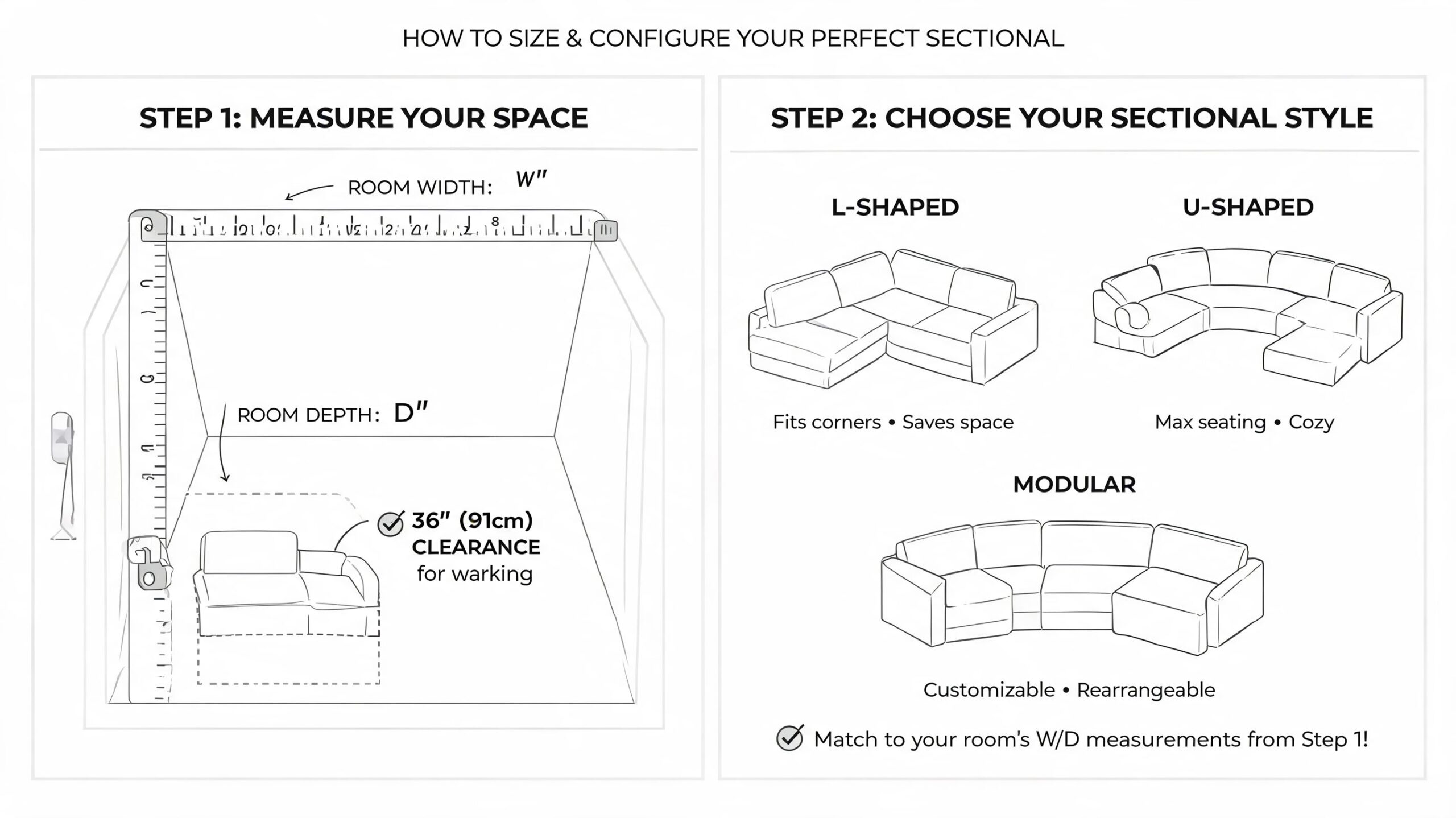
A sectional has to clear the front door, move down the hallway, swing past the stair rail, and settle into the room without swallowing the traffic path. In older homes around Southwestern Virginia, that's not a small detail. It's the detail.
Measure the room and the route
Start with the room, but don't end there.
Take these measurements before you fall in love with a sectional:
- Room width and length: Know how much footprint you can realistically give up
- Doorway openings: Measure the narrowest entry point, not just the front door
- Hallways and stair turns: Tight corners stop furniture faster than flat walls do
- Window placement and vents: These affect where an arm, chaise, or corner can sit
For a practical walkthrough, use this guide on how to measure furniture before delivery.
Verified data from Bob's sectionals category background highlights a problem many buyers miss. Some fixed L-shapes require professional help 25% more often, while many modular sectionals break down into 20 to 30 lb pieces that can fit through 24-inch doorways.
That's why modular construction matters so much in older homes. The issue isn't just style. It's access.
Pick the shape that matches how you live
Not every sectional solves the same problem.
- L-shape: Usually the safest choice for family rooms. It defines the seating area without boxing in the whole space.
- Chaise end: Works well when one side of the room is more open and you want a casual lounging seat.
- Modular build: Best when your home has access challenges or you expect to move or rearrange later.
If you're coordinating a move and want a practical outside perspective on handling large furniture through narrow spaces, this article on best Central Coast furniture removalists is a solid reminder that delivery logistics matter just as much as dimensions on paper.
Measure twice. Then measure the path the sofa takes to get to the room. That second set of measurements saves more headaches than the first.
A sectional should make a room feel easier to use. If people have to sidestep around it, if the chaise blocks the natural walkway, or if delivery is a guessing game, it's the wrong configuration no matter how nice the fabric looks.
A Simple Guide to Cleaning and Maintenance
Microfiber gets a lot of attention because it's usually simpler to care for than people expect. Still, easy-care doesn't mean no-care. A little routine maintenance keeps the sofa looking fresh and helps you avoid the kind of spot-cleaning mistakes that leave rings or stiff patches.
The first thing to check is the cleaning code on the tag. Most upholstered furniture uses a code such as W, S, W/S, or X. That code tells you what type of cleaner is appropriate. If you skip that step, you're guessing, and guessing is how small spills become bigger problems.
What to do right after a spill
When somebody spills a drink, speed matters more than force.
- Blot first: Use a clean, dry cloth. Press gently. Don't rub.
- Check the tag: Make sure the cleaner matches the fabric code.
- Test in a hidden area: Always try your cleaner where it won't show first.
- Use a light touch: Too much moisture can leave marks.
- Let it dry fully: Then lightly brush the nap if needed to restore texture.
A reliable maintenance habit matters just as much as emergency cleanup. Vacuum with an upholstery attachment, especially along seams, under cushions, and where pet hair settles. That keeps grit from grinding into the fabric over time.
What works and what usually doesn't
A few habits help microfiber stay presentable without turning care into a chore:
- Do use clean white cloths: They help you avoid color transfer.
- Do vacuum regularly: Pet hair and dust are easier to remove before they build up.
- Don't soak the fabric: Over-wetting often causes more trouble than the original spill.
- Don't scrub aggressively: That can rough up the surface and change the look of the nap.
For a fuller walkthrough, this guide on how to clean a fabric sofa properly covers the basics well.
If you're cleaning after a spill and also thinking about hygiene, this practical resource on BacteriaFAQ's guide to Pseudomonas offers useful context on why proper drying and surface cleaning matter.
A microfiber sectional usually looks its best when you treat spots early, use less cleaner than you think you need, and let the fabric dry completely before judging the result.
Routine care wins here. Not heroic cleaning sessions.
Styling Your Sectional From Functional to Fabulous
A sectional usually has to do two jobs in Southwest Virginia. It needs to look good on Saturday when family comes over, and it needs to hold up on Tuesday when kids, pets, and everyday life take over. Good styling respects both.
A microfiber sectional gives you a solid starting point because the fabric already feels relaxed and livable. It does not demand a formal room. It works well in a farmhouse outside Hillsville, a brick ranch in Galax, or a tighter living room in an older home where every piece has to earn its spot.

Start with the shape you already have
Most sectionals already define the room for you. An L-shaped sectional creates a natural conversation area, separates the seating zone from the rest of the space, and often saves you from buying extra chairs you do not really need.
That matters in local homes where rooms are not always wide open and perfectly square. In SW Virginia, I see plenty of living rooms with fireplaces off-center, odd window placement, or a walkway that cuts right through the main seating area. A sectional can solve that problem, but only if the rest of the room stays simple enough to let it work.
A few styling choices usually make the biggest difference:
- Layer pillows by texture, not just color: Combine a smoother fabric with something woven or nubby so the sofa feels finished without looking busy.
- Use one or two throws with purpose: Fold one over the chaise or one corner seat. That looks tidy and still feels inviting.
- Choose a rug that gives the sectional a boundary: At minimum, the front feet should relate clearly to the rug so the seating area feels grounded.
- Add one shape that softens the lines: A round coffee table, oval ottoman, or curved lamp helps break up the blocky look sectionals can have.
- Leave breathing room around the piece: If the sofa barely clears the side table, the whole room feels cramped.
Keep the room from looking bulky
The styling mistake I see most often is not with the sectional itself. It is everything people crowd around it after the fact. Heavy end tables, oversized recliners, dark storage pieces, and too many pillows can make a good sectional look twice its size.
Cleaner furniture lines usually help. If you like a simpler look, this guide to clean lines and organic shapes shows why lighter shapes and less visual weight make a room feel calmer.
Layout matters just as much as decor. A sectional has to share space with traffic paths, lamps, and the coffee table people walk around every day. This set of living room arrangement ideas for real family spaces is useful if your room also has a TV wall, fireplace, or narrow pass-through.
The best styled sectional looks balanced, comfortable, and ready for real use.
That is where local help can save you from expensive guesswork. Big-box stores and online photos can show a pretty room, but they cannot see your narrow doorway in Independence or the tight corner in your split-level near Mount Airy. Good in-store design help and delivery planning make styling easier because the sectional is sized right, placed right, and supported with pieces that fit your home instead of a showroom set.
Finding Your Family's Sofa at Guynn Furniture
Saturday afternoon in Southwest Virginia often looks the same. The kids are piled onto one end of the sofa, somebody has a dog at their feet, and the room has to work hard without feeling fussy. A microfiber sectional sofa fits that kind of daily use well. It offers comfort, holds up to regular traffic, and usually asks less of the owner than many dressier fabrics.
That matters even more in this part of the region, where a sofa has to fit the house before it can fit the style. I have seen plenty of families from Galax to Hillsville fall in love with a sectional online, then hit trouble at the front steps, the hallway turn, or a split-level stair landing. The better buying experience starts with measuring, honest conversation, and someone who understands the homes around here.
A microfiber sectional is often a good match for a few clear types of shoppers:
- Families who want a sofa that feels inviting every day, not just when company comes over
- Budget-conscious buyers who need durability and a fair price in the same package
- Homeowners updating one room at a time and needing a dependable anchor piece
- Households in older Southwest Virginia or Northern North Carolina homes where room shape and delivery access can make or break the choice
The store matters almost as much as the sofa.
Being able to sit on different sectionals in person helps you judge seat depth, cushion support, and fabric feel far better than a product photo ever will. It also gives you a chance to ask practical questions. Will this piece clear a narrow doorway in Independence? Does this configuration make sense for a long living room in Galax? Is the chaise better on the window side or the TV side? Those are the questions that save people from expensive returns and daily frustration.
Guynn Furniture makes that process easier because the help is local and specific. Shoppers can compare trusted brands such as La-Z-Boy, Ashley, and Bassett in person, then get guidance from design staff who can sort through scale, layout, and what will work in the home. That kind of advice is useful when a room looks simple on paper but has an off-center fireplace, a tight traffic path, or an entry that limits what can be brought inside.
The practical side matters too. Local price matching, a 30-day price guarantee, financing for qualified buyers, and free in-home delivery and setup within 60 miles all remove common headaches. For many families, the biggest relief is knowing the crew bringing the sectional in has handled homes like theirs before.
Since 1902, Guynn Furniture & Mattress has served families across Galax, Independence, Hillsville, and nearby communities with a neighborly, no-pressure approach. Stop by one of the showrooms to try microfiber sectionals in person, compare what feels right, and get advice that fits your room, your budget, and the way your household lives.