The Correct Height for TV: Avoid Neck Strain

A new TV has a way of making the whole room feel full of possibility. The screen is sharper, movie night suddenly sounds better, and everyone can already picture where the sofa pillows will end up by halftime. Then the tape measure comes out, the wall starts looking less certain, and one simple question takes over. What's the correct height for TV placement so it feels good to watch?
That question matters more than most families expect. A TV that's a little too high can leave everyone shifting, tilting, and rubbing their necks by the end of the evening. A TV that's placed with the room, the seating, and real daily habits in mind usually disappears into the background, which is exactly what good comfort does.
Across Southwestern Virginia and Northern North Carolina, homes rarely look like perfect showroom boxes. Some have fireplaces. Some have open layouts. Some have deep sofas, while others have La-Z-Boy recliners that completely change posture. The right answer usually starts with the people who'll be watching, not the wall itself.
That New TV Feeling and The First Big Question
A family brings home a beautiful new television, leans it carefully against the wall, and immediately starts second-guessing everything. Too low might look awkward. Too high might feel dramatic for a minute, then miserable by the second movie. Once the first hole goes in the wall, nobody wants to redo it.
That's why this decision deserves a calm approach. The correct height for TV placement isn't just about symmetry or what looks polished in a photo. It affects how relaxed shoulders stay, whether eyes settle naturally on the screen, and how comfortable the room feels during ordinary evenings.
For many households, the first instinct is to center the TV based on the wall itself. That sounds logical, but rooms don't get watched by walls. They get watched by people sitting on sofas, sectionals, and recliners with very different sightlines. A wall may have a visual midpoint, but your family has a viewing midpoint, and those two aren't always the same.
A TV can look beautifully centered on the wall and still be wrong for the room.
Older homes, remodeled spaces, and open-concept layouts make this even trickier. A fireplace may pull the TV upward. A tall console may raise the screen higher than expected. A favorite chair in the corner may become the seat that tells the truth about what works and what doesn't.
A helpful first move is to map the room before drilling anything. This guide on best placement for your sofa and television can make the wall feel less like a guess and more like a plan.
What families usually want
Most households aren't chasing a technical spec sheet. They want a room that feels easy to live in.
- Comfort first: The screen should feel natural to watch through a full movie, not just for a quick test.
- A clean look: The TV should relate well to the furniture below it and not feel like it's floating too high.
- Confidence: Nobody wants to wonder, every night, whether the TV should've gone lower.
That's the true goal. Not perfection on paper. Comfort in real life.
The Golden Rule for Comfortable TV Viewing
A comfortable TV height starts with one simple target. The center of the screen should meet your eyes when you are seated in your normal viewing position. In many living rooms, that lands somewhere in the mid-range from the floor, but the measurement matters less than the person in the chair.
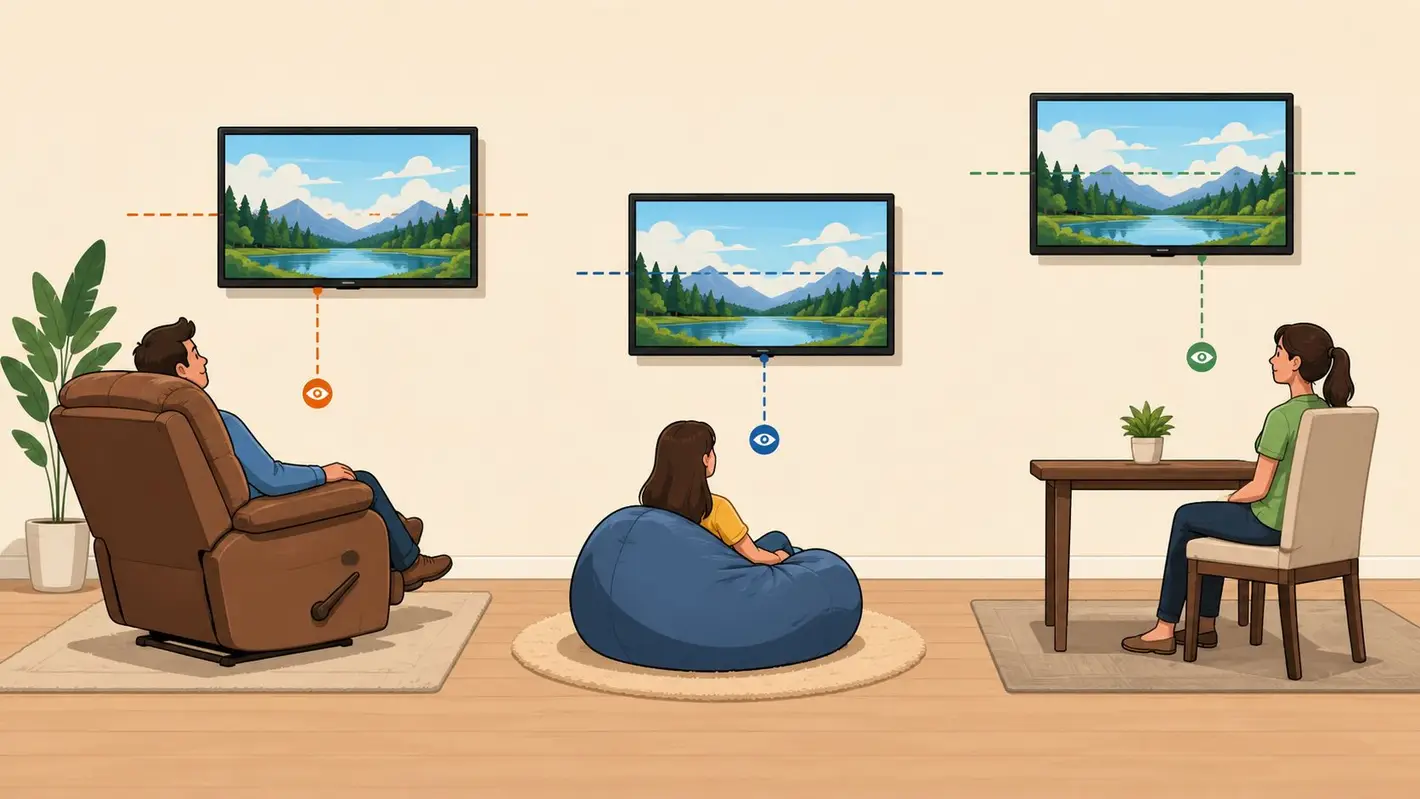
That guideline holds up for a reason. When your eyes fall near the middle third of the screen, your neck stays relaxed, your shoulders stay easy, and a long movie night feels better than a quick five-minute test.
Why the baseline works
Families often hear a single number and treat it like a rule carved in stone. In real rooms, it is only a starting point. The true rule is seated eye level.
That means the process is straightforward:
- Sit in the seat you use most
- Measure from the floor to your eye level
- Use that measurement to place the center of the TV
I have seen plenty of TVs mounted to satisfy the wall, while the seating told a different story. The screen looked centered. The room did not feel comfortable. That usually shows up after a week or two, when someone starts rubbing their neck during a movie.
The rule works best when the furniture leads
This is also why furniture layout matters so much. A low, deep sofa gives you one eye line. A taller seat or a firmer upright chair gives you another. If you are still arranging the room, this guide to living room furniture placement can help you line up seating and screen position before you commit to a mount.
A useful checkpoint is the first ten minutes of watching. If your eyes settle naturally on the screen, you are close. If you feel your chin lifting, the TV is probably too high.
Wall decor follows a similar principle. These expert tips for homeowners hanging art explain why eye-level placement feels right in a room, and that same idea carries over to TV mounting.
What usually works in real living rooms
| Approach | Usually works? | Why |
|---|---|---|
| TV centered to seated eye level | Yes | Keeps viewing posture relaxed |
| TV centered to wall height only | Sometimes | Can ignore the actual seating position |
| TV mounted high for appearance alone | Rarely | Often leads to neck tilt and fatigue |
The main point is simple. The best height is the one that fits the way your family sits. That matters even more once reclining furniture enters the picture.
How Your Favorite Chair Changes Everything
The standard advice starts to wobble the moment reclining seating enters the room. A person sitting upright on a sofa and a person leaned back in a recliner do not look at the wall from the same height or angle. That difference is exactly why many families mount the TV according to the usual rule, then wonder why the room still doesn't feel right.

Most generic guidance skips over that detail. Yet this discussion of ideal TV mounting height for reclining setups highlights a key issue: most content rigidly prescribes a 42-inch center height, failing to address how reclining furniture, like a La-Z-Boy, causes seated eye level to drop significantly, meaning a standard mount can force uncomfortable neck strain.
A sofa and a recliner don't behave the same way
On a traditional sofa, viewers tend to sit more upright. Their head stays higher, and the common baseline often feels reasonable. In a recliner, the body settles back. The eyes sit lower. The chin tips differently. Suddenly, a TV placed by the old one-number rule can feel much higher than expected.
That's why the correct height for TV placement has to start with the seat people use most, not the seat that photographs best.
A room with one upright loveseat and two recliners should usually be planned around the primary viewing posture. If the household spends most evenings reclined, that posture deserves more weight than the occasional upright perch.
Where people get into trouble
The mistake isn't caring about appearance. The mistake is letting appearance outrank comfort.
Common trouble spots include:
- Recliners under a standard mount: The TV looked right during installation, but it feels too high once the footrest goes up.
- Mixed seating with no priority seat chosen: One spot feels fine, another feels strained, and the room never settles.
- Basing the mount on standing sightlines: A TV can look perfect while standing in the middle of the room and still be tiring from the main chair.
The best seat in the room should help decide the TV height. Not the empty wall.
A furniture-first way to decide
A little honesty helps here. Ask which seat gets used for the long movie, the Sunday game, or the evening wind-down. If it's a recliner, measure from that reclined position. If it's a sectional corner seat, measure there. If the room has multiple everyday positions, compromise thoughtfully instead of defaulting to the wall center.
That approach is especially useful in homes built around deep comfort seating. A family comparing lounge options can get a better feel for how posture changes screen height needs by reading this ultimate recliner buying guide.
The takeaway
A TV doesn't become comfortable because it follows a popular number. It becomes comfortable because it fits the way the room is lived in. Reclining furniture changes posture enough that a “standard” mount can stop being standard the second someone leans back.
Your Simple Step-by-Step Measurement Guide
A good TV height is easier to find than many homeowners expect. Once the main seat is chosen, the job becomes a simple measuring exercise, and it works far better than guessing from the middle of the wall.

The easiest way to measure correctly
Use painter's tape, a tape measure, and the chair your household uses most. If that chair is a recliner, measure with the back and footrest in the position people use for a full movie, not the upright showroom position.
Sit down the way you really watch
Settle into the seat naturally. Shoes off, feet up, head relaxed. Small posture changes can shift the right height more than people expect.Measure eye level from the floor
Have someone measure from the floor to the center of your eyes while you stay in that viewing position.Mark the wall with tape
Put a small strip of painter's tape at that eye-level mark. That gives you a clear target instead of a rough estimate.Find the center of the screen
Measure the visible screen height of the TV, then divide that number in half. That midpoint is what should line up closest to your tape mark in a comfort-first setup.Map the full TV outline before drilling
Use painter's tape to mark the top, bottom, and sides of the TV on the wall. This step catches a lot of common mistakes, especially when a console, soundbar, or mantel is part of the layout.
A useful example for a larger screen
For a 65-inch TV, many living rooms end up with the screen center somewhere in the upper-40-inch range from the floor. That can be a helpful starting point, but it is only a starting point.
I see this all the time with recliners. A height that feels fine from a standard sofa can feel too high once someone leans back and raises the footrest. In those rooms, the better answer is often a little lower than the “standard” number.
One smart adjustment for multi-use rooms
Some rooms have two real viewing zones. One person is watching from the sofa, another is glancing over from the kitchen island or dining table. In that case, perfect eye-level alignment for one seat may not be the best whole-room choice.
A practical compromise is to keep the seated viewer's sightline landing around the middle to lower-middle portion of the screen rather than forcing a strict centered match. That usually keeps the main seat comfortable without making the TV feel too low for the rest of the room.
A few measuring habits that prevent rework
- Check cushion compression: Deep or soft seats drop the body after a few minutes, and that changes eye level.
- Confirm mount and outlet placement together: Before drilling, make sure the bracket height works with power access and cord routing. These home electrical outlet solutions can help if the wall setup is awkward.
- Measure the furniture below the TV: A console that is too tall can crowd the screen and force the mount higher than comfort allows.
- Live with the tape outline for a day: Walk through your normal evening routine and see how it feels from the seats that matter most.
If the room is still coming together, this guide on how to measure a room for furniture helps you plan the TV, seating, and storage as one setup instead of solving each piece separately.
Solving Tricky Placements Like Fireplaces and Consoles
Some walls make TV placement easy. Others come with a built-in argument. Fireplaces and media consoles are the two most common examples, and they call for different kinds of judgment.

When the fireplace wall wins the design debate
A fireplace often seems like the obvious focal point. The problem is that it can push the TV higher than comfort allows. If that location is the only realistic choice, safety matters just as much as viewing angle.
Professional installers recommend a minimum 4–8 inch clearance from the mantel top, plus a heat test where the wall should feel cool to the touch after the fireplace has run for an hour, as explained in this fireplace TV mounting guide. If the wall stays warm, the placement needs a different plan.
That's also the point where cable management and outlet access become part of the conversation. For homeowners dealing with awkward power placement, these home electrical outlet solutions offer useful planning ideas before the TV goes up.
Why consoles usually give better results
A media console usually creates a friendlier setup because it starts lower and keeps the TV visually connected to the furniture. The room often feels calmer when the screen doesn't float too far above the piece beneath it.
A few signs a console-based setup is working:
- The TV relates to the furniture below it: It feels anchored instead of disconnected.
- The gap looks intentional: Enough breathing room without making the screen feel stranded.
- Storage solves the clutter: Components, remotes, and accessories have a home.
Corner layouts deserve special attention because they can distort how high or low a screen feels from different seats. A well-proportioned corner media console can make an awkward wall much easier to live with.
Fireplaces ask for compromise. Consoles usually reward common sense.
If the room offers both options, the console wall often wins on comfort.
Let Us Give You a Helping Hand
Some TV installations are simple weekend projects. Others involve tricky studs, stone fireplace surfaces, oversized screens, or a room layout that never feels obvious. There's nothing wrong with deciding that this is one job that deserves a second set of hands.
That choice is often the most practical one. A well-placed TV affects comfort every single day, and a rushed install can leave behind wall repairs, awkward cable paths, or a viewing angle that never quite settles in. When the room includes recliners, mixed seating, or an open layout, outside guidance can save a lot of frustration.
For bigger room updates, it also helps to look at the whole space instead of the TV by itself. Seating height, console scale, walking paths, and lighting all work together. That's where design guidance can make the room feel finished instead of pieced together.
Families throughout Galax, Independence, Hillsville, and the wider Southwestern Virginia and Northern North Carolina region often want help that feels local, clear, and low-pressure. That kind of support matters, especially when the room includes comfort-focused seating from La-Z-Boy, living room pieces from Ashley or Bassett, or a full home refresh that may also involve Sealy or Therapedic sleep solutions in other spaces.
Whether the goal is a traditional family room, a remodel in progress, or a practical update with affordable options, a no-pressure atmosphere makes the decision easier. It also helps to know there are in-stock choices for immediate delivery, a low price promise with local competitor matching and a 30-day price guarantee, and Free in-home delivery and setup within 60 miles.
Visit Guynn Furniture & Mattress for friendly, expert help that's been serving families since 1902 in Galax, Independence, Hillsville, and across Southwestern Virginia and Northern North Carolina. Visit our showrooms in Galax, Independence, or Hillsville to test the comfort for yourself. Schedule a consultation with our design team to start planning your dream room today. Browse our selection online at guynnfurniture.net.