Standard Chair Dimensions: Dining, Office & More


Shopping for chairs can feel strangely hard. One store says a seat is “standard,” another calls the same shape “compact,” and suddenly a dining nook, office corner, or reading chair starts to feel like a measuring puzzle.
The good news is that standard chair dimensions follow a few predictable patterns. Once the seat, depth, arm, and overall height are clear, it gets much easier to match a chair to a table, a room, and the people using it. Guynn Furniture & Mattress serves Galax, Independence, Hillsville, and the wider Southwestern Virginia and Northern North Carolina region, and that local, no-pressure approach helps turn a confusing chart into a workable plan.
Introduction to Standard Chair Dimensions
A chair only feels standard when it fits three things at once: the body, the table, and the room around it. Start with the measurements that affect those three points, then match the chair to how it will be used at home.
For most adult seating, ergonomic guidance points to a seat-height range of 405–460 mm, which is about 16–18 inches, with seat widths of 405–508 mm and seat depths of 380–460 mm for upright adults. In everyday terms, that means many familiar chairs are built around a seat height that keeps feet grounded and knees from feeling cramped.
A few simple questions make the rest easier to sort out:
- What is the chair for? Dining, desk work, casual lounging, or a child's room each needs different proportions.
- Who is using it? Height, leg length, and posture habits change the right fit.
- What does it sit next to? Tables, desks, walls, and arms on neighboring chairs affect comfort just as much as the chair itself.
A chair that looks fine in a showroom can still feel wrong at home if the seat is too high for the table or too deep for the person using it. A measuring tape at the table, desk, or reading corner usually answers that question faster than guesswork.
Local details matter too. Homes in Galax, Independence, Hillsville, and the wider Southwestern Virginia and Northern North Carolina region often have a mix of room sizes, table heights, and everyday uses, so a chart works best when it is checked against the space in front of you. Understanding those local nuances can turn a confusing chart into a workable plan, and Guynn Furniture & Mattress offers free delivery in Southwestern Virginia, which makes it easier to bring the right chair home once the measurements line up.
Understanding Chair Dimension Terms
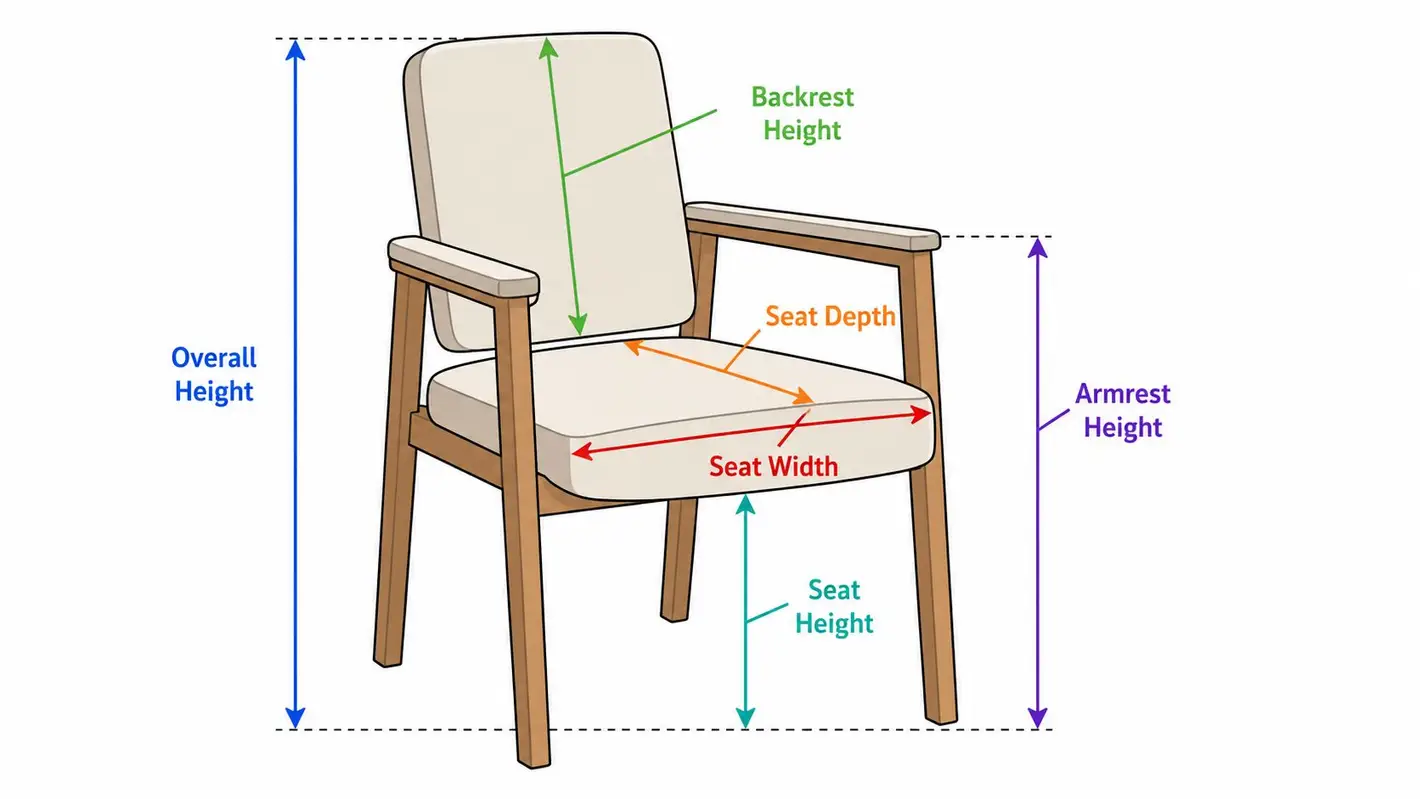
A chair can look right at first glance and still feel wrong once you sit down. The usual cause is a mismatch between the names people use for chair parts and the points they measure.
Seat width is the usable space from side to side where someone sits. Seat depth is the usable space from front to back, measured on the sitting surface rather than to the outer trim or frame.
Seat height is measured from the floor to the top of the seat. That measurement can make a chair feel low or high at the table even if the backrest looks perfectly sized.
Backrest height runs from the seat surface to the top of the back. Armrest height is measured from the seat to the top of the arm, and it helps determine whether the chair can tuck under a table and whether the sitter's shoulders have room to relax.
Overall height measures from the floor to the highest point of the chair. Footprint is the amount of floor space the chair occupies, which matters when several chairs need to move around a table or pass through a narrow hallway.
For a quick check at home, use this simple guide to measuring furniture before you compare chair dimensions to your room or table.
Simple mistake to avoid: measuring to the top of a table apron instead of the seat height. That can throw off the whole fit.
The University of Melbourne ergonomics guidance places traditional adult chair proportions in a familiar range for seat height, seat width, seat depth, and armrest height (University of Melbourne ergonomics guidance). The main takeaway is simple. Chair fit depends on the full seating shape, not just one measurement on its own.
Standard Dimensions for Dining and Side Chairs
Dining chairs do a very specific job. They need to fit under the table, support an upright meal posture, and still leave enough room for elbows, knees, and easy sliding in and out.
A useful real-world reference comes from Bassett Furniture, which lists a dining side chair at 19 inches wide, 19 inches deep, 18 inches high at the seat, and 36 inches overall height. Its dining arm chair is 24 inches wide, 18 inches deep, 18 inches high at the seat, and also 36 inches overall height. Those figures show why armchairs usually need more planning at a table than side chairs do.
For many homes, the seat height matters most. A chair around 18 inches high usually works well with standard dining tables, because it keeps the sitting position upright without forcing the knees too high. The seat width and depth matter too, since a chair that's too narrow can feel pinched and one that's too deep can push the sitter away from the table edge.
A few practical checks help before bringing chairs home:
- Leave room under the table: the seat should clear the tabletop structure and apron comfortably.
- Watch the width per person: a wider arm chair needs more table space than a slim side chair.
- Think about movement: chairs should slide out without banging nearby walls, buffet pieces, or other seats.
For a family dining room, the goal is not just “fit.” The goal is easy conversation, comfortable posture, and enough space that everyone can sit down without turning the meal into a shuffle. For more selection tips, the guide on how to choose dining chairs can help align style with everyday use.
Standard Dimensions for Armchairs and Lounge Chairs
Armchairs and lounge chairs are less about straight posture and more about settling in. That changes the shape of the chair, because the seat often needs to feel supportive without forcing the body into a rigid position.
A common adult chair seat height still tends to sit near the familiar 16 to 18 inch range noted in ergonomic guidance, but lounge seating can feel different because the seat depth is usually more generous. The deeper seat lets the user recline a little, stretch the legs, or curl up with a book without feeling perched on the edge.
Back height also changes the experience. A taller back supports the shoulders and helps the chair feel anchored, while a lower back can keep a room feeling lighter and more open. That's why two chairs with similar footprints can feel completely different in daily use.
A good way to think about armchairs is by room purpose:
- Conversation seating: compact enough to face a sofa or coffee table without crowding the path.
- Reading seating: a deeper seat and supportive back help the body relax longer.
- Accent seating: proportions matter, but the chair still has to function, not just look decorative.
For smaller living rooms, oversized arms can dominate the floor plan fast. For larger rooms, a chair with a wider stance can balance a bigger sofa without looking undersized. In either case, the footprint should be checked against walkways and side tables before anyone falls in love with the silhouette.
A chair that feels inviting in a showroom can still overwhelm a room at home. That's why the measured footprint matters just as much as cushions or fabric when a family wants a comfortable, usable layout.
Standard Dimensions for Accent Office and Bar Stools
Different chair types solve different problems. A desk chair has to support long sitting, a bar stool has to reach a raised surface, and an accent chair usually has to do a little of both comfort and visual work.
For office seating, the numbers matter because the chair needs to adjust to the person, not the other way around. Office seating standards specify adjustable seat heights of 14.8–20.2 inches per BIFMA G1-2013 and 15–22 inches per ANSI/HFES 100-2007 (office chair dimensions reference). That adjustment range is a big reason office chairs can serve a wider range of users than fixed dining chairs.
Accent chairs often look roomier than dining chairs because they are meant to make a statement as well as offer comfort. Their proportions can be broader, but the main thing to watch is whether the chair still leaves clear walking space around it and doesn't block a console, desk, or reading lamp.
Bar stools are the opposite of dining chairs in one key way, they're built for height. The important fit question is whether the seat aligns with the counter or bar surface without forcing the knees too high or the shoulders to hunch.
A few fit checks keep the room practical:
- Desk use: the chair should allow elbows to rest comfortably without raising the shoulders.
- Counter use: the seat height has to match the surface, not just the style.
- Accent placement: the chair should support circulation around the room, not interrupt it.
For homeowners comparing raised seating options, 5 reasons to consider bar height dining can help with the layout side of the decision. The main idea is simple, the right height turns a stool or office chair into a useful part of the room instead of a visual mistake.
Standard Dimensions for Children's Chairs
Children need smaller chairs, but they also need chairs that make sense for how they sit, play, and grow. A seat that feels fine one year can feel awkward the next, which is why children's dimensions need a little more flexibility than adult furniture.
A toddler chair is often built around a lower seat height, while a school-age chair is a bit taller and broader. For practical home use, the important thing is that the child can sit with feet supported and arms able to reach the table or desk without shrugging.
A few easy checks help parents choose well:
- Seat height: lower for toddlers, a little higher for school-age children.
- Seat width: wide enough to sit comfortably, but not so wide that the child slides around.
- Back support: should encourage an upright position at play tables and homework desks.
- Edge safety: rounded corners and stable legs matter in busy family rooms.
Children also outgrow chairs faster than most furniture categories. A chair that works at a puzzle table may soon feel too low for a study desk, so it helps to think in stages instead of trying to buy one perfect chair for every age.
Children's seating works best when the child's feet can reach the floor or a foot support, and the table height lets the arms move naturally.
For families balancing pets, playtime, and homework corners, the guide on how to choose kid-friendly and pet-friendly furniture is a practical next stop. A child's chair should feel safe, easy to use, and easy to replace as needs change.
Ergonomic and ADA Seating Considerations
Comfort is more than a number on a tag. A chair can match a standard dimension chart and still fail the person using it if the seat is too fixed, the arms sit too high, or the depth doesn't support a natural posture.
Ergonomic guidance is clear that a fixed-height seat is only a compromise, and that a usable chair should adjust about 9 inches in height and 14 to 18.5 inches in depth to fit different users rather than average dimensions alone (guideline for selecting chairs). That kind of adjustability matters for home offices, shared workspaces, and rooms where several family members use the same seating.
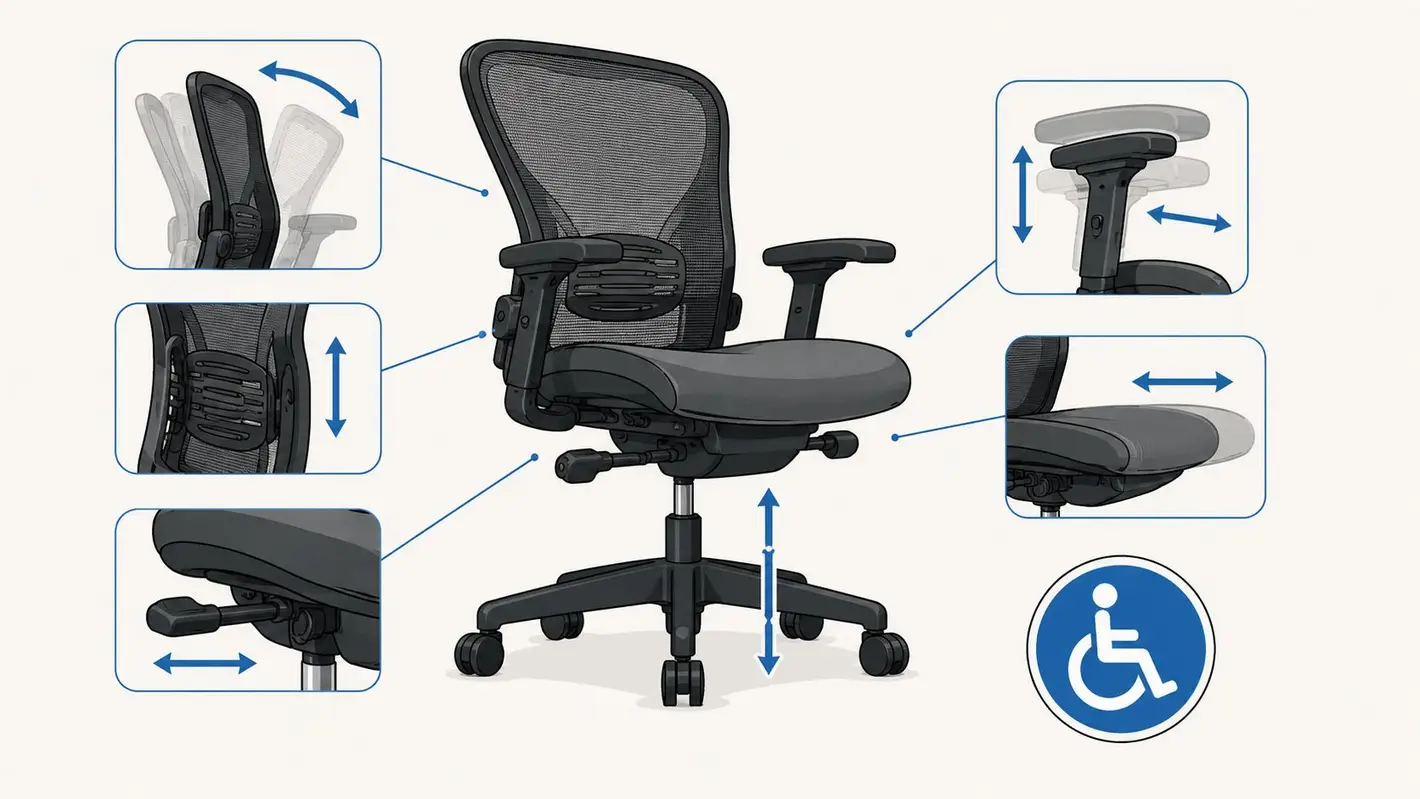
The practical reason is simple. Different bodies need different clearances, and different tasks ask for different posture support. A chair used for reading may feel fine with a relaxed recline, while a chair used for laptop work usually needs more upright support and more precise arm positioning.
A few design priorities make a chair more universally useful:
- Seat adjustment: helps align the thighs and feet.
- Depth adjustment: helps support shorter or longer legs.
- Armrest height: helps keep shoulders from lifting.
- Back support: helps the spine stay comfortable over time.
For readers who want a deeper posture reference, the PosturaZen guide to correct sitting posture offers useful context on body alignment during seated work. That kind of reference is especially helpful when a chair is being chosen for long computer sessions or a shared family office.
How to Measure Chairs and Room Space
The easiest way to avoid a return is to measure the chair and the room before the purchase. A tape measure and a notepad can save a lot of second-guessing later.
Start with the chair itself. Measure seat width, seat depth, seat height, and overall height, then check the arm height if the chair has arms. If the chair is already in the home, measure the space it occupies when pulled out from the table, not just the size of the cushion.
Then measure the room. Look at the distance from the table edge to walls, buffets, fireplaces, or door swings. If the chair sits in a narrow path, that walking lane needs to stay open even when someone is seated or getting up.
A simple process works well:
- Measure the seat first: write down width, depth, and height.
- Measure the table clearance: check how far the chair slides in.
- Measure the surrounding path: make sure people can pass without squeezing.
- Measure door and drawer movement: avoid hidden conflicts with cabinets or entryways.
One common mistake is forgetting the chair's movement zone. A dining chair may fit tucked in, but once a person pulls it back, it can take much more room than expected. That's why in-home measuring matters as much as showroom measuring.
For a practical walkthrough, use how to measure a room for furniture before heading to the store. If the measurements are written down clearly, a design team can help match the chair to the room with less guesswork and less stress.
Conversion Chart and Quick Reference Tables
A quick reference helps when the shopping trip gets busy or when a room measurement sits in one unit and the product tag sits in another. The chart below brings the key chair types into one place so the fit can be compared at a glance.
| Chair Type | Seat Width (in/cm) | Seat Depth (in/cm) | Seat Height (in/cm) | Arm Height (in/cm) | Overall Height (in/cm) |
|---|---|---|---|---|---|
| General adult seating | 16 to 20, 40.6 to 50.8 | 15 to 18, 38.1 to 45.7 | 16 to 18, 40.6 to 45.7 | 7 to 9 above seat, 17.8 to 22.9 above seat | Varies by style |
| Dining side chair | 19, 48.3 | 19, 48.3 | 18, 45.7 | Varies by style | 36, 91.4 |
| Dining arm chair | 24, 61.0 | 18, 45.7 | 18, 45.7 | Varies by style | 36, 91.4 |
| Adjustable office chair range | Varies by model | Varies by model | 14.8 to 20.2, 37.6 to 51.3 | Varies by model | Varies by model |
| Adjustable office chair range | Varies by model | Varies by model | 15 to 22, 38.1 to 55.9 | Varies by model | Varies by model |
The chair type matters as much as the number. A dining chair and an office chair may both be called “standard,” but they solve different posture problems and fit different spaces.
The most useful habit is to compare the seat height first, then look at width and depth. If the seat height is wrong, the rest of the dimensions rarely save the fit.
Local Design Services and Next Steps
Standard dimensions are a starting point, not the whole plan. A home gets more comfortable when the chair size, table height, walking space, and how a family lives in the room all work together.
Guynn Furniture & Mattress has served the region since 1902, and that history matters because furniture decisions are easier when local people are helping with the details. The team can help apply dimension charts to real rooms in Galax, Independence, Hillsville, and throughout Southwestern Virginia and Northern North Carolina, whether the need is a dining set, a desk chair, or seating for a multi-use family room.
A helpful next step is a design conversation with Debra Williams or the expert design staff when the room feels tricky. That support can make the difference between a chair that merely fits on paper and a chair that works well in the home.
A few practical reasons to connect locally:
- Free in-home delivery and setup within 60 miles keeps the setup process simple.
- Free Price Promise support helps when budget matters, because local competitors' advertised pricing can be matched or refunded within 30 days.
- Large in-stock selection gives families a chance to get seating sooner instead of waiting around for an online-only shipment.
Guynn Furniture & Mattress also carries familiar comfort-focused names, including La-Z-Boy, Ashley, Bassett, Sealy, and Therapedic, which gives shoppers a place to compare styles in person. That makes it easier to sit down, check the dimensions, and choose with confidence.
Visit our showrooms in Galax, Independence, or Hillsville to test the comfort for yourself. Schedule a consultation with our design team to start planning your dream room today. Browse our selection online at guynnfurniture.net. A CTA for Guynn Furniture & Mattress.