


How to Pick a Mattress for Back Pain


Three in five people had woken up experiencing back pain, according to the 2024 Sealy Global Sleep Census, conducted by Quantum Market Research among more than 20,000 people worldwide. That finding doesn't mean every sore back needs a new mattress, but it does challenge the idea that morning discomfort is unusual.
Learning how to pick a mattress for back pain starts with a practical correction: for everyday, nonspecific low-back pain, begin around medium to medium-firm, not automatically with the hardest bed. Then judge the mattress as part of a complete sleep setup, with enough time to test comfort rather than guess from a label.
Start With Your Sleep Position
A mattress can feel comfortable while someone sits on its edge and feel entirely different once the shoulders and hips settle into it. The useful question isn't whether a bed feels soft or firm. It's whether the surface supports the sleeper's usual position without creating pressure.
Support and firmness aren't the same thing. Firmness describes the surface feel. Support describes how well the mattress holds the body without letting heavier areas drop too far.
Where to start by sleep position
Shoppers should use the row matching the position they spend most of the night in. Someone who briefly reads on their back but sleeps on their side should shop primarily as a side sleeper.
| Sleep position | Firmness to start | Alignment check | Pressure points |
|---|---|---|---|
| Side | Medium with a softer top | Spine level from shoulders to hips and waist not sagging | Shoulder and hip |
| Back | Medium | Low back filled in and pelvis not in a hammock | Lumbar area |
| Stomach | Medium-firm to firm | Hips not sinking and low back not arched | Abdomen and low back |
| Combination | Medium and responsive | Easy to turn and alignment holds in each position | Shoulder, hip, and low back |
For side sleepers, cushioning needs to accommodate the shoulder and hip while support remains beneath the waist. A surface that barely yields may leave the shoulder compressed; a surface that is very plush may let the pelvis drop. The side-sleeper mattress guide offers a closer look at that balance.
Back sleepers need gentle contact beneath the lower back without the pelvis settling into a hollow. Stomach sleepers generally need more resistance beneath the hips, but an uncomfortable surface isn't helpful because it's firm.
Combination sleepers have an additional requirement: easy movement. A mattress that feels pleasant when still may become frustrating if rolling requires pushing out of a deep impression.
Use position as a filter, not a diagnosis
For households sorting out different sleeping preferences, The Sleep Consultant offers a useful resource to compare side and back sleeping. Position information can help narrow the showroom choices, but it can't identify the cause of back pain.
Consider a side sleeper whose shoulder aches on a rigid mattress. Adding surface cushioning may make sense, but only if the underlying support keeps the waist from dipping. Choosing the softest available bed skips that second requirement.
Practical rule: The best starting mattress lets prominent areas settle while supporting the spaces between them.
There's also a clear stopping point. Progressive weakness, radiating pain or numbness, fever, major trauma, bowel or bladder changes, or unexplained weight loss call for medical evaluation, not a mattress errand. Sudden bowel or bladder changes or rapidly progressing weakness warrant urgent care.
How to Test a Mattress for Your Back
Firmness labels aren't standardized across brands. A medium in one collection can feel noticeably different from a medium in another. The mattress firmness guide can help translate the terminology, but the lie-down should decide.
A showroom visit works best when it follows a repeatable routine. Otherwise, shoppers can end up comparing whichever mattress they tried most recently with an increasingly fuzzy memory of the others.
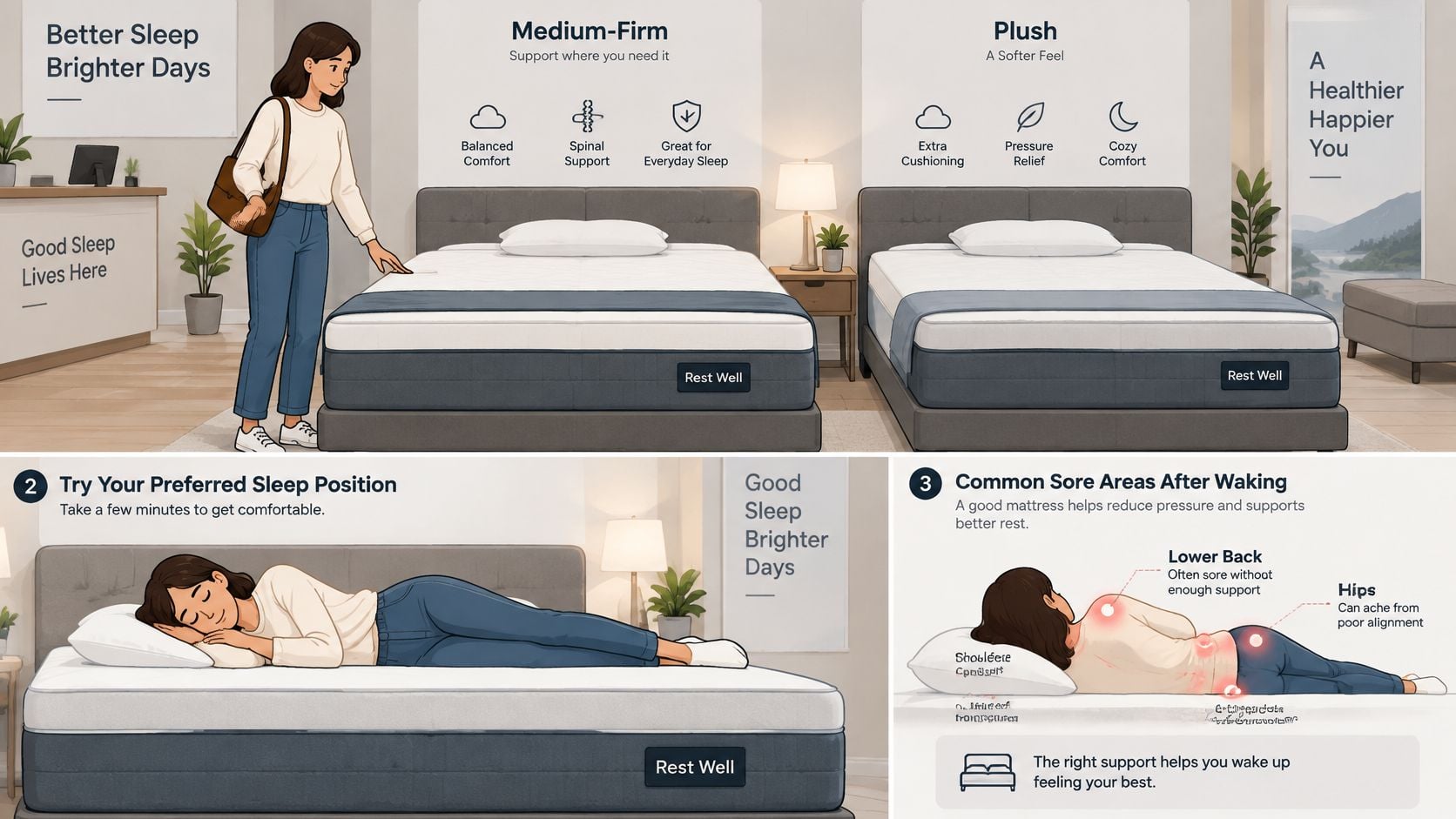
Follow a consistent showroom routine
Name the usual position and morning symptoms. Before lying down, identify whether discomfort centers on the lower back, shoulder, hip, or another area. Describe when it appears, too: during the night, while getting up, or after moving around.
Begin with medium or medium-firm models. In a randomized, double-blind trial of 313 adults, medium-firm mattresses produced better outcomes than firm mattresses over 90 days, with odds ratios of 2.36 for pain in bed, 2.10 for disability, and 1.93 for pain on rising; a practical showroom assessment should include at least 10–15 minutes in the intended sleep position. Those odds ratios aren't percentages of pain relief, and the confidence interval for pain on rising included no difference.
Settle into the actual sleeping position. Stay still rather than repeatedly bouncing or changing poses. Let the comfort layers respond before deciding whether the mattress feels supportive.
Watch the pelvis relative to the shoulders. A pronounced dip beneath the hips suggests that the surface may allow too much sink. A showroom helper can observe this more easily than the person lying down.
Ask someone to inspect the trunk. A companion should look for an obvious bend or sag rather than attempt a medical assessment. Clothing should be comfortable enough that the body's resting shape isn't hidden by a bulky coat.
Check side-sleeping pressure. The shoulder and hip should settle without sharp pressure, tingling, or a sense of being perched above the mattress. The waist shouldn't hang unsupported between them.
Check back-sleeping contact. The lower back should feel supported without being pushed into an exaggerated arch. A pelvis that sinks into a hollow is a different problem from a surface that feels pleasantly cushioned.
Sit, stand, and transfer. Test the edge where getting out of bed will happen. This matters especially for older adults or anyone who needs a stable place to pause before standing.
Notice movement, warmth, and the perimeter. Have a partner shift position, roll toward the edge, and check whether changing positions feels awkward. A brief visit won't reproduce a full night's temperature, but immediate discomfort still matters.
Record the result before moving on. Write down the model, comfort level, pressure spots, and ease of turning. Specific notes such as “shoulder comfortable, hips too low” are more useful than “pretty good.”
Interpret comfort without expecting a cure
The trial supports starting with balanced firmness, not prescribing the same mattress to every shopper. Its participants had chronic, nonspecific low-back pain, so the results shouldn't be stretched into a treatment recommendation for every spinal condition.
A mattress can also pass one test and fail another. Comfortable pressure relief doesn't make up for difficult transfers, and a stable edge doesn't compensate for painful shoulder pressure.
A promising showroom mattress should feel comfortable while resting and manageable while moving.
A short lie-down can't predict the first month at home. Before payment, the household needs written trial, exchange, and warranty terms, not an assumption that an uncomfortable mattress can automatically go back.
Memory Foam Hybrid Latex and Innerspring
Construction matters after the sleeping-position filter is set. A systematic review covering 39 qualifying studies associated medium-firm mattresses with improved comfort, sleep quality, and spinal alignment, but didn't identify one material as the answer for every sore back.
Mattress types for a sore back
| Type | Feel | Often helps | Watch-out |
|---|---|---|---|
| Innerspring | Bouncy and cooler | Back sleepers who want push-back and a strong edge | Can feel too hard at the shoulder and hip |
| Memory foam | Slow contour and hug | Side sleepers who need pressure relief | Heat and a deep sink that misaligns a heavier body |
| Hybrid | Coils plus a foam or latex top | Combination sleepers and couples | A thick pillow top can sag early |
| Latex | Responsive and buoyant | Shoppers who want alignment with less sink than memory foam | Higher price and a springy feel some people dislike |
Innerspring provides a more immediate push-back, while memory foam allows a slower, closer contour. A hybrid divides those jobs between its support core and comfort layers.
Latex generally feels buoyant rather than enveloping. Shoppers who dislike sinking may prefer that response, although the springiness isn't universally comfortable.
Guynn Furniture & Mattress recommends memory foam or hybrid mattresses for back support. That recommendation still needs the showroom test: construction alone can't establish whether a particular model suits a particular sleeper.
Pair the Mattress With the Whole Bed
Firmness alone doesn't determine morning comfort. A supportive mattress can still be uncomfortable when paired with an unsuitable pillow, an incompatible base, or a bed height that makes standing difficult.
An adjustable base is an optional part of that system, not a back-pain treatment. Its value depends on whether changing position improves comfort without creating another problem.
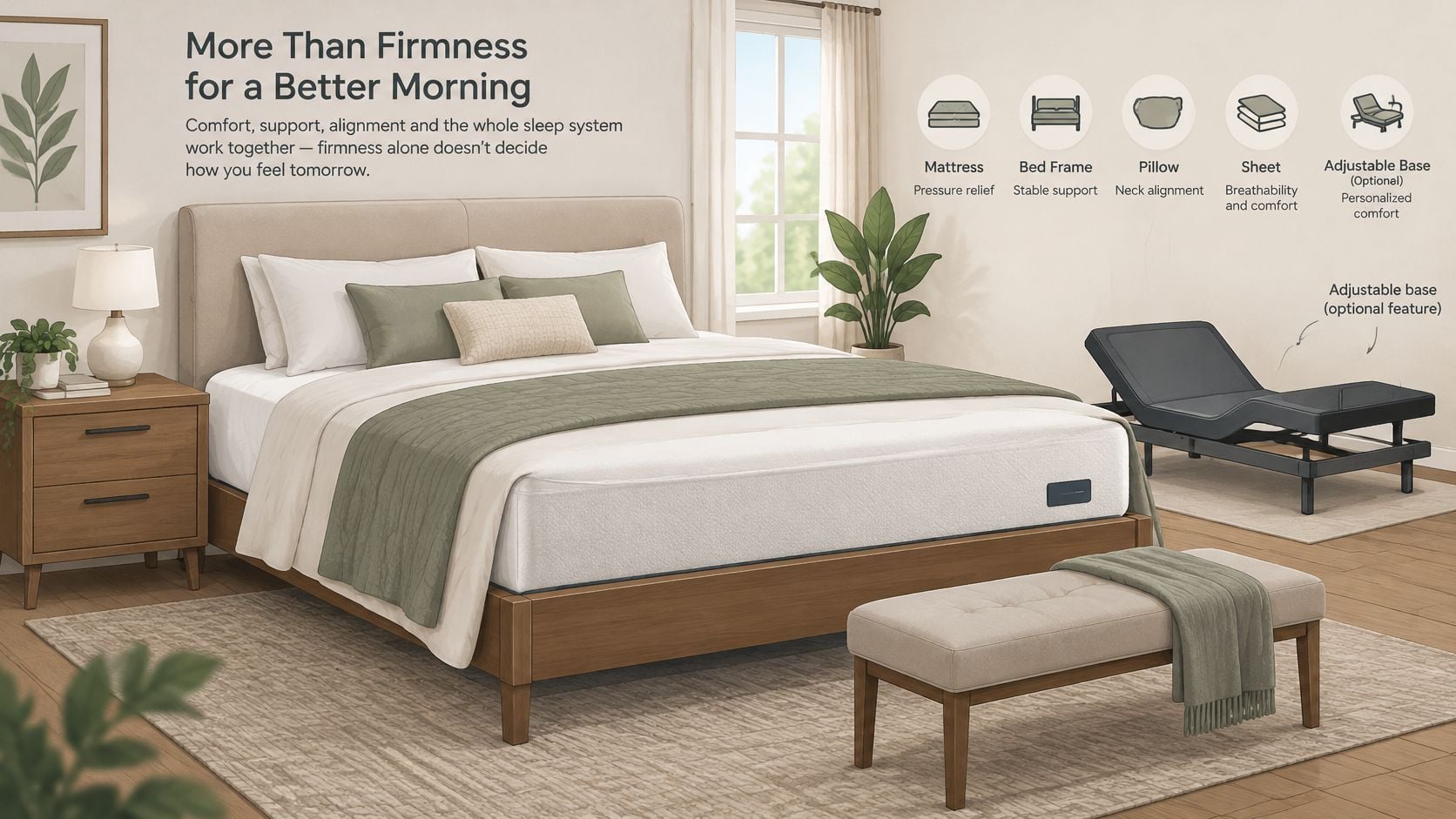
What adjustability can and can't establish
A 2025 academic conference report published in Sleep reported 15% better perceived sleep quality, 18% greater morning restfulness, and 28% less perceived back pain among participants using an adjustable base. These are encouraging self-reported findings, but they're early evidence, not proof that adjustable bases treat back pain.
For a back sleeper, gently raising the knees may ease the pull through the lower back. A slight head elevation may also feel comfortable, provided the pillow and base together don't curl the neck forward.
A split king or split California king can allow partners to choose different angles. That can help when one person prefers a raised position and the other wants to remain flat, but the household should test the center division and bedding arrangement.
Compatibility comes first. A mattress must be approved for the intended adjustable base; it shouldn't be forced to bend just because it fits the frame. For stationary setups, the box spring versus foundation guide helps clarify the support underneath the mattress.
Check the complete setup
- Pillow height: Side sleepers generally need enough height to fill the shoulder-to-head gap. Stomach sleepers usually need a thinner pillow so the head isn't pushed farther backward.
- Edge support and bed height: The complete bed should allow stable sitting and a controlled rise. A taller mattress on a taller base can make transfers harder rather than easier.
- Temperature: Hot sleepers should test the cover, protector, sheets, and bedding together where possible. A cool-feeling showroom surface doesn't guarantee comfortable overnight temperature.
- Partner movement: One partner should change position while the other rests. Separate preferences may require a different setup rather than a compromise neither person likes.
- Home testing: Confirm whether any available trial covers the mattress, base, or both. An exchange option for one component doesn't automatically apply to the whole bed.
Say a back sleeper feels comfortable with the knees raised but slides toward the foot when the head rises. More elevation isn't necessarily better. The useful setting is the one that allows relaxed support without sliding, bracing, or neck strain.
Comfort check: An accessory should solve a specific problem, not create a reason to buy another accessory.
An adjustable base is a poor fit when the mattress isn't compatible, the sleeper can't reposition safely, or the chosen angles make symptoms worse. People with relevant medical conditions or mobility restrictions should discuss positioning with a clinician before relying on elevation.
Persistent or worsening pain still needs clinical attention. Another pillow, topper, or powered adjustment shouldn't become a substitute for finding out why symptoms continue.
Trials Warranties and When to Replace
An older mattress with a visible hollow or uneven support deserves a replacement comparison before another topper. A topper changes how the surface feels; the weakened support underneath keeps doing what it was doing, like fresh paint over a cracked wall.
In a 28-day study involving 62 people, participants generally slept better on new beds after replacing mattresses averaging 9.5 years old, and those assigned the least expensive beds reported more lower-back pain than those using medium- and higher-priced beds. The researchers emphasized the role of newness itself, and the price pattern suggests a middle path: a reasonably made bed serves most backs better than the cheapest option on the floor. Treat roughly a decade of use as a prompt to inspect your mattress rather than a countdown to the showroom.
Decide whether the old mattress still supports sleep
A mattress that looks reasonably flat can still feel uneven under a sleeper's weight. A visible surface impression can also be harmless padding settling, so judge how the bed behaves, not only how it looks.
The signs that a mattress needs replacing can help a household tell a tired bed apart from a comfort preference that has changed. The strongest practical reasons to compare replacements are a persistent sag, uneven resistance, difficult repositioning, or morning discomfort that keeps getting more noticeable.
When comparing replacements does begin, medium firmness makes a sensible first test. The firmest model on the floor can create its own pressure points at the shoulders and hips, so start in the middle of the range and let your body vote on firmer or softer.
A temporary change can provide useful information without proving a diagnosis. Consistently sleeping more comfortably elsewhere may justify inspecting the home mattress and base, yet the mattress may still share the blame with the pillow, the base, or the sleep position itself.
Get the purchase terms in writing
Before committing, shoppers should work through a clear checklist:
- Trial length: Establish whether a home trial exists, when it begins, and whether any minimum-use period applies.
- Return costs: Identify who pays collection or return shipping and whether any handling charges apply.
- Exchange eligibility: Confirm whether a mattress used at home can be exchanged, and whether the replacement has its own conditions.
- Base requirements: Check which supporting frame or foundation the mattress needs and whether existing equipment qualifies.
- Warranty process: Keep the receipt, product identification, and written care requirements together.
- Bedding condition: Soiled or damaged bedding can't be returned, so a suitable protector should go on before the first night.
A warranty and a comfort trial serve different purposes. A warranty covers structural defects in the product. Whether a mattress turns out to suit your back is a separate question, handled through the trial and exchange terms where they exist.
Guynn Furniture & Mattress warrants mattresses and box springs against structural defects such as broken wood frames, springs, and border wires. Body impressions in bedding with multiple padding layers count as normal wear rather than a defect.
Normal padding compression and failed structural support aren't interchangeable. The written warranty determines how a suspected defect is assessed.
Make the test day useful
Comfortable clothes make it easier to settle naturally. Bringing the usual pillow reduces the chance of choosing a mattress based on an unfamiliar head-and-neck position.
A visit during the part of the day when ordinary stiffness is most noticeable may help a shopper describe what feels better or worse. There's no need to provoke severe pain to make the test meaningful, and the warning signs covered alongside sleep position still apply if symptoms feel unusual.
Lie still long enough to notice pressure rather than judging from the initial bounce. Then test the mattress the way it will live at home: on a compatible base, with a protector fitted, long enough for the surface to warm up. A mattress only performs as part of the whole setup, so the trial that matters is the one conducted with all its parts in place.
Test Comfort in a Local Showroom
A mattress can feel comfortable for a minute and still prove awkward after a longer rest. In a showroom, test how easily you settle into your usual sleep position, turn over, and get up.
Bring the checklist, not a predetermined answer
Start with your main sleeping position, what feels uncomfortable on your current mattress, and any practical limits at home. For example, note if a low bed is hard to get up from or if you and your partner prefer different comfort levels.
The local mattress showroom guide can help you plan a visit. Bring notes so you can compare models against the needs of your bedroom, rather than relying on a quick first impression.
- Compare comfort consistently: Use the same pillow and resting position on each mattress you're considering.
- Describe daily needs: Mention difficulty getting in or out of bed, a restless partner, or a preference for a particular feel.
- Consider the room layout: Ask about access around the bed and how the setup will fit with other furniture.
- Plan delivery or pickup: Guynn Furniture & Mattress offers free in-home delivery within 60 miles of any location. Customer pickup is available by appointment.
Keep the household budget clear
If the bed base or bedroom arrangement also needs attention, compare the cost of the complete setup. That gives you a clearer picture than focusing on the mattress price alone.
Guynn Furniture & Mattress offers interest-free financing, subject to credit approval. Its Price Promise allows shoppers to contact the business about a lower price in the local retail area, and it matches a lower price for the same product from a local competitor on the spot.
The goal is a setup that suits your sleep position, feels manageable to move on, and fits your budget. A showroom visit lets you test those details before choosing.
Guynn Furniture & Mattress has mattress options from brands including Sealy and Serta, along with an online catalog to browse before a visit. If you're shopping in person, use your notes to guide a focused comparison and ask questions about how each option may fit your needs.


