Buffet Credenza Sideboard Guide: Sizes, Styles, Placement


What good is a beautiful buffet if the serving platter won't fit inside, the drawers block a dining chair, or the cabinet rocks on the rug? Those everyday checks matter more than whether the tag says buffet, credenza, or sideboard.
Furniture shopping can feel overwhelming, especially when similar-looking cabinets carry different names. A practical approach starts with what the household needs to store, then considers measurements, construction, placement, and safety before choosing a finish.
What Buffet, Credenza and Sideboard Really Mean
All three names describe closely related long, low cabinets for dining rooms or living rooms. The differences lie in intended use, proportions, and regional vocabulary.
The three terms work like regional names for the same dish: the recipe stays consistent even when the label changes. A cabinet with doors below and a serving surface on top earns any of these names depending on who wrote the price tag and where the piece is meant to live.
The modern sideboard developed from earlier European serving furniture and became a distinct dining-room form during the 18th century, when designers introduced hollow storage pedestals and drawers for napkins and cutlery, according to Encyclopaedia Britannica's history of the sideboard. Today's cabinets keep that same working combination of serving surface, concealed storage, and display space.
A household might keep dishes behind cabinet doors and folded table linens in drawers. During a family meal, the top holds serving bowls; afterward, it displays a lamp and framed photographs. A retailer might call that piece a buffet or a sideboard without changing how the family uses it.
Buffet, credenza and sideboard compared
| Term | Typical Use | Defining Trait |
|---|---|---|
| Buffet | Serving and dining | Broad top for food service with enclosed storage |
| Sideboard | Dining room storage and display | Cabinet-based dining piece with cupboards or drawers |
| Credenza | Storage in dining or living rooms | Low profile, usually under 36 inches high, with clean-front doors or drawers |
| Buffet credenza | Serving, storage and display in one piece | Combines all three functions |
The same cabinet can look at home in several settings.
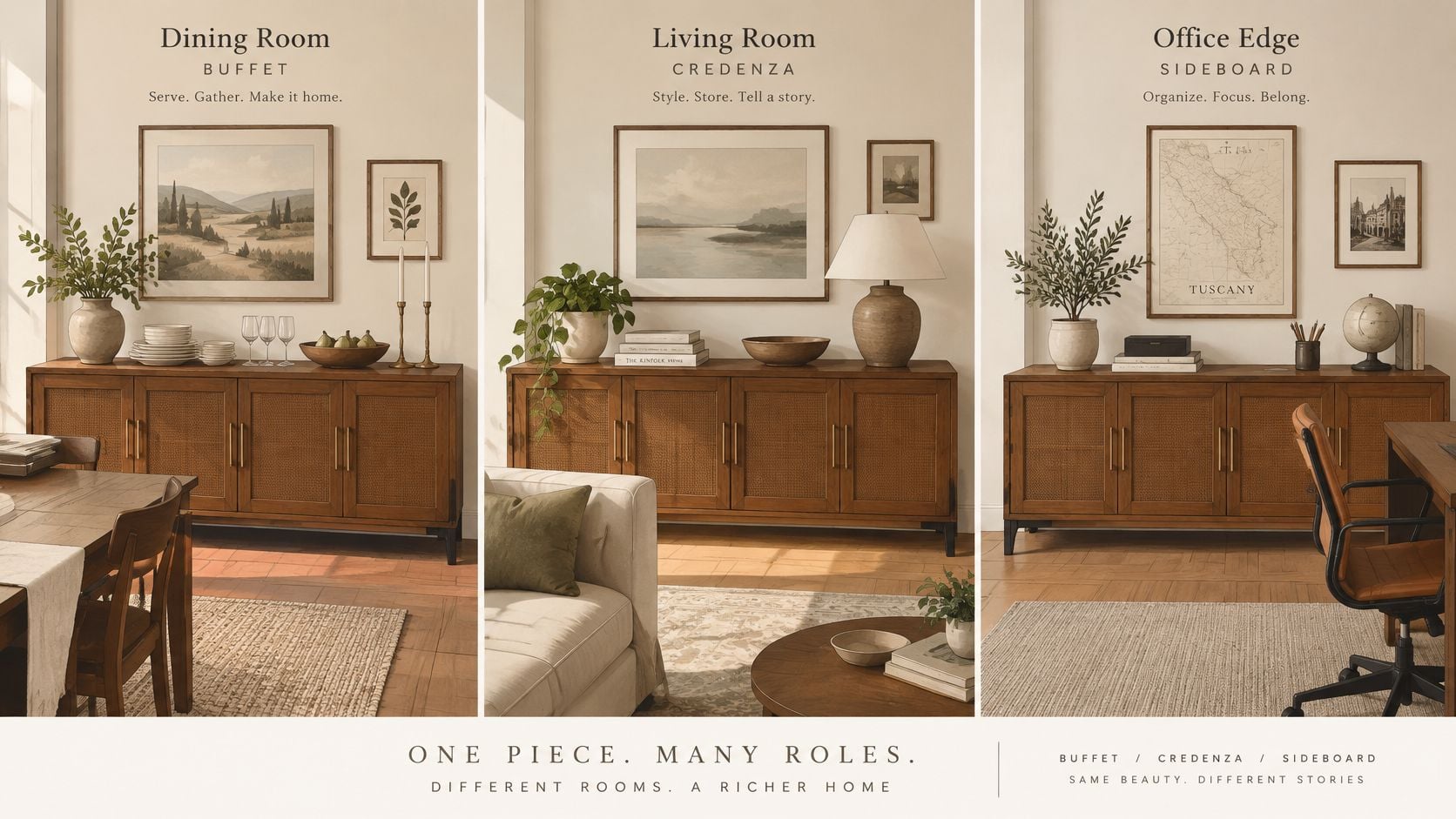
Read the Features Before the Label
A dining-focused buffet should make serving convenient. A living-room credenza might need cable access for media equipment, while a cabinet used in a workspace needs usable compartments for supplies or files.
Carved fronts, plain wood doors, and metal accents appear across all three names, so styling alone rarely settles which term a retailer chooses. What separates a helpful cabinet from a frustrating one shows up in daily use: drawers that open past a pulled-out chair, doors that swing without striking the wall, and shelves sized for the dishes the household owns.
Weight matters too. A cabinet loaded with stoneware and glassware sits very differently on a rug than an empty one, and that changes how steady it feels when drawers slide open. When comparing a buffet credenza sideboard, the usable interior and the fit against the wall matter more than the product name.
Typical Sizes and Heights for Each Style
A cabinet's footprint decides more than whether it fits the wall. It controls how much walking room the family keeps, how far serving dishes travel to the table, and whether the piece can reach the room at all. The table below gathers typical measurements you'll encounter across dining and living room cabinets.
| Style | Width | Depth | Height | Best Room |
|---|---|---|---|---|
| Compact sideboard | 45–54 in | 15–18 in | 30–36 in | Small dining rooms |
| Standard sideboard | 60 in | 16–20 in | 30–36 in | Most dining rooms |
| Long buffet | 72 in | 18–22 in | 30–36 in | Large dining rooms and open plans |
| Buffet-height cabinet | 60–72 in | 18–20 in | About 40 in | Serving and display |
| Low credenza | 60–72 in | 16–18 in | Below the dining-height range; confirm on the product spec sheet | Living room media and storage |
These figures are comparison profiles. Makers vary, and a low credenza's height deserves a product-specific check rather than an assumed number, because it sets where the top surface lands relative to a seated viewer.
A compact cabinet leaves more visible wall space in a smaller dining room. A standard sideboard gives a balanced starting point, while a long buffet suits a larger wall where serving dishes can spread across a broader surface. Depth is the measurement people underestimate: every added inch projects into the walkway that carries traffic between the table and the rest of the house. Height carries a quiet safety angle too. A taller, narrower cabinet holds its weight higher, so its stance and wall contact deserve a second look before the shelves are loaded.
Measure the Journey, Not Just the Destination
Delivery access can rule out a cabinet that fits perfectly in the room. ItemFits' sideboard delivery guide describes an upright corner turn requiring nearly 40 inches of hallway width for a long cabinet, compared with about 27 inches when the cabinet is tipped onto an end.
Rotating a cabinet is a judgment call, though. Glass doors, stone tops, fixed legs, and the manufacturer's handling instructions may restrict how a delivery team can move it.
- Trace the route: Include the entrance, hallway, stairs, landings, and tight turns.
- Record obstructions: Measure around handrails, light fixtures, door hardware, and trim.
- Check handling options: Confirm whether legs or shelves are removable before assuming they come off.
A furniture measuring guide walks through recording each doorway, turn, and clearance before delivery day.
Practical rule: Choose depth for everyday movement through the room, and choose width in proportion to the available wall.
Choosing Drawers, Doors or Shelves for Your Storage Needs
A 13-inch serving platter will not rest flat in a cabinet listed at 15 inches deep. The back panel, door thickness and hinges each claim part of that figure, so the interior measurement is the one that decides whether a layout works.
Storage deserves attention before appearance. Grand View Research's U.S. homeware market overview reports that 46% of Americans identify insufficient storage as a challenge to keeping the home organized, while 38% organize partly so the home looks good for guests.
A cabinet should make putting things away easier instead of forcing the household to reshuffle everything for one serving bowl.
Storage layouts and what they hold best
| Layout | Best For | Trade-off |
|---|---|---|
| All drawers | Linens, flatware and small servingware | Heavier to load and drawers extend forward into the walkway |
| Doors with adjustable shelves | Dinnerware, platters and stacked bowls | Shelves need height planning and dust control |
| Mixed drawers and doors | Dishes in cabinets, flatware and linens in drawers | Can cost more and needs careful loading |
| Open center with side cabinets | Display pieces and serving bowls | Less enclosed storage |
| Media-ready with rear vents | Receivers, consoles and cable boxes | Needs ventilation and cable access |
Check Usable Space Inside
The number on a spec sheet describes the cabinet's outer shell. Interior space runs smaller once the back panel, door thickness, hinges and drawer box take their share, so measure each platter across its widest point, handles included, and compare it against the inside dimension.
Adjustable shelves make room for tall pitchers or stacked bowls. They can raise the price, though construction, finish and hardware quality often matter more to the final figure than the shelf hardware itself.
Clearance matters at the front of the cabinet too. An open drawer or a swung door reaches into the walkway, so leave enough room in front for both the hardware and the person using it.
Drawers deserve a hands-on test. They should move smoothly without twisting, and their rated capacity should suit the intended contents. Neasden Hardware's explanation of smooth-gliding runners for kitchen drawers offers helpful background on runner types when comparing drawer mechanisms in storage furniture.
For electronics, rear openings alone do not ensure adequate cooling. Equipment instructions should determine ventilation space, and cable plugs must fit without being crushed against the back.
Sort the Largest Items First
List the five largest items intended for the cabinet, then note their dimensions and how often they're used. A wide platter, a tall appliance, and a stack of games demand different compartments.
Guynn's dining storage selection guide can help organize those priorities. The best layout is the one that holds the awkward items while keeping everyday essentials easy to reach.
Solid Wood, Veneer and Metal Materials That Hold Up
Crouch down and look at the screws holding the top in place before you admire the finish. The fasteners reveal more about long-term suitability than a thick-looking top or a dark stain.
Solid hardwood offers traditional character and can often be refinished, depending on its construction and finish. It also gains and loses moisture as indoor conditions change, so good joinery must accommodate that movement rather than fight it.
Purdue University Extension's wood movement guidance explains that a 6-percentage-point moisture-content change in sugar maple can produce approximately 2.5% dimensional change and recommends allowing about 2% in-service wood movement in conservative design. As an extreme cross-grain comparison, that dimensional change across a 60-inch solid-wood component could approach 1.5 inches, although actual movement depends on grain orientation, species, construction, and room conditions.
Look Under the Top
Elongated screw slots and figure-eight fasteners can secure a solid top while allowing movement. Properly designed breadboard ends and floating panels serve a similar purpose in appropriate assemblies.
A top rigidly fastened across its grain places stress on the wood and joints as seasons change. Thick tops still need elongated screw slots or floating attachment hardware to move with the wood.
The main material choices have different strengths and care needs.
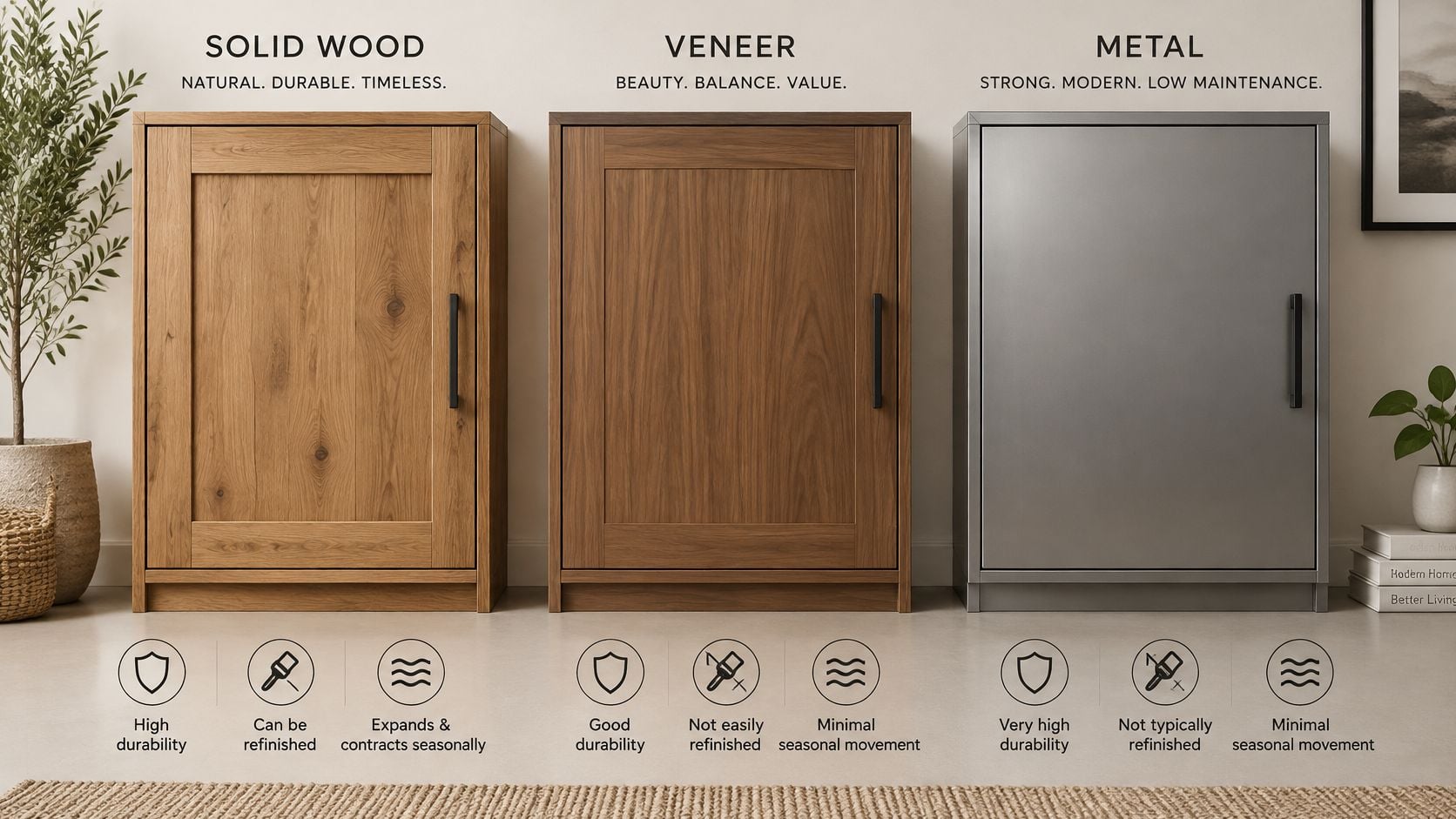
Veneer over plywood or MDF can provide attractive wood grain on a dimensionally stable substrate. Thin veneer does chip along exposed edges and cannot tolerate deep sanding, so check that corners and door fronts have protective banding before you commit.
Metal frames create a different appearance and should be checked for sound joints, even finishes, and secure connections. Glass needs protected edges, while stone adds substantial weight that must be considered alongside the cabinet's construction and loading instructions.
Compare Construction and Care
- Identify the case: Ask which parts are solid wood, veneered panels, or engineered wood.
- Inspect attachment details: Look for hardware that accommodates a solid top's movement.
- Clarify repairs: Determine whether the finish can be touched up and whether replacement hardware is available.
Guynn's hardwood construction and longevity guide offers additional terminology for comparing wood furniture.
A well-built veneered cabinet can be a sensible long-term choice when its edges are banded and its hardware holds firmly.
For daily care, wipe spills promptly and use protective mats beneath hot or wet serving dishes. Follow the finish manufacturer's cleaning instructions rather than assuming every wood surface needs oil or polish.
Where to Place It in Dining and Living Rooms
A sideboard earns its floor space only if the room still works around it. Measure clearances before committing to a wall: keep at least 36 inches between the cabinet front and the nearest table edge, chair, or opposing furniture, and allow 42–48 inches where that gap doubles as a traffic route through the room.
Clearance is about people in motion. A chair pulled back so someone can stand extends well beyond its tucked position, so test the gap with seating in use rather than against an empty room.
Dining Room Placement
The longest uninterrupted wall is often a useful starting point. Centering a cabinet there creates visual balance, and the spot should also keep serving dishes within reach without forcing guests to squeeze behind occupied chairs.
Drawers you open mid-meal deserve special attention. Position them away from the busiest seat, because a cabinet that reads as balanced before dinner can become a bottleneck once everyone sits down. Guynn's dining room decorating ideas show how storage placement can work alongside lighting, wall art, and the dining table without crowding the room.
Living Rooms and Transitional Spaces
A credenza along a living room wall can hold books, household supplies, or suitable media equipment. If you slide a sofa forward to improve the arrangement, confirm the shift hasn't stolen clearance from a walkway elsewhere in the room.
Entry cabinets need a different test. The front door must swing its full arc without striking the piece, arriving guests need somewhere to stand, and open cabinet doors shouldn't trap anyone against the entrance.
For a larger remodel, Task Masters Inc.'s discussion of how to design a home around your needs offers useful context for planning around household routines rather than decorative symmetry alone.
Protect the Location
Placement also affects the furniture itself. Smithsonian Museum Conservation Institute guidance identifies temperature and humidity fluctuations as causes of dimensional movement in wood, so keep wooden cabinets away from direct fireplace heat, radiators, strong heating vents, persistent moisture, and intense sunlight. A cabinet parked against a heat register can develop gaps or warped panels over time, even when the joinery is sound.
Before settling on a position:
- Sit down: Pull each nearby chair back as it would be used during a meal.
- Open the cabinet: Check the full travel of doors and drawers.
- Walk the route: Carry a serving tray through the space and notice pinch points.
Painter's tape can mark the footprint before delivery, and cardboard laid within that outline makes the cabinet's depth easier to judge. Ten minutes of taping beats an afternoon of rearranging.
Preventing Tip-Overs in Homes with Kids and Pets
A 60-inch sideboard with a fully loaded top drawer can tip forward when a child pulls on the handle. Low height alone never guarantees stability. Base width, backing, floor conditions, drawer configuration, and loading all decide how a cabinet behaves under stress.
The U.S. Consumer Product Safety Commission's furniture-tip-over briefing describes ASTM F2057 testing procedures that assess an empty unit with drawers opened to their operational limits and a 50-pound load applied to a fully extended drawer, one drawer at a time. This standard covers the test method, not every dining sideboard.
Extended drawers shift the center of gravity forward, the same way a tray grows harder to balance the farther it moves from your hand. Heavy upper contents or a television on top push that balance point in the same direction.
Make Installation Part of the Purchase
- Anchor securely. Use the manufacturer's restraint hardware or a properly rated anti-tip system attached to a wall stud or another approved structural fixing.
- Inspect the structure. Choose a broad, stable base and sturdy backing that supports the specified restraint attachment.
- Load from the bottom. Place heavy dishes, cookware, and serving pieces in the lowest compartments without exceeding shelf limits.
- Check the floor. Carpet, rug edges, and uneven boards can make a cabinet lean or rock. Use manufacturer-approved leveling adjustments.
- Plan for rental restrictions. Obtain permission for a suitable restraint installation. An adhesive-only device does not equal a structural anchor; if secure anchoring isn't possible, choose a different storage arrangement.
- Remove climbing temptations. Keep toys, remotes, and attractive objects out of sight rather than encouraging children to reach upward.
Safety reminder: Delivery and placement rarely include structural anchoring. Confirm who will install the restraint and how it will attach before the cabinet is used.
The Australian product-safety guide to toppling furniture specifically includes buffets and sideboards among furniture that can topple. U.S. and Australian guidance both support anchoring furniture and keeping heavier items low.
Apply the Same Thinking Beyond Dining Furniture
A tall chest of drawers faces the same physics in a bedroom, and Guynn's guide to choosing a five-drawer chest helps when comparing drawer-heavy storage elsewhere in the home. Rules about climbing work best after secure installation is already in place, since children and pets pull, jump, and collide with furniture faster than any reminder can stop them.
Visit Guynn to Test Your Next Buffet Credenza
A showroom visit goes faster when the cabinet is judged as a working storage piece, not a style label. Bring a phone photo of the room, a simple sketch, and measurements. Then check clearance the way a door hinge does: leave room for door and drawer swing, baseboard projection, nearby chairs, and the small reveal solid wood needs as it expands and contracts with seasonal humidity.
Bring a Short Checklist
- Room and route measurements: Include the intended wall, nearby furniture, entrance, stair turns, and any tight delivery corners.
- Storage priorities: Carry the largest-item list and decide whether drawers, doors, or mixed compartments suit the household.
- Installation details: Note wall construction, baseboard projection, flooring, outlet locations, and any restrictions on anchoring.
- Finish references: Photographs or samples of nearby flooring and furniture make color and sheen comparisons easier.
Testing should go beyond looking at the front. Open every door, pull each drawer to its stop, examine shelf adjustment points, and check whether handles are comfortable to grasp. For households with limited hand strength, a handle's shape can matter as much as its appearance.
Local Guidance Without Pressure
At Guynn Furniture & Mattress, family-run since 1902 and serving Galax, Independence, Hillsville, and the wider Southwestern Virginia and northern North Carolina region, shoppers can compare construction and room fit at a measured pace. Dining-room brands include Ashley, Elements, Tennessee Enterprises, and Liberty; the broader lineup includes Bassett and La-Z-Boy, and the store is a La-Z-Boy Showcase dealer. For a difficult layout, design staff including Debra Williams can help develop a scaled room plan when storage, seating, and circulation compete for the same space.
Clear Expectations Before Delivery
Free in-home delivery and installation within 60 miles means the cabinet is carried inside and set in place. Structural anchoring arrangements should be confirmed separately, especially in homes with children or pets.
The Low Price Promise matches a local competitor's advertised price on the spot or refunds the difference within 30 days of purchase. Payment choices include in-house financing and Lendmark Financial Services, with no-interest plans for credit-qualified customers and no minimum purchase required.
Bring the checklist, wall notes, and largest-item list before choosing a cabinet. Browse the online catalog at guynnfurniture.net, then compare cabinet layouts, construction, and fit in person at Guynn Furniture & Mattress.