Glider Swivel Rockers: Your Guide to Ultimate Comfort


A lot of homes have that one missing spot. The sofa may be fine for movie night, and the dining chairs may work for quick conversations, but there's still no chair that feels made for slow mornings, late-night feedings, or the quiet few minutes before the house wakes up.
That's usually when families start looking at glider swivel rockers. The name sounds a little technical at first, which is part of the problem. Most shoppers aren't trying to learn furniture vocabulary. They're trying to find a chair that feels good, fits the room, and keeps working long after the novelty wears off.
In Southwestern Virginia and Northern North Carolina, that search often happens during real life. A nursery is almost finished. A reading corner needs one final piece. A living room needs a chair that's softer and easier to use than the old upright seat no one chooses anymore. For families around Galax, Independence, and Hillsville, it helps to have guidance from a local store that's been part of the region since 1902.
Table of Contents
- The Search for the Perfect Comfort Spot
- What Exactly Is a Glider Swivel Rocker
- The Magic Behind the Motion
- Glider vs Rocker vs Recliner Which is Right for You
- Your Ultimate Buying Checklist for the Perfect Fit
- Keeping Your Glider in Great Shape for Years to Come
- Find Your Perfect Glider at Guynn Furniture
The Search for the Perfect Comfort Spot
Most families can describe the chair they want before they know what it's called. They want something gentle enough for rocking a baby, supportive enough for reading, and easy enough to use that they don't have to shift and scoot every few minutes just to get comfortable.
That's why glider swivel rockers keep coming up in real homes. They aren't just nursery chairs, and they aren't only for one stage of life. The same chair that helps with bedtime routines can later move into a den, bedroom, or living room and still earn its place every day.
A common mistake is shopping by looks first and motion second. The shape matters, but comfort furniture has to work while someone's sitting in it. A chair can look soft in a photo and still feel awkward after ten minutes.
A good comfort chair doesn't just fill a corner. It changes how that corner gets used.
For homes building a cozy retreat around books, lamps, and soft textures, a guide on creating the perfect reading nook can help narrow down what kind of chair belongs there. In many cases, a glider swivel rocker ends up being the piece that makes the whole nook work.
Families across Galax, Independence, Hillsville, and the wider Southwestern Virginia and Northern North Carolina region often want something simple from the shopping process, too. They want honest help, a no-pressure atmosphere, and furniture that feels right in their actual home. That kind of guidance matters when a chair isn't just another purchase. It's the seat people will reach for after a long day.
What Exactly Is a Glider Swivel Rocker
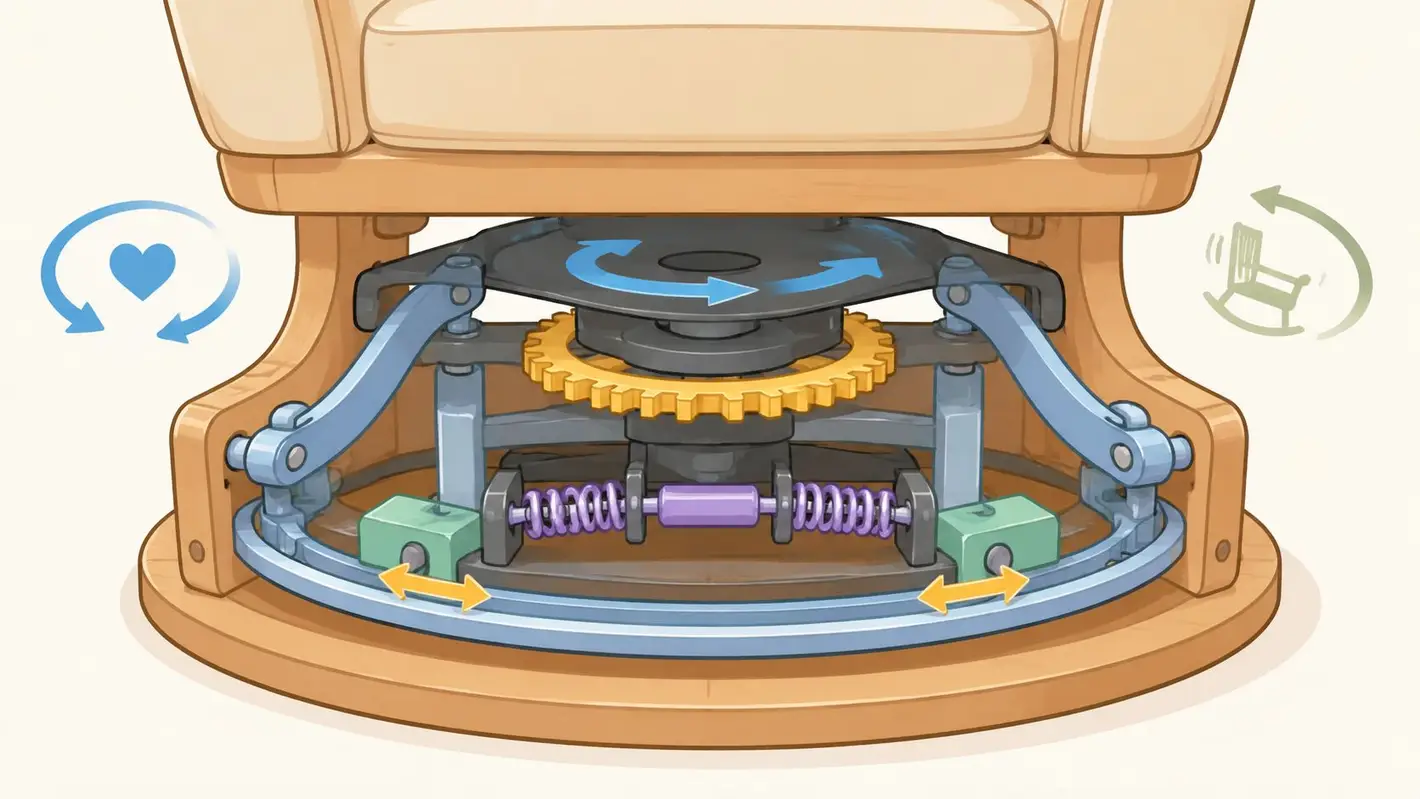
The easiest way to understand a glider swivel rocker is to break the name into parts. Each word describes a motion the chair can make while someone stays seated.
According to this overview of swivel rocker gliders, the category is valued for combining three motions in one chair: swivel, rock, and glide. That same source notes that its popularity connects the long appeal of rocking chairs, which have been popular since the 1700s, with the convenience of 360-degree swivel seating.
Three motions in one chair
Glide is the smooth back-and-forth movement, typically the first characteristic observed. It feels controlled and gentle, more like sliding along a path than tipping.
Swivel means the chair can rotate around its base. That's useful when someone wants to turn toward a crib, face the television, or join a conversation without standing up and dragging the chair around.
Rock is the motion that gives the chair some of its familiar comfort. It adds the soothing rhythm people often associate with classic relaxation seating.
For many shoppers, the confusion comes from assuming glide and rock are the same thing. They aren't. A glide moves in a smoother path, while a traditional rock has more of an arc. When those functions are paired with swivel, the chair becomes much more flexible in daily use.
Why that combination feels different
A standard accent chair stays put. A classic rocker offers one main motion. A glider swivel rocker does more than one job, which is why it fits so many rooms.
That versatility matters in spaces where people don't sit the same way every time. One evening might call for a reading lamp and stillness. Another might call for feeding a baby, reaching for a side table, and turning toward the doorway without getting up.
A helpful way to picture it is this:
- Glide feels like a steady, guided sway.
- Rock feels like the familiar motion of a traditional rocking chair.
- Swivel feels like easy repositioning without effort.
Practical rule: If a chair needs to support quiet routines, conversation, and everyday lounging, multi-motion seating usually makes more sense than a chair built for only one kind of use.
That's the key appeal of glider swivel rockers. They don't ask the room to adapt to them. They adapt to the way the room gets used.
The Magic Behind the Motion

The motion feels simple from the seat, but there's a lot going on underneath. That's good news for shoppers, because the best mechanisms do their job with minimal noise and without demanding attention.
A product explanation of the swivel glider rocker mechanism describes a combination of a fixed-track gliding system and a 360-degree swivel base, which helps reduce the need to twist the torso while seated. That same source notes that models using enclosed ball bearings are designed for quieter motion and improved durability over time.
What happens under the seat
A traditional rocker moves on curved runners. That's the classic look many people know, but it creates a different feel and a different relationship with the floor.
A glider works from a base that stays grounded while the seat moves along a controlled path. For many households, that's easier to live with. The movement feels steadier, and the chair doesn't depend on exposed runners touching the floor the way an old-style rocker does.
The swivel base adds another layer of convenience. Instead of shifting the whole body or planting a foot to scoot around, the seated person can turn.
That matters in everyday situations like these:
- Nursery use when a caregiver wants to face the crib, then turn toward a dresser or doorway.
- Living room use when someone wants to talk with family, then pivot back toward the fireplace or television.
- Mobility-sensitive use when changing position without standing feels easier on the body.
Why quiet motion matters
Noise is easy to ignore in the showroom and impossible to ignore at home. A chair that creaks during every movement won't feel relaxing for long.
Enclosed ball bearings matter because they're designed to support smoother, quieter operation. That can make a real difference in a nursery, during early-morning routines, or in a quiet room where even small noises seem louder.
Some features sound technical on paper, but they matter for very human reasons. Less twisting, less noise, and smoother movement all make a chair easier to live with.
This is one reason shoppers often feel an immediate difference when they test several motion chairs side by side. The shape of the chair matters, but the mechanism changes how the comfort behaves.
Glider vs Rocker vs Recliner Which is Right for You
Choosing between these chairs usually comes down to one question. What kind of comfort does the room need most?
Some rooms need soothing motion. Some need a place to fully lean back and put feet up. Others need a chair that can do a bit of everything without taking over the whole layout. For shoppers sorting through those trade-offs, a quick look at what a recliner chair is can help frame the broader category before narrowing the choice.
Chair Features at a Glance
| Feature | Swivel Glider | Traditional Rocker | Standard Recliner |
|---|---|---|---|
| Main motion | Glide plus swivel, often with rocking comfort | Rocking motion on runners | Reclining back with foot support |
| Best for | Nurseries, reading corners, living rooms, flexible seating | Classic comfort and simple motion | Lounging, naps, media rooms |
| Turning ability | Rotates to change direction while seated | Usually stays facing one direction | Usually limited unless paired with swivel |
| Feel in use | Controlled, smooth, easy to reposition | Familiar and rhythmic | Deep relaxation and leg support |
| Floor relationship | Base stays grounded | Runners contact the floor | Larger stationary footprint when closed |
| Small-room friendliness | Can work well, but still needs clearance to move | Often easier to understand visually | Can need more front clearance when extended |
| Common shopper concern | “How much space does it need to move?” | “Will the motion feel too old-fashioned?” | “Will it fit once fully reclined?” |
How shoppers usually decide
A traditional rocker suits buyers who love a classic look and want one familiar motion. It's simple and timeless, but it doesn't offer the same flexibility of direction.
A standard recliner makes sense when full-body lounging is the priority. For movie watching or afternoon naps, that can be the clear winner. The trade-off is that some recliners ask for more room in front when open.
A swivel glider lands in the middle in a very useful way. It supports calm motion, easier turning, and everyday seated tasks without requiring the chair to become a full recliner.
That's why this chair type often appeals to several different shoppers at once:
- Young families want gentle motion in a nursery.
- Readers want a chair that supports long sitting sessions.
- Older adults often appreciate being able to turn without straining.
- Remodelers like that the chair can move from one room to another over time.
Some motion chairs also blend categories, especially in comfort-focused collections where gliding, rocking, swiveling, and reclining may appear together in one piece. That can be a smart option for shoppers who don't want to compromise, but it does make in-person testing even more important.
Your Ultimate Buying Checklist for the Perfect Fit

A good chair can still be the wrong purchase if it doesn't fit the room, the body, or the household. To avoid frustration, many shoppers slow down and check the basics before falling in love with a fabric or silhouette.
For anyone comparing motion seating in more depth, this ultimate recliner buying guide can also help with the comfort and space questions that overlap across chair categories.
Measure the room, not just the chair
This is the first checkpoint because it affects everything else. A glider swivel rocker may look compact from the front, but motion furniture needs breathing room.
The biggest point shoppers miss is clearance. The chair has to move without bumping a wall, side table, crib, or media cabinet. Some product content in the market leaves that question unanswered, even though the practical issue is whether the chair can glide and rotate safely in a smaller room.
Before shopping, it helps to note:
- Back clearance: Space behind the chair for motion.
- Side clearance: Room for the chair to turn without hitting nearby pieces.
- Walking space: Enough open area so the chair doesn't interrupt the room's path.
- Delivery path: Hallways, doorways, and stairs matter just as much as the final room.
A chair can fit on paper and still feel crowded in real life. Motion needs space, not just square footage.
Look past the fabric sample
Upholstery always catches the eye first, but the outer fabric is only part of the story. Shoppers should also pay attention to stitching, cushion resilience, base stability, and how the arms feel when used repeatedly.
For households thinking through color, texture, and wear, this guide to designing with custom upholstery fabrics offers helpful context on how fabric choices affect everyday living. That's especially useful when a chair needs to work with pets, children, or a room that gets heavy daily use.
Durability is another area where vague marketing language can be misleading. One nursery-grade swivel glider rocker is listed as undergoing 125-lb seat-drop testing repeated 10,000 times, along with 60,000 arm impacts, according to this durability detail from Delta Children. That kind of testing is worth noticing because repeated use, not just one-time weight, is what often loosens joints and wears a chair down.
Test comfort with real posture
A quick sit isn't enough. People shop differently when they test a chair the way they'll use it.
Instead of perching on the edge for a few seconds, it helps to:
- Sit back fully and notice where the lower back lands.
- Rest the arms naturally to see whether shoulders stay relaxed.
- Move through the chair's motion to check whether the mechanism feels smooth and controlled.
- Turn while seated and notice whether the body feels supported or strained.
- Stay seated a little longer than planned, because discomfort often shows up after the first minute.
Comfort is personal. One shopper may prefer a firmer seat that feels supportive, while another wants a softer, sink-in feel. Neither is wrong. What matters is whether the chair supports the body in the way the room will ask of it.
Safety matters in daily use
Safety conversations often focus on nurseries, but they apply more broadly. Any home with children, guests, or mobility concerns should look carefully at how a motion chair behaves.
A stable base matters. So does smooth operation. Shoppers should also notice whether the mechanism feels exposed or well-contained, especially in homes where little hands tend to explore everything under a chair.
A careful checklist includes:
- Base stability: The chair should feel grounded, not tippy.
- Predictable motion: Sudden jerks or uneven movement are warning signs.
- Accessible arms: Helpful for sitting down and standing up.
- Easy turning: Useful for users who don't want to twist through the torso.
- Long-term support: Cushions should feel supportive, not just soft on day one.
For many families in Galax, Independence, Hillsville, and the surrounding Southwestern Virginia and Northern North Carolina area, this is also where showroom testing helps the most. Photos can show color and shape. They can't show whether a chair feels calm, balanced, and easy to use.
Keeping Your Glider in Great Shape for Years to Come
A well-made chair should age gracefully, but it still needs a little attention. Most maintenance is simple, and a few steady habits can help preserve both comfort and appearance.
Simple care habits that help
Start with the fabric. Regular vacuuming with an upholstery attachment helps remove dust, crumbs, and grit before they settle into seams or wear down the surface through friction.
For spills, quick action matters. Blot first instead of rubbing, then follow the cleaning guidance for the upholstery type. For households wanting a little extra help with posture-friendly seating habits and accessories, Meliusly's furniture solutions provide a useful overview of support-related considerations that can complement a comfort chair setup.
A few easy routines make a real difference:
- Vacuum the seat and arms: This keeps grit from grinding into fabric.
- Check the base area: Dust can collect around moving parts.
- Rotate cushions if the design allows: This can help wear develop more evenly.
- Keep the chair out of harsh direct sun when possible: Light can be hard on some upholstery over time.
When a chair starts to feel off
Most chairs don't suddenly fail. They give small warnings first.
A new squeak, a slight wobble, or fabric that looks pulled in one area often means the chair needs attention before the issue grows. An annual check of visible bolts or fasteners can help keep the frame feeling snug.
If a stain happens, the safest first move is usually to identify the upholstery and clean accordingly rather than guessing. A practical guide on how to remove furniture stains can help households respond without making the problem worse.
Furniture lasts longer when small problems get handled early. A little upkeep beats a major repair every time.
That approach fits the values of many long-term furniture buyers. A comfort chair isn't disposable. With reasonable care, it can stay useful through many seasons of family life.
Find Your Perfect Glider at Guynn Furniture

Glider swivel rockers make more sense once people try them in person. The motion, seat depth, arm height, and overall feel are hard to judge from a screen, especially when the chair is meant to become part of daily routines.
Historically, the category also has deeper roots than many shoppers realize. The glider motion appeared as a distinct furniture form in 1939, building on a rocking-chair tradition that reaches back to the 18th century, with rocking chairs already noted in England by 1725. That timeline, along with the 1860 bentwood rocking chair milestone tied to Michael Thonet, is outlined in this history of the rocking chair and glider. It's a helpful reminder that today's motion chairs are the result of generations of comfort-focused design.
Why local testing still matters
For regional shoppers, the primary value of a local showroom is confidence. A family can compare how different chairs move, whether a seat feels too deep or too upright, and how upholstery looks in person under normal light.
Guynn Furniture & Mattress carries motion seating options and serves households in Galax, Independence, Hillsville, and the wider Southwestern Virginia and Northern North Carolina region. As a La-Z-Boy Showcase dealer, the store also offers access to one of the most recognized comfort brands in the category, along with selections from Ashley, Bassett, Sealy, and Therapedic across the home.
A product example like the Sorrento glider recliner in charcoal gives shoppers a starting point, but in-person testing is where the decision gets easier. That's especially true when a buyer is balancing style, support, and room layout at the same time.
A comfortable purchase should feel straightforward
Furniture shopping gets overwhelming when every choice feels final. It helps when the process is simple and transparent.
For many families, that means looking for a store with:
- A no-pressure atmosphere so they can sit, compare, and think.
- A large in-stock selection for shoppers who don't want to wait on an online-only timeline.
- Expert design staff for help placing a chair in a nursery, living room, or reading corner.
- Free in-home delivery and setup within 60 miles so the chair arrives properly placed.
- A Low Price Promise with local price matching and a 30-day price guarantee when price matters.
- Flexible financing for households planning a larger room update.
Debra Williams and the expert design staff can also help shoppers think beyond a single chair and plan the whole room around it. That matters for the aspiring remodeler who wants the chair to fit the home's style, not just the floor plan.
Since 1902, families in this region have valued practical guidance, dependable service, and furniture that feels made for everyday living. A glider swivel rocker may start as one purchase, but in the right room it often becomes the seat everyone notices first and wants to claim.
Visit Guynn Furniture & Mattress to explore comfort seating for every stage of home life. Visit the showrooms in Galax, Independence, or Hillsville to test the comfort for yourself. Schedule a consultation with the design team to start planning a dream room today, or browse the selection online at guynnfurniture.net.