Coffee Table with Lift Top: Choosing the Right One


A laptop slips off a lap, a dinner plate balances on a cushion, and a child's homework spreads across the floor because the living room has no proper work surface. A coffee table with lift top offers a quiet fix. Instead of asking the body to bend toward a low table, it raises the tabletop closer to the user.
The right choice still requires more than a good-looking finish. The table needs a dependable mechanism, suitable working height, stable construction, enough clearance, and storage that matches the household's routine. Families in Galax, Independence, Hillsville, and the wider Southwestern Virginia and Northern North Carolina region can also test these details in person rather than guessing from a product photograph.
What a Lift-Top Coffee Table Actually Does
A standard coffee table stays low, usually serving as a place for drinks, books, remotes, and décor. A lift-top model adds a moving surface that hinges upward and forward, bringing the tabletop toward sofa height. Some designs raise the entire top, while others use a split or bi-fold arrangement that opens only part of the surface.
That movement creates three useful roles in one piece of furniture:
- Laptop perch: A seated user can work from the sofa without balancing a computer on the legs.
- Couch dining surface: Plates, drinks, and trays sit closer to the body, reducing the need to hunch forward.
- Living-room storage: The closed table can hold remotes, controllers, blankets, books, and snacks, with some designs revealing a concealed compartment when the top opens.
The design also suits rooms where a separate desk would crowd the walking path. A table can remain compact and visually calm when closed, then become a temporary workstation during homework, bill paying, or remote work.
The movement matters
Most lift tops travel upward and toward the person sitting at the sofa. That forward motion matters because it places the surface over the user's lap area rather than leaving it too far away. The table should still leave enough room for knees, feet, and movement around the sofa.
The hidden compartment adds another layer of usefulness, but storage volume varies considerably. Some tables offer only about 3 to 6 cubic feet of storage, so shoppers should measure the items they plan to keep inside instead of assuming every lift top replaces a cabinet. Independent lift-top storage guidance also highlights the difference between a table that merely opens and one that remains stable during daily use.
A practical caution
A lift-top table isn't automatically the right fit for every home. The moving surface can make the table heavier, introduce pinch points, and shift the center of gravity when raised. Readers considering the tradeoffs can review these lift table cons explained before deciding whether the added function suits their routine.
For households that want drawers instead of a lift compartment, Guynn's guide to a coffee table with storage drawers offers another way to keep everyday clutter contained. The key question remains simple: will the table make regular activities more comfortable without becoming difficult to operate?
A Brief History of the Coffee Table and Its Lift-Top Cousin
The coffee table grew out of the casual living room. Low tables supported tea, reading, conversation, and later television viewing, gradually replacing more formal arrangements that kept guests farther from the floor and from one another.
One of the earliest documented uses of “coffee table” as a distinct furniture label appeared in Britain in 1868, when designer E. W. Godwin listed a piece under that name. Period accounts later credited J. Stuart Foote of Imperial Furniture Company with helping popularize the modern low table in American homes by 1920. The coffee table's role changed as living rooms became places for lounging, informal entertaining, and everyday family activity. A documented history of coffee tables traces that progression from decorative accent to practical living-room staple.
From decoration to multitasking
As homes absorbed more activities, furniture designers had a practical problem to solve. A living room might need to support meals, children's projects, reading, television, and computer use without making space for a full desk or dining table.
The lift-top format extended the coffee table's original purpose rather than abandoning it. The table remained low and approachable when closed, then changed height when someone needed a more convenient surface. Multifunctional furniture traditions influenced this development, particularly designs intended to make limited rooms work harder.
Why the format feels natural today
Laptop use and flexible work routines made the raised surface easier to appreciate. A household doesn't need to dedicate an entire room to occasional computer work when a lift top can create a temporary desk in the room already used for relaxing.
The historical thread is straightforward. The coffee table began as a low companion for informal living, and the lift-top cousin adds adjustable function to that same role. The appearance may be familiar, but the useful part is hidden beneath the top, where hinges, springs, and supports determine whether the table feels effortless or awkward.
How the Lift Mechanism Works Behind the Scenes
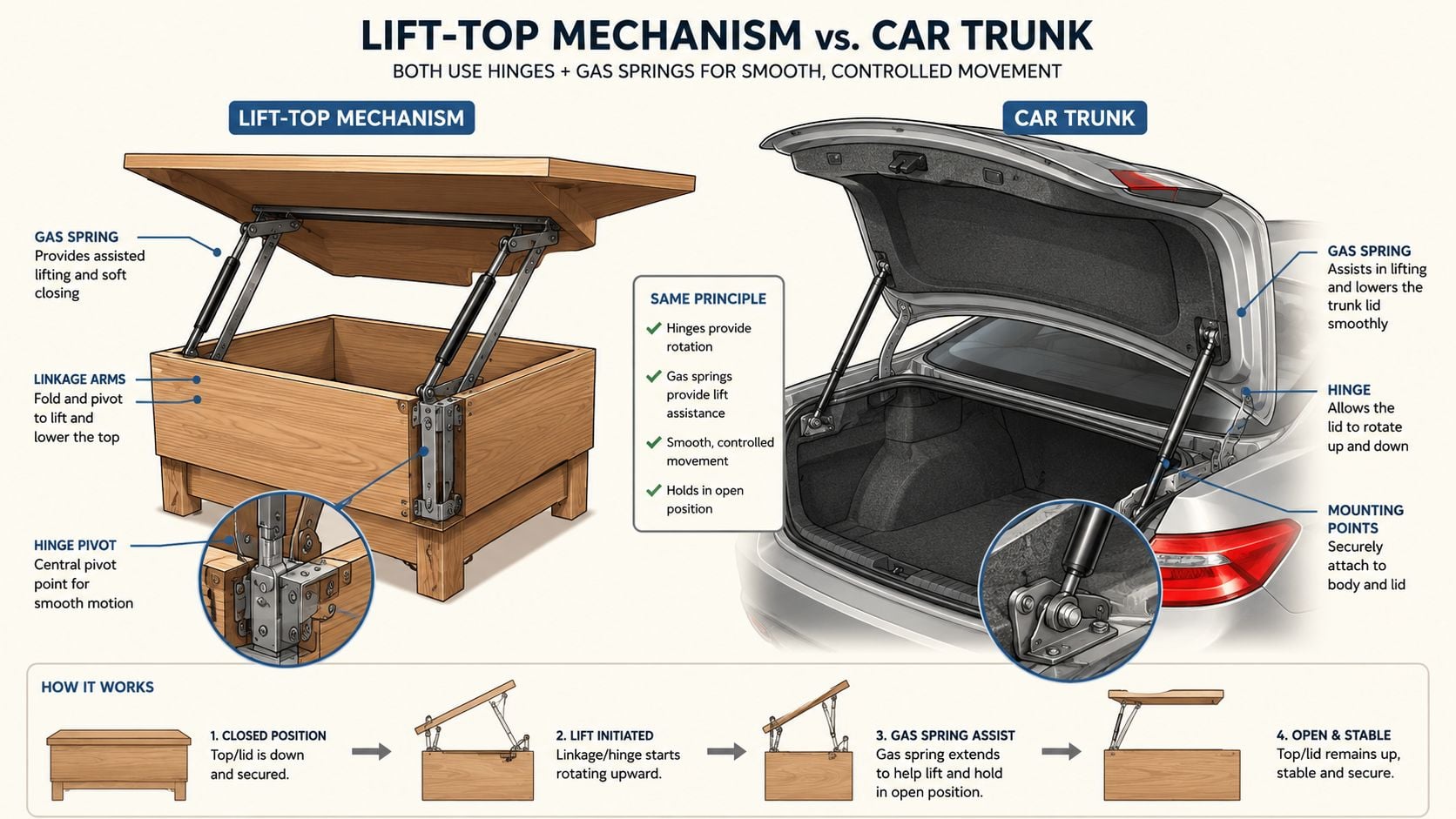
A lift-top mechanism works much like the assisted lid on a vehicle's rear compartment. Hinges guide the path, while a nitrogen-charged gas spring or spring-assisted linkage helps counterbalance the tabletop. The support reduces the force needed to raise the surface and controls the descent so the top doesn't fall.
Many tables use a spring-assisted hinge that lifts the top and holds it at a working position. Simpler designs may depend on basic hinges, leaving the user to provide most of the lifting force. The difference becomes obvious when the table is opened repeatedly during homework, meals, or daily laptop use.
What moves inside
A typical mechanism combines several parts:
- Hinges guide the top through its upward and forward path.
- Gas springs or assisted linkages offset part of the tabletop's weight.
- Catches or cams help hold the top in its raised position.
- Stops and damping points control how far the top travels and how it closes.
Some designs use bi-fold tops. One panel may lift for a laptop while the remaining section stays closed for décor or a drink. Butterfly-style mechanisms can fold outward, creating a broader working area while keeping the closed table relatively compact.
The mechanism must match the tabletop's weight and center of gravity. If the spring is undersized, the top may feel heavy or fail to hold its position. If it's oversized, the surface can rise too aggressively, creating instability or increasing the risk of finger pinching. Hardware guidance identifies common lift-height movement from roughly 380 to 450 millimeters closed to 650 to 760 millimeters raised, depending on the design. This explanation of lift-table hardware connects those measurements to laptop, dining, and near-sofa work.
The signs of trouble
A healthy mechanism should move smoothly and predictably. Sagging, a sudden drop, unusual creaking, or a top that won't remain raised can signal worn or poorly matched hardware.
Testing furniture mechanisms follows the same principle used for other moving furniture. A table performance test report emphasizes stability, strength, and durability under load. Independent hardware guidance commonly discusses lift-top targets around 25 to 35 kilograms of load capacity and 20,000 to 30,000 opening cycles, but those figures describe hardware expectations, not permission to overload a table.
For readers curious about assisted movement in other furniture, Guynn's explanation of how lift chairs work provides a related look at the role of controlled mechanical support. Pretty wood matters, but the mechanism determines whether a lift top remains useful after the novelty wears off.
Measuring Your Space and Matching the Lift Height
A successful purchase starts with the sofa, not the showroom floor. A tape measure, a notepad, and the actual seat cushion give a more reliable reference than a generic sample because cushions compress and sofas vary in height.
Begin with the room layout. Measure the open area between the sofa and opposing seating, then note the walking path around the table. The coffee table should feel reachable without blocking knees or forcing people to turn sideways.
Build the closed-height checklist
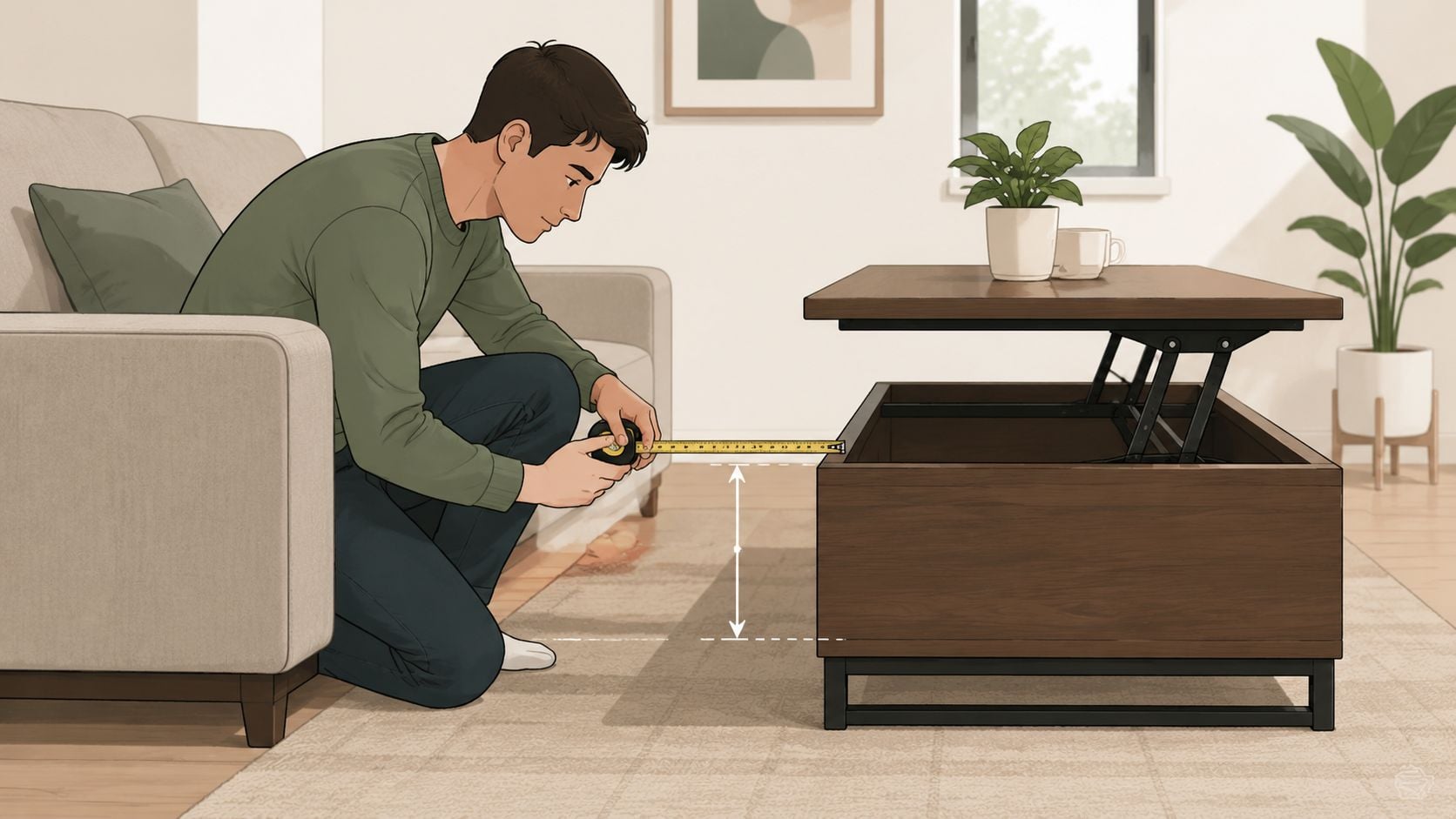
Measure the sofa seat from the floor to the top of the cushion while the cushion is in its normal position. The intended table height should generally sit close to the sofa seat, with the closed table often 1 to 2 inches below the sofa arm or seat as a practical starting point.
Leave 2 to 4 inches between the table edge and the front of the sofa so legs can move comfortably. Depth matters just as much as width. A usable arrangement should preserve at least 18 inches of legroom depth where people sit, especially when the lift top will move toward them.
Use this quick checklist:
- Record the compressed sofa-seat height.
- Measure the available table width and depth.
- Mark the walking route around the furniture.
- Check the distance from the table edge to the sofa.
- Confirm that drawers, doors, or the lift panel won't hit nearby furniture.
The furniture measuring guide from Guynn can help households organize these measurements before visiting a showroom.
Match the raised position to the user
The raised height should serve the person using it, not merely look impressive in a product listing. When seated with feet flat on the floor, the tabletop should generally come within 2 to 4 inches of the user's elbow. That position supports a laptop, tray, or notebook without requiring raised shoulders or a bent wrist.
Retail examples show why shoppers need to test the actual movement. One listing describes a surface that rises 9.25 inches above the table and reaches 27.25 inches from the floor, while another lists a closed height of 18 inches and a lifted height of 23.5 inches. A retail lift-top listing with measured heights demonstrates that models can vary substantially.
Bring the sofa's measurements, consider the seated user's elbow position, and test laptop clearance before choosing. A table that lifts too low may still encourage hunching, while one that rises too high can make typing and dining uncomfortable.
Choosing Materials That Hold Up to Real Life
Material selection affects more than appearance. It changes how the table feels under a forearm, how it handles a spilled drink, and how confidently it stays planted when a child leans near the raised edge.
Solid wood offers warmth, visible grain, and a substantial feel. Its weight can help resist unwanted movement, and many surfaces can be repaired or refinished when scratches and dents appear. That same natural character means marks may show, especially in a household where homework, snack trays, and pet activity happen around the table.
Engineered wood, including MDF, plywood, or veneered construction, can provide smooth finishes and consistent panels. It may offer strong value, but exposed seams and edges need protection. Spills can cause swelling if moisture reaches vulnerable areas, and hard play can chip an unprotected edge.
Metal frames paired with wood or engineered tops can add rigidity and clean lines. Powder-coated steel generally handles bumps and pet claws better than a raw finish, while the top still determines much of the table's tactile character.
| Material | Feel | Durability | Kids & Pets |
|---|---|---|---|
| Solid wood | Warm, weighty, and textured | Can be repaired, though scratches and dents remain visible | Stable, but natural surfaces need care |
| Engineered wood | Smooth and uniform | Vulnerable seams and edges need spill protection | Good for regular use when edges are well treated |
| Metal frame with wood top | Firm and structured | Strong frame, with finish quality affecting wear | Powder coating can handle everyday bumps well |
Inspect the details
A careful shopper should look beyond the material label. Edge banding, sealed surfaces, reinforced joints, and a base that doesn't wobble reveal more about daily performance than a color name.
Check whether the lift hardware connects to a reinforced section rather than a thin panel. Open and close the top while listening for strain. A warranty can also indicate whether the manufacturer expects the mechanism, joints, and finish to withstand normal use.
Practical rule: A table should suit the household's habits. A dog bed pressed against one corner, a child's elbows during homework, and a tray of snacks each test construction differently.
For a deeper explanation of wood choices and longevity, Guynn's guide to choosing hardwood furniture provides useful background. Families can then compare the tactile appeal of solid wood with the consistent finish of engineered panels and the reinforcement of a metal frame.
Styling a Lift-Top Table in Your Living Room
A lift-top table should look settled when closed and remain practical when open. Start with the rug. A rug that reaches the front legs of the sofa and lets the rear legs remain exposed can anchor the seating area without making the room feel boxed in.
The table's proportions should support the sofa rather than compete with it. A long sofa often suits a rectangular lift top, while a compact seating group may benefit from a round or softened shape. In a busy walkway, rounded corners can make movement feel easier, especially where children or pets pass through.
Keep the lift path clear
Decorative styling needs to respect the mechanism. Permanent objects should stay away from the side or panel that rises, and tabletop décor should remain low enough to clear the moving surface. A practical limit is under 6 inches for tabletop décor, allowing books, trays, and small arrangements to remain useful without blocking the lift.
A simple arrangement might include:
- A low bowl: Holds remotes or small items without spreading clutter.
- A thin stack of books: Adds height and texture while remaining easy to move.
- A soft basket nearby: Catches blankets or toys without occupying the lift panel.
The table should not become a display that has to be dismantled every time someone opens it. For additional coffee-table decorating ideas, Guynn's coffee-table styling guide offers a broader approach to balancing decoration with function.
Design for the routine
Place a lamp so it lights a laptop or homework area without reflecting directly into a screen. For dinner in front of the television, keep a tray close to the seated user and make sure the raised top doesn't collide with a sofa back or nearby chair.
Hidden storage works best when cables and charging accessories have a designated container. A small pouch or divided box can prevent cords from spilling across the compartment. Seasonal changes can stay simple, such as woven baskets and warmer textures during colder months, then ceramic bowls and lighter accessories when the room feels brighter.
Exact stain matching isn't necessary. Instead, compare undertones. A warm wood finish generally works better beside other warm finishes, while a cooler gray-brown table can coordinate with cooler flooring or upholstery. This approach helps the lift top feel connected to existing furniture without forcing every piece to look identical.
Safety, Care, and Buying Locally With Confidence
A lift-top table becomes dependable when the household treats the mechanism as moving hardware rather than as a toy or weight-bearing platform. Keep fingers clear of the spring path and hinge points. Close the top slowly with both hands, and teach children to wait until the surface is fully lowered before reaching near the moving parts.
The raised tabletop is intended for normal light use, not for sitting or heavy-duty support. Product specifications for lift-top tables and mechanisms may publish limits such as 45 pounds for a lifted tabletop, 80 pounds for an enclosed compartment, or 100 pounds for certain hardware kits, so the correct limit must come from the specific product. Published lift-mechanism load guidance reinforces the need to follow the table's own instructions.
Maintain the working parts
A simple care routine can catch problems before they become frustrating:
- Inspect the bolts: Tighten the four main bolts if they loosen.
- Clean the cylinders: Wipe gas cylinders with a dry cloth rather than applying unnecessary liquid.
- Vacuum the compartment: Remove crumbs, dust, and pet hair from the storage cavity.
- Test the catch: Confirm that the locking catch still holds at full extension.
- Watch the motion: Stop using the table if the top sags, drops suddenly, or develops unusual creaking.
Routine checks are especially useful in homes where the table opens repeatedly for laptops, meals, or children's activities.
Why local testing helps
Online photographs can't show how much force a spring requires, whether the top wobbles, or whether the raised position fits a particular sofa. In a local showroom, shoppers can open the mechanism, test the height, inspect the finish, and consider whether the storage compartment suits actual belongings.
Guynn Furniture & Mattress offers lift-top storage tables among its cocktail and coffee-table selection, along with furniture from La-Z-Boy, Ashley, and Bassett. Its broader home offering also includes mattress brands such as Sealy and Therapedic. The company has served the region since 1902, and its expert design staff, including Debra Williams, can help households visualize a room before committing to a layout.
Guynn also provides a large in-stock selection for immediate delivery, free in-home delivery and setup within 60 miles, and a Low Price Promise that matches local competitors with a 30-day price guarantee. Those policies can make a local purchase easier to coordinate than an online-only order, particularly when a heavy table must pass through a doorway and be positioned near existing furniture.
Prepare before delivery
Clear the route from the entry door to the living room. Measure doorways and tight turns, move fragile décor, and identify where adjacent furniture will be protected during setup. The household should have the sofa in its intended position before the table arrives, making it easier to judge spacing and lift clearance immediately.
A thoughtful purchase combines tested movement, suitable height, stable construction, and a care plan. The table should make laptop work, homework, and couch dining more comfortable without creating a new household chore.
Visit Guynn Furniture & Mattress in Galax, Independence, or Hillsville to test lift-top tables and explore a large in-stock selection, with free in-home delivery and setup within 60 miles. Schedule a consultation with the design team to plan the room, or browse the selection online at guynnfurniture.net.