Power Recliner vs Manual: Which Is Right for Your Home


A family in Southwestern Virginia can spend an afternoon comparing recliners and still leave with the same question: Should the new chair be power or manual? One person wants effortless adjustment for an older parent. Another prefers a simple chair with fewer parts. Someone else is already thinking about pets, outlet placement, delivery, and whether the chair will crowd the living room.
The right answer isn't automatically the more advanced model. A power recliner often earns its higher price through easy positioning and mobility support, while a manual recliner can deliver dependable comfort with less mechanical complexity. The best choice depends on who will use it, how the room works, and how much maintenance the household is willing to accept.
Guynn Furniture & Mattress has helped local households make those decisions since 1902. Its showrooms serve Galax, Independence, Hillsville, and the wider Southwestern Virginia and Northern North Carolina region, with options from La-Z-Boy, Ashley, Bassett, Sealy, and Therapedic. A helpful starting point is this overview of what a recliner chair is, followed by a hands-on comparison rather than a rushed online purchase.
Choosing Between Power and Manual Recliners
The easiest way to understand the power recliner vs manual decision is to think about a normal evening at home. A reader may want the footrest slightly raised, the back tilted just enough to support a book, and the headrest adjusted without shifting position. A manual chair may handle the job well, but a power model makes those small changes with a button.
Another household may have a tighter room, no convenient outlet, and a strong preference for straightforward furniture. In that setting, a manual recliner can be the smarter purchase. The chair works without electricity, tends to be easier to reposition, and avoids the added motor and control components found in power seating.
The short comparison
| Decision factor | Power recliner | Manual recliner |
|---|---|---|
| Operation | Push-button motor control | Lever, handle, or body-weight movement |
| Positioning | Near-continuous adjustment | Usually preset or limited locking positions |
| Mobility needs | Often easier for users with limited mobility | Requires more physical effort |
| Electrical access | Required | Not required |
| Mechanical complexity | Higher | Lower |
| Best fit | Precision, daily use, mobility support | Simplicity, flexible placement, value |
The global recliner market was valued at $27.4 billion in 2025 and is projected to reach $39.8 billion by 2034, at a 5.2% CAGR, according to global recliner market data. Power recliners represented about 58.3% of unit sales and 63.2% of revenue in 2025, while manual recliners represented 41.7% of units. Those figures help explain why shoppers see so many motorized choices, but market popularity doesn't settle the question for an individual home.
The practical recommendation is simple. Choose power when effortless adjustment will improve daily comfort or independence. Choose manual when the household values uncomplicated operation, flexible placement, and fewer possible service issues.
How Power and Manual Recliners Work
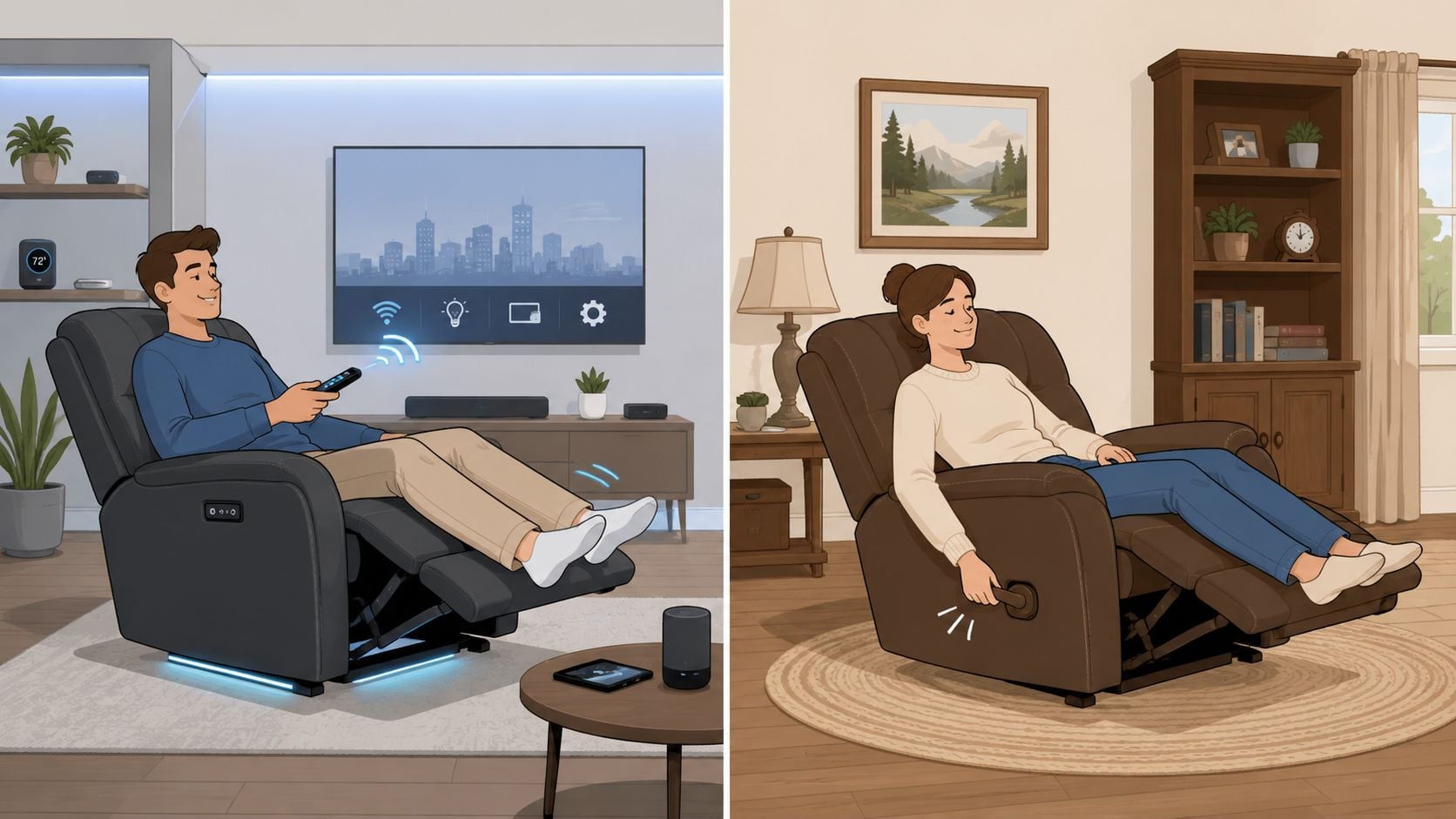
A manual recliner uses a mechanical system built around a spring-and-ratchet style mechanism. A lever releases the lock, allowing the chair to move into its reclining range. Some designs use a handle, while others respond to the user's body weight and leg movement.
Independent comparisons commonly describe manual recliners as offering 2 to 4 preset positions or a limited set of locking positions, while power recliners offer infinite or nearly unlimited stops, as explained in this power recliner and manual recliner comparison. That distinction matters during real use. A manual chair may provide upright, reading, and reclined positions, but the user usually works within the positions the mechanism allows.
A power recliner adds an electric motor and control system. Pressing a button moves the backrest, footrest, or other adjustable sections smoothly, letting the user stop at a preferred point. Instead of choosing between a few fixed angles, someone watching television can make a small adjustment to the back, raise the legs slightly, or fine-tune pressure around the lower back.
What each mechanism feels like
A manual recliner asks the user to participate in the movement. Pulling a handle, leaning back, or using the legs to close the footrest may feel natural for one person and tiring for another. The mechanism is direct, and many buyers appreciate that directness.
A power recliner removes most of that physical effort. The control may sit on the chair's side or connect through a remote, allowing the user to adjust position while remaining seated. This is particularly useful for someone with limited mobility, arthritis, reduced upper-body strength, or difficulty reaching a side lever. Power reclining seating options can also include different configurations for rooms where one chair isn't the only seating need.
Practical rule: The person who uses the chair most should test the mechanism, not just the person paying for it.
The difference becomes obvious when both chairs sit side by side. One person may enjoy the quick, physical action of a manual lever. Another may find that the same action causes strain or makes precise positioning difficult. Guynn showrooms in Galax, Independence, and Hillsville give shoppers a chance to test both mechanisms before deciding.
Cost of Ownership: Power vs. Manual Recliners
Sticker price tells only part of the story. A power recliner generally costs about $200 to $500 more than a comparable manual model, according to this 2026 power and manual reclining sofa cost guide. That extra purchase cost is easier to justify when the chair serves someone who benefits from button-controlled movement. It is harder to justify when the user prefers simple operation and has no trouble with a handle or lever.
Weight affects the household before the chair is even used. Power models are about 15 to 30 pounds heavier, which can complicate delivery, stair access, narrow doorways, and later room rearrangement. Measure the route into the room, not just the space where the chair will sit.
A power recliner also needs a suitable outlet and safe cord placement. Electricity is usually a minor ownership expense, estimated at under $2 per year in the cited guide, but the outlet can limit furniture placement and create a tripping concern if the cord is poorly routed.
Power vs Manual Recliner Cost Breakdown
| Cost Factor | Power Recliner | Manual Recliner |
|---|---|---|
| Upfront purchase | Usually about $200 to $500 more than a comparable manual model, according to the ownership-cost guide | Generally lower upfront cost |
| Electricity | Under $2 per year, according to the same cost reference | No electricity required |
| Moving weight | About 15 to 30 pounds heavier | Usually lighter because it lacks motorized components |
| Repair considerations | More complex because of motors, wiring, and controls | Simpler spring-and-ratchet construction |
| Placement | Needs electrical access and safe cord routing | More flexible placement |
| Delivery planning | Weight and access deserve careful review | Usually easier to handle |
The larger long-term difference is maintenance complexity, not power consumption. A manual recliner has fewer moving parts and no electrical system, so troubleshooting is generally more direct. This explanation of how recliner mechanisms work shows why the two designs can differ in service needs.
Ask a practical question: “Which chair costs less after delivery constraints, outlet placement, and likely service needs over 5 to 10 years?” That answer depends on the room and the person using the chair, not just the checkout total.
Guynn's Low Price Promise helps control the purchase price by matching local competitors and providing a 30-day price guarantee. Free in-home delivery and setup within 60 miles can also reduce the work and practical expense of getting a heavier chair inside, assembled, and positioned correctly.
For households considering lift assistance instead of standard reclining, this guide to lift chair costs helps separate a comfort purchase from a mobility-focused chair.
Which Recliner Fits Your Household
A recliner can feel perfect in the showroom and still fail at home. A retired adult may need push-button control, while a compact apartment may need a chair that can sit away from an outlet. Pets, children, walking paths, and daily routines all affect the right choice. Match the chair to the household first, then compare mechanisms.
Older adults and limited mobility
Power is the clear recommendation for anyone who struggles with a lever, pulling motion, or upper-body effort. Push-button control makes position changes easier and more precise, and the user does not need to brace the body to start reclining. That support can make reading, watching television, resting, and raising the legs more comfortable every day.
Manual still suits an older adult with good strength who prefers simple controls. Have the actual user operate the chair before buying. Age alone does not determine the right mechanism. For more targeted guidance, review this recliner chair guide for elderly users.
Back comfort requires its own check. Seat depth, lumbar support, head support, and the chair's overall shape affect posture and pressure points. This orthopedic chair support back guide offers useful background before a showroom visit.
Families with children and pets
Busy homes need upholstery that matches real use. Check whether the fabric or leather can be cleaned easily, whether the cushions stay secure, and whether the moving footrest creates a gap where toys or pet paws could get caught. Ask how the material will handle repeated sitting, spills, claws, and direct sunlight.
Power brings convenience, but it also adds controls and components that household members must use carefully. Manual can be the better family-room choice when several people share the chair and straightforward operation matters more than fine positioning.
Small rooms and difficult layouts
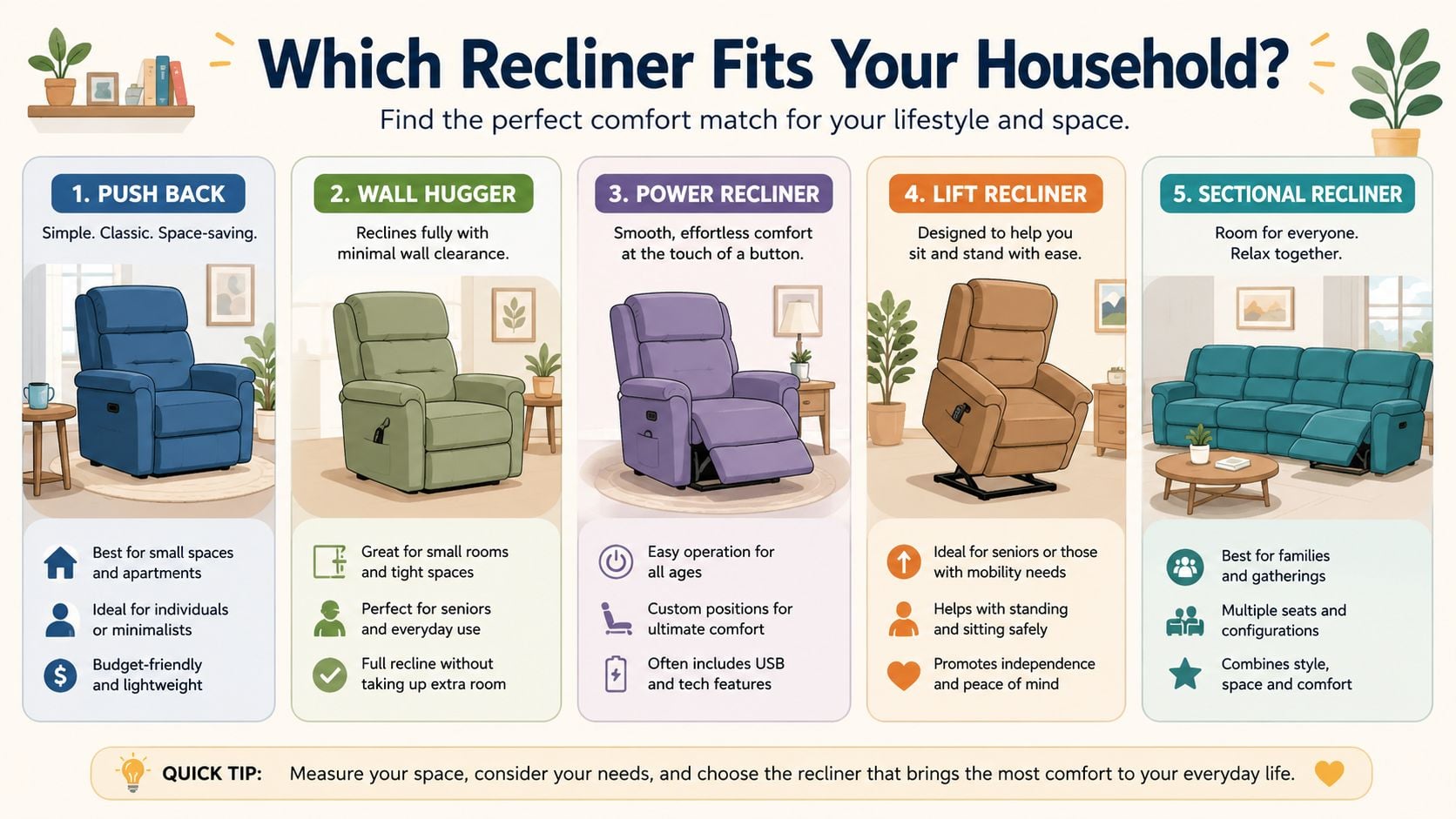
Manual recliners offer more placement freedom when outlets are scarce or furniture moves often. They avoid cord routing and let the household arrange the room around walking paths, tables, and changing needs.
Power can still work in a small room. Look for wall-hugger frames, slimmer profiles, hidden footrests, lumbar support, and USB charging, then confirm that the chair's movement will not block a passage. Cord placement matters around children and pets, especially in rooms with frequent foot traffic.
The hidden cost of fit is frustration. A chair that blocks a walkway, crowds a sofa, or forces an extension cord can become a poor long-term purchase, even if its sticker price looks attractive. Guynn's design staff, including Debra Williams, can help place the recliner within a larger plan involving a sofa, sectional, lighting, and walkways.
Choose power for effortless daily support. Choose manual for simpler operation and flexible placement. If mobility needs and room limits point in different directions, resolve the user's daily comfort first, then confirm the layout can support it.
Smart Shopping Tips for Your Perfect Recliner
A chair can feel comfortable in a showroom and still fail at home. Test it with your household's real needs in mind, including mobility, pets, cleaning, room layout, and daily use. Sit first, then compare prices.
Test the chair as it will be used
A proper test takes more than a quick sit. Check these points:
- Try the upright position: Keep both feet comfortable on the floor and confirm that the back supports a natural posture.
- Operate the mechanism: Pull the manual lever or use the power control several times. The motion should feel manageable, quiet, and predictable.
- Test fine positioning: Stop a power model at different points for reading, television, and leg elevation. Confirm that the controls are easy to reach.
- Inspect the upholstery: Touch the fabric or leather and ask how it will handle children, pets, sunlight, spills, and routine cleaning.
- Check access: Sit down and stand up without awkward movements or support from nearby furniture. This matters most for anyone with limited mobility.
Test both reclined and upright positions. Make sure the footrest closes fully, the head support suits your height, and the armrests let you rise without strain. A mechanism that feels impressive for one minute may become irritating after repeated daily use.
Measure the room before visiting. Record the chair's footprint, reclining clearance, walking paths, doorways, and outlet location. Include space for pet traffic and cleaning access. A cord, blocked passage, or chair that crowds another seat can create ongoing costs through rearrangement, repair, or replacement.
Review the full purchase
Ask about fabric care, warranty terms, delivery, setup, service appointments, and parts before paying. Guynn offers a large in-stock selection for immediate delivery, giving local shoppers an option beyond an online-only order.
Financing can change the monthly burden. Guynn offers flexible financing, including no-interest plans through Lendmark Financial Services for credit-qualified customers, with no minimum purchase required. Review the complete terms and choose payments the household can maintain.
Guynn matches local competitors and offers a 30-day price guarantee. Free in-home delivery and setup within 60 miles can also reduce the physical work and unexpected handling costs. For more guidance, use this smart furniture shopping guide.
Top Recliner Features and Models at Guynn
The strongest recliner choice starts with the mechanism, then adds only the features that improve daily use. A power model with adjustable head support, lumbar movement, USB charging, heat, or massage can create a more personalized seat, but those upgrades should serve a real routine rather than sit unused.
La-Z-Boy power recliners are a natural option for shoppers who want detailed positioning and comfort features such as heat, massage, and USB ports. Guynn is a La-Z-Boy Showcase dealer, so shoppers can explore the brand's comfort-focused collection in a local showroom instead of relying on photographs alone.
Manual options from Ashley and Bassett suit buyers who prefer a simpler chair and a more restrained feature set. A manual recliner can be especially sensible for a room without a convenient outlet, a household that rearranges furniture often, or a shopper who wants fewer electrical components to maintain.
Other Guynn offerings expand the choice beyond a single style. The showroom includes furniture from Ashley and Bassett, along with bedding from Sealy and Therapedic, so a recliner purchase can be considered alongside the room's broader comfort needs. Expert design staff, including Debra Williams, can help coordinate scale, upholstery, placement, and supporting pieces.
Guynn Furniture & Mattress provides local showroom shopping, a large in-stock selection, design assistance, financing options, a Low Price Promise with a 30-day price guarantee, and free in-home delivery and setup within 60 miles. That combination matters because the right recliner isn't only about the mechanism. It's also about testing the fit, getting it through the door, placing it safely, and knowing where to turn after purchase.
Visit our showrooms in Galax, Independence, or Hillsville to test the comfort for yourself, and connect with Guynn Furniture & Mattress for power and manual recliners suited to your home. Schedule a consultation with the design team to start planning your dream room today, or browse the selection online at Guynn Furniture & Mattress.