Blue and White Comforter Styling Guide for a Calmer Bedroom


A homeowner can spend an hour in front of a bedding wall, surrounded by solids, jewel tones, oversized florals, and coastal prints, and still feel stuck. A blue and white comforter often catches the eye because it looks familiar without looking boring, but the key question is whether it will stay comfortable, practical, and attractive after ordinary family life begins.
The right choice depends on more than color. Fabric, fill, construction, mattress depth, room style, washing requirements, and household habits all shape whether the comforter earns its place. The guidance below takes the practical view, the same approach that helps families choose bedding, mattresses, and furniture for real homes rather than staged rooms.
Why a Blue and White Comforter Still Earns Its Place
The first sixty seconds in a bedding aisle can reveal a lot. A shopper should step back from the display, look at the blue under the store's lighting, and check whether the white reads crisp or overly stark. A pattern should also be viewed from several feet away, because a design that feels charming up close can become visually busy across an entire bed.
Blue and white has a useful balance. Blue brings calm visual weight, while white keeps the bed bright and clean-looking. Bedroom color guidance commonly associates blue with a calming effect and white with simplicity and clarity, which supports the palette's restful reputation rather than treating it as decoration alone. Bedroom color psychology guidance connects blue with a sleep-friendly atmosphere, while additional color psychology advice describes white as a clean, bright neutral base.
A patterned comforter also handles daily life better than a completely solid white one. Light lint, dust, and minor signs of use are less obvious when blue sections, stripes, checks, or small geometrics break up the surface. That makes the palette useful in a guest room, a primary bedroom, or a shared family space. It also works with warm wood, cool gray, natural woven accents, and many neutral wall colors.
Practical rule: If the bedding looks calm from the doorway and still interesting at the foot of the bed, it has a better chance of feeling right for years.
The style has history, too. On 1 May 1759, George and Martha Washington ordered a tester bedstead with “fashionable blew or blew and white Curtains” from London, a documented example of blue-and-white bedroom textiles as an elite decorative style in colonial America. Mount Vernon's account of the Washington bedroom order also describes coordinated curtains, cornices, and chair covers, showing how the palette once formed a complete room scheme.
A buyer still needs to judge the less glamorous details. Material, fill, size, pattern scale, and care determine whether the comforter stays useful after the first wash and the first season. For shoppers comparing color palettes before buying, this expert guide to bedroom color choices offers a helpful way to consider the rest of the room rather than choosing bedding in isolation.
Materials, Fill, and Construction That Actually Matter
Color sets the mood, but the shell and fill determine how the bed feels at night. A blue and white comforter with an attractive pattern can still disappoint if the fabric traps heat, the fill clumps, or the construction leaves cold areas.
Shell fabrics change the sleeping experience
Cotton percale feels crisp and airy, making it a strong choice for hot sleepers. Cotton sateen feels smoother and softer, with a subtle sheen that suits a more polished bedroom. Microfiber often costs less and resists wrinkles, but it generally feels less breathable than cotton.
Linen blends bring visible texture and a relaxed finish. They work especially well with light oak, woven rugs, and informal rooms, although their natural texture won't appeal to someone seeking a perfectly smooth, neat bed.
Fill types suit different households
Down offers lightweight warmth and a lofty feel, but it needs regular fluffing and may raise concerns for people sensitive to allergens. Down-alternative polyester provides consistent loft, easier washing, and a practical option for families, pet owners, and allergy-conscious households. Wool helps regulate temperature but can feel heavier, while cotton stays breathable and tends to sleep cooler in warmer conditions.
The clearest all-around recommendation is a cotton shell with down-alternative fill. It balances breathability, manageable care, and predictable comfort without making the household work around a delicate insert.
| Material or fill | Breathability | Warmth | Care | Best for |
|---|---|---|---|---|
| Cotton percale shell | High | Depends on fill | Gentle washing | Hot sleepers and crisp bedding fans |
| Cotton sateen shell | Moderate to high | Depends on fill | Gentle washing | Softer, smoother bedroom styles |
| Microfiber shell or fill | Moderate | Consistent | Easy care and wrinkle resistance | Value-focused households |
| Linen blend shell | High | Light to moderate | Gentle care, natural texture | Relaxed, layered rooms |
| Down fill | High | Lightweight and lofty | Infrequent washing and thorough drying | Sleepers who want airy warmth |
| Down-alternative fill | Moderate to high | Consistent | Easier machine care | Kids, pets, and allergy concerns |
| Wool fill | High | Warm and regulating | Follow the care label closely | Sleepers wanting natural insulation |
| Cotton fill | High | Light to moderate | Gentle washing | Summer use and breathable layering |
Construction controls warmth distribution
Fill power measures down loft, or the volume occupied by one ounce of down. Warmth also depends on fill weight, shell fabric, and construction, so a high loft rating alone doesn't tell the whole story. Guidance on fill power and comforter construction explains why baffle-box construction helps limit fill migration and cold spots.
Baffle boxes create internal compartments that let lofty fill expand while keeping it distributed. Sewn-through channels stitch the top and bottom layers together, which creates a flatter profile and can suit lighter bedding. Corner loops matter when the comforter is used as a duvet insert because they keep ties attached and prevent the insert from sliding inside its cover.
For a deeper explanation of how comforters, quilts, and related bedding pieces differ, the complete bedding and mattress protector guide provides useful shopping context.
Getting the Size and Fit Right for Your Bed
A comforter should be sized for the whole bed profile, not just the label on the mattress. A mattress with a pillow top, foundation, or substantial side depth needs more coverage than a slim mattress, even when both carry the same bed-size name.
Measure the mattress width, length, and depth from the top surface to the bottom edge. A comforter that matches the mattress exactly can look taut and flat, with the sides pulling upward instead of falling naturally.
| Bed size | Mattress depth 8 to 12 inches | Mattress depth 12 to 16 inches | Recommended drop |
|---|---|---|---|
| Twin | Standard twin comforter | Oversize twin or longer option | Enough to cover the side and mattress edge |
| Full | Standard full comforter | Oversize full or full-queen option | A visible side drop without exposing the foundation |
| Queen | Standard queen comforter | Oversize queen or king-width option | Generous coverage across both sides |
| King | Standard king comforter | Oversize king or wider option | An intentional drop over the mattress sides |
The table is a practical starting point, not a substitute for measuring the specific bed. A mattress deeper than 12 inches usually deserves a larger comforter, especially in a queen or king bedroom where a generous overhang makes the bed look grounded rather than skimpy. Standard sizing often works well in guest rooms and children's rooms, while an oversize comforter can anchor a primary bedroom.
Shams should be chosen for the pillows, not for the comforter's label. A properly fitted sham makes the head of the bed look finished without forcing the comforter to cover more area than the room needs.
For shoppers comparing blanket and bedding dimensions across manufacturers, the Minky Couture sizing guide from On Pins & Needles Quilting Co. offers useful reference terminology. A mattress-size guide such as this bedroom mattress sizing resource can also help households confirm the foundation and mattress dimensions before purchasing.
Where Blue and White Bedding Works Best in 2026
Blue and white bedding still works in current rooms, but it needs the right supporting details. The palette looks fresh when the room combines warm wood, matte black hardware, layered neutrals, or textured fabrics. It looks tired when every accessory repeats a nautical theme.
Match the pattern to the room
- Coastal rooms: Choose softened blue, simple stripes, pale wood, and natural texture. Skip anchors, sailboats, and matching ocean artwork unless the room is intentionally themed.
- Hamptons-inspired bedrooms: Use a blue-and-white stripe with white walls, substantial wood furniture, and restrained decorative pillows.
- Modern farmhouse rooms: Pair the comforter with aged wood, quiet checks, woven baskets, and muted blue rather than bright navy.
- Classic Americana rooms: Traditional checks, toile-inspired motifs, and deeper blue can feel established without becoming formal.
- Scandinavian-leaning rooms: Keep the pattern small and the accessories spare. Blue should act as a controlled accent against warm white, pale wood, and soft gray.

Pattern scale matters more than many shoppers expect. Small geometrics and tone-on-tone stripes usually feel more current than large repeating sailboats or oversized anchors. In a child's primary bedroom, the same palette can feel juvenile if the pattern is too literal. Dated brass fixtures and heavily themed accessories can create the same problem.
The safest purchase is a reversible comforter or a simple duvet cover with a flexible insert. One side can carry the stronger pattern, while the other side can provide a calmer surface when the room needs a refresh. Layering solid pillows and throws also lets the room move toward traditional, transitional, or modern without replacing the main insert.
For rooms that combine blue with warmer metallics, a blue and silver decor guide offers useful color-pairing ideas. Households exploring a more relaxed regional look can also review coastal design guidance before committing to a strongly themed bedroom.
Styling Your Room Around the Comforter
A blue and white comforter should be the room's anchor, not the beginning of a matching-set chase. The strongest bedrooms repeat the colors in small doses while introducing different textures and one controlled accent pattern.
Build the palette from large surfaces to small details
Start with the walls. Soft gray, warm white, muted green, and restrained navy can all support blue-and-white bedding. A warm white usually prevents the room from feeling icy, especially when the comforter includes a cool blue.
Next, choose the headboard. Upholstered linen softens the pattern, light oak adds warmth, and painted white wood creates a brighter traditional look. Nightstands in natural wood, painted finishes, or simple dark hardware can connect the bed to the rest of the room without copying its pattern.
Pillow layering works best when each layer has a job:
- Euro shams create height behind the sleeping pillows.
- Standard sleeping pillows keep the bed functional.
- One lumbar or smaller accent pillow adds shape without making bedtime a chore.
- One secondary pattern is enough. The remaining pillows should use solids or quiet texture.
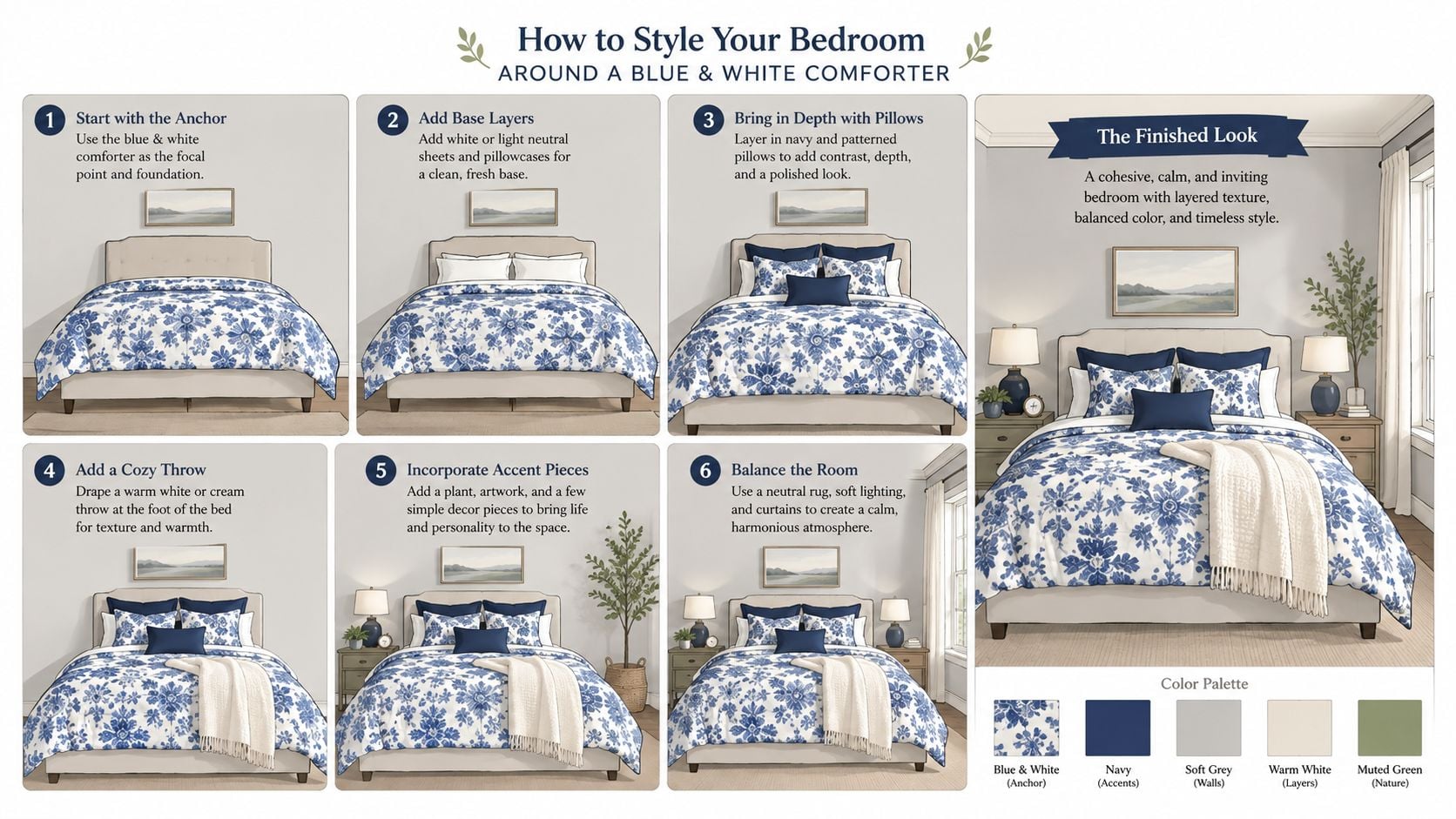
Finish the room without overmatching
A rug should repeat either the blue, the white, or a neutral texture, but it doesn't need to contain every color in the room. Blackout curtains in warm white, flax, or a muted blue can frame the bed while protecting sleep from unwanted light. A washable throw at the foot of the bed gives shared bedrooms and family spaces an easy layer to remove.
Renters can use removable wallpaper behind the headboard to add depth without permanent work. Shared bedrooms benefit from washable throws, simple pillow arrangements, and surfaces that don't require constant styling.
The bed accessory guide offers further ideas for arranging pillows, layers, and finishing pieces. The guiding principle remains simple: mix solids, textures, and one accent pattern instead of buying every piece in the same print.
Caring for Your Comforter So It Lasts
The care label comes first. A comforter's fill, shell, embroidery, and construction determine whether it belongs in a household machine, a large commercial washer, or a professional cleaning service.
Washing the insert safely
Use these decisions as a practical guide:
- Down: Choose a large front-loader or commercial laundromat machine, gentle cycle, warm or cool water as the label permits, and mild detergent. Avoid fabric softener because it can strip natural oils from down.
- Down alternative: Use a gentle cycle with cool water and mild detergent. This fill is usually easier for families to wash at home, but the machine still needs enough room for the comforter to spread out.
- Cotton fill: Follow the label closely and avoid overloading. Cotton can become heavy when wet, so a large-capacity machine may be necessary for larger beds.
Independent down-bedding care guidance recommends a delicate cycle, mild detergent, low-heat drying, and no fabric softener for down-filled comforters with cotton or cotton-synthetic shells. Detailed down comforter washing guidance also warns that bulky inserts can ball up in a standard top-loader, preventing proper cleaning and drying.
Retail care guidance commonly recommends cold water, gentle washing, low heat, and no bleach, although some labels permit warmer washing and medium drying. A bedding laundry care guide reinforces the need to follow the individual care tag rather than applying one setting to every comforter.
Drying and storing matter just as much
Dry the comforter completely on low heat. Clean tennis balls or dryer balls can help separate clumps, but the insert may need more than one drying cycle. Damp fill can develop a mold problem, so the comforter shouldn't return to the bed or closet until the center feels fully dry.
Professional cleaning is the safer route for down, silk blends, delicate embroidery, or any item whose label prohibits home washing. A household that lacks a large machine can use a door-to-door dry cleaning service rather than forcing a king comforter into an undersized washer.
Between seasons, store the comforter in a breathable cotton bag, never a sealed plastic bin. Cedar blocks can help keep the storage area fresh, while a duvet cover protects the surface during regular use. Turning the insert periodically and washing sheets regularly reduces concentrated body-oil transfer. Lifespan estimates vary by fill, with well-maintained down or wool comforters lasting roughly 10 to 15 years, microfiber about 5 to 10 years, and cotton about 5 to 7 years under regular use, as summarized by comforter lifespan guidance.
Finding the Right Set at Guynn Furniture
A screen can show a blue pattern, but it can't show how the fabric feels, how much the fill shifts, or whether the blue looks too cool beside a bedroom's existing wood and paint. A showroom lets a household compare pattern scale, fabric hand, and comforter weight side by side.
Guynn Furniture & Mattress has served Galax, Independence, Hillsville, and the wider Southwestern Virginia and Northern North Carolina region since 1902. Its bedding and sleep selections can be considered alongside bedroom furniture, including La-Z-Boy, Ashley, Bassett, Sealy, and Therapedic offerings when a household is planning more than a single textile purchase.
Shoppers should bring:
- Mattress measurements: Include width, length, and depth.
- Room samples: Fabric swatches, paint cards, or a photograph taken in daylight can prevent color mismatches.
- Household needs: Mention pets, children, allergies, hot sleeping, or a preference for easy washing.
- Room plans: A design consultation with Debra Williams or the expert design staff can connect the comforter to the headboard, nightstands, pillows, and window treatments.
Guynn also provides a large in-stock selection for immediate delivery, which helps households that don't want to wait on an online-only order. The retailer offers Free in-home delivery and setup within 60 miles, serves local communities across Southwestern Virginia and Northern North Carolina, and supports purchases with a Low Price Promise that matches local competitors and includes a 30-day price guarantee. Financing can help buyers plan a broader bedroom refresh without treating the comforter as an isolated purchase.
Visit Guynn Furniture & Mattress to compare blue and white comforters with bedroom furniture, mattresses, and room finishes in a no-pressure atmosphere. Visit the showrooms in Galax, Independence, or Hillsville to test the comfort for yourself, or schedule a consultation with the design team to start planning a calmer bedroom today.