Free Standing Corner Shelves: A Practical Buying Guide

A living room can feel finished everywhere except one corner. The sofa and television stand meet at an awkward angle, a floor lamp sits slightly off balance, and framed photos wait on the floor because no flat surface is available. That unused wedge of wall isn't a design failure. It may be the most useful storage opportunity in the room.
Free standing corner shelves can turn that overlooked space into a home for plants, books, family photographs, a reading light, or treasured keepsakes. The right choice depends less on appearance alone and more on daily use. A shelf for lightweight decor has different requirements from one expected to hold books, dishes, or office supplies.
Furniture has been solving this space problem for centuries. Freestanding shelving developed from earlier storage furniture into the modern bookcase, with industrial-era manufacturing making standardized shelves more accessible. A shelving patent registered on November 24, 1857 shows that engineered shelf systems were already being formalized by the mid-19th century, as described in this history of the bookcase.
The decisions are manageable when taken in order: how the shelf will be used, what “free standing” means, which materials suit the room, what the specifications reveal, and how the piece will get safely into the home. A patient showroom conversation can make furniture shopping feel less overwhelming, especially when a shopper brings room measurements and a few photographs.
When a Corner Becomes the Right Place to Start
A small room often reveals the need for a corner shelf before anyone names it. The sofa may stop short of the wall, the television stand may leave a narrow triangular gap, and a side table may make the walking path feel crowded. Meanwhile, a stack of books has taken over the floor and a plant has been moved three times because there isn't a suitable place for it.
That corner is usable real estate. A freestanding shelf gives the room vertical storage without taking over the open floor area needed for chairs, movement, or a pet's favorite path. It can also create a visual finish, giving an empty angle a purpose instead of leaving it to collect dust.
Start with the shelf's daily job
The intended contents should guide the purchase more than a product photograph.
- Display corner: Lightweight decor, framed pictures, small plants, and decorative objects call for attractive proportions and easy cleaning.
- Book storage: Books need stable shelves, sensible depth, and a clear load rating. A tall, narrow unit can look elegant, but it shouldn't be treated like a heavy bookcase unless its specifications support that use.
- Practical household storage: Baskets, dishes, folded linens, and office supplies may require stronger construction and shelves that can tolerate repeated handling.
- Flexible family use: A mixed arrangement often needs a sturdy bottom shelf, reachable upper tiers, and enough visual openness to keep the room from feeling cramped.
The category has also become a measurable furniture market. One 2025 industry estimate values the global corner shelf market at USD 2.67 billion in 2024 and projects USD 4.54 billion by 2033, with a projected 6.1% CAGR, according to this corner shelf market estimate. Those figures reflect a practical need, corners are commonly underused, while homes and commercial rooms continue to seek compact organization.
A buyer doesn't need to chase a trend to benefit from the idea. The useful question is simple: what should this corner make easier every day? Once that answer is clear, style, size, material, and stability become much easier to judge.
What Free Standing Really Means for a Corner Shelf
A free standing corner shelf is a complete furniture unit that rests on the floor and can be moved without removing it from a wall. A regular bookcase placed against a wall works in much the same way. Both have a flat base, both can be repositioned, and neither requires a built-in opening.
A built-in cubby is different. It's cut into drywall or framing and becomes part of the room. A floating shelf is different too, because it's attached to a wall, usually through brackets or hardware secured to structural support. Those options can look clean and permanent, but they commit the shelf to one location.
Flexibility has practical value
Free standing shelving suits renters, frequent decorators, and households that may rearrange rooms over time. It can move from a living room to a bedroom, office, or entry area without leaving a pattern of holes or requiring a drywall repair.
That flexibility doesn't mean every unit is equally stable. Some designs include anti-tip straps or optional wall anchors. An anchor adds a safety measure, but it doesn't turn the piece into a built-in. The shelf remains movable, while the strap helps reduce the risk of tipping.
Tall freestanding furniture can tip when loaded unevenly or touched, so anchoring deserves particular attention in homes with children or pets. Guidance reviewed for corner shelving notes that taller units, especially those over 60 inches, merit extra caution and that voluntary standards plus proper anchoring are important safeguards because the United States has no federal technical regulation requiring furniture stability. The discussion appears in this corner shelf safety guidance.
Practical rule: “Free standing” describes installation, not permission to ignore stability.
A shopper comparing a shelf with a corner media piece can also consider how the item will relate to the rest of the room. A corner media console may solve a larger storage and television problem, while a narrow etagere-style unit may handle display needs with less visual weight. The best choice depends on whether the corner needs open display, concealed storage, or both.
Popular Styles and Materials Worth Considering
A showroom makes material differences easier to understand because shoppers can touch the edges, move a shelf gently, and see how each finish reflects light. Four material families appear most often: solid wood, engineered wood with veneer, metal, and mixed constructions that may include glass.
Solid wood brings warmth, visible grain, and a substantial feel. It generally handles heavier use well, although that strength comes with more weight and often a higher price. A traditional living room, bedroom, or study may benefit from its natural character. Customers who want to understand wood species and long-term care can review this guide to choosing hardwood furniture for longevity and style.
Engineered wood with veneer can provide a convincing wood appearance while keeping the unit lighter and more accessible in price. Quality varies, so shoppers should inspect edge finishing and ask about moisture exposure. Engineered panels can be more vulnerable to chipped edges or swelling if water repeatedly reaches unprotected surfaces.
Metal creates a modern or industrial impression and can keep the visual profile slim. It often feels strong in the hand, but a cool black or metallic frame may look out of place beside very traditional furnishings unless the room already contains similar accents.
Mixed materials combine the warmth of wood shelves with the line of a metal frame. Tempered glass tiers can make a tight corner feel visually open, though glass requires steadier handling and shows dust more readily.
| Material | Look & Feel | Load Capacity | Price Range | Best For |
|---|---|---|---|---|
| Solid wood | Warm, grounded, grain-forward | Often suited to heavier use, verify the rating | Higher investment | Traditional rooms and lasting furniture |
| Engineered wood with veneer | Wood appearance, lighter feel | Varies by panel and frame | More accessible | Value-conscious display and organization |
| Metal | Slim, cool, contemporary | Often strong, verify per-shelf limits | Varies by construction | Modern rooms and practical storage |
| Mixed wood and metal | Balanced, versatile, open | Depends on frame and shelf material | Broad range | Transitional spaces and mixed decor |
| Tempered glass combinations | Light visual footprint | Best for carefully selected contents | Varies by design | Open display in compact rooms |
Manufacturers sometimes combine engineered wood and metal in one unit. One listed seven-tier corner shelf uses E0-grade particle board with a black metal frame and states a capacity of up to 100 pounds per shelf. That example demonstrates why material names alone aren't enough. The frame, panel grade, fastening, and stated load rating all matter.
Specs That Separate Decorative Pieces from Real Storage
A corner shelf can look tall and useful in a photograph while offering very little practical capacity. The specifications tell a clearer story. Buyers should look for the unit's footprint, shelf depth, overall height, tier count, per-shelf rating, and total-unit rating.
A reviewed five-tier freestanding model measures 11.8 inches by 11.8 inches by 51 inches and carries a maximum static load of 11 pounds per shelf, according to the manufacturer's corner shelf dimensions and load listing. That is a useful example of how compact a corner unit can be, but it also shows why a narrow decorative shelf shouldn't automatically be assigned a book-storage job.
Read the load rating correctly
Freestanding corner units commonly carry much lower loads than industrial corner racks. A technical roundup places many freestanding units in the range of 10 to 22 pounds per shelf and 30 to 50 pounds for the entire unit, while one reviewed five-tier model is rated at 11 pounds per shelf. These figures are available in this technical corner shelf review.
The reason is structural. A tall, narrow piece with cantilevered shelves has a higher sensitivity to uneven loading than a broad, braced storage rack. Heavier objects belong on the lowest shelves, and weight should be spread across the unit instead of concentrated on one tier.
| Spec | Decorative Range | Functional Range |
|---|---|---|
| Footprint | Compact, narrow corner profile | Broad enough for intended contents and stable placement |
| Shelf depth | Suited to small decor | Enough room for books, baskets, or dishes |
| Tier count | Fewer display levels | Four or more levels for mixed storage, if construction supports it |
| Per-shelf rating | Light objects only | A clearly stated rating matched to the contents |
| Total-unit rating | May be limited | Stated separately from per-shelf capacity |
| Frame design | Decorative support | Reinforced frame, secure fasteners, and leveling features where appropriate |
Higher-capacity designs use different engineering. A current six-tier steel wire corner shelf lists 100 pounds per shelf and 600 pounds total, while a commercial-grade steel standard lists 300 pounds per shelf and 1,500 pounds total with C-channel supports and center bracing. These examples come from the steel corner shelving specifications. They aren't direct substitutes for a living room display shelf, but they clarify why reinforced steel, anti-racking structure, center bracing, and leveling feet raise capacity.
Measuring the Corner Before You Measure the Shelf
A successful purchase starts with a tape measure, not a catalog. The corner may look square, but trim, outlets, vents, and nearby furniture can change the usable space.
Three checks prevent most surprises
First, inspect the angle. A true 90-degree corner gives a predictable fit. If the walls meet at an unusual angle, a triangular or adjustable design may work better than a standard quarter-round unit.
Second, mark the floor. Use painter's tape to outline the proposed footprint. Neutral guides note that freestanding tiered corner shelves often need about 11 to 12 inches of corner radius, while tighter spaces may suit wall-mounted designs with about 8 inches of clearance. The practical distinction is important, a shelf that fits on paper can still obstruct movement if its front edge reaches too far into the room. Those measurements are discussed in this corner shelf space-planning guide.
Third, identify obstacles. Measure around:
- Baseboards: A thick profile can leave the shelf leaning away from the wall.
- Outlets and switches: The unit shouldn't block access to controls.
- Vents and returns: Keep airflow clear.
- Door swings: Check the full movement of doors and cabinet fronts.
- Nearby seating: Preserve a comfortable path around the corner.
A shelf depth in the general range of 10 to 14 inches often accommodates books and baskets without dominating a compact room, but the actual contents should decide the final number. Height deserves the same attention. The upper tier should be reachable for regular use and should sit comfortably below window trim, picture rails, or other architectural details.
Readers who are furnishing several pieces at once can use this room measuring guide for furniture to record wall lengths, walkways, openings, and existing furniture. A simple note on a phone should include the corner angle, available floor width, usable depth, ceiling or trim limitations, outlet locations, and the tallest item planned for the shelf.
Styling and Load Habits That Make the Shelf Last
A corner shelf works harder when it looks intentional. Styling isn't just decoration, it helps the shelf communicate its purpose and prevents one tier from becoming an overloaded catchall.
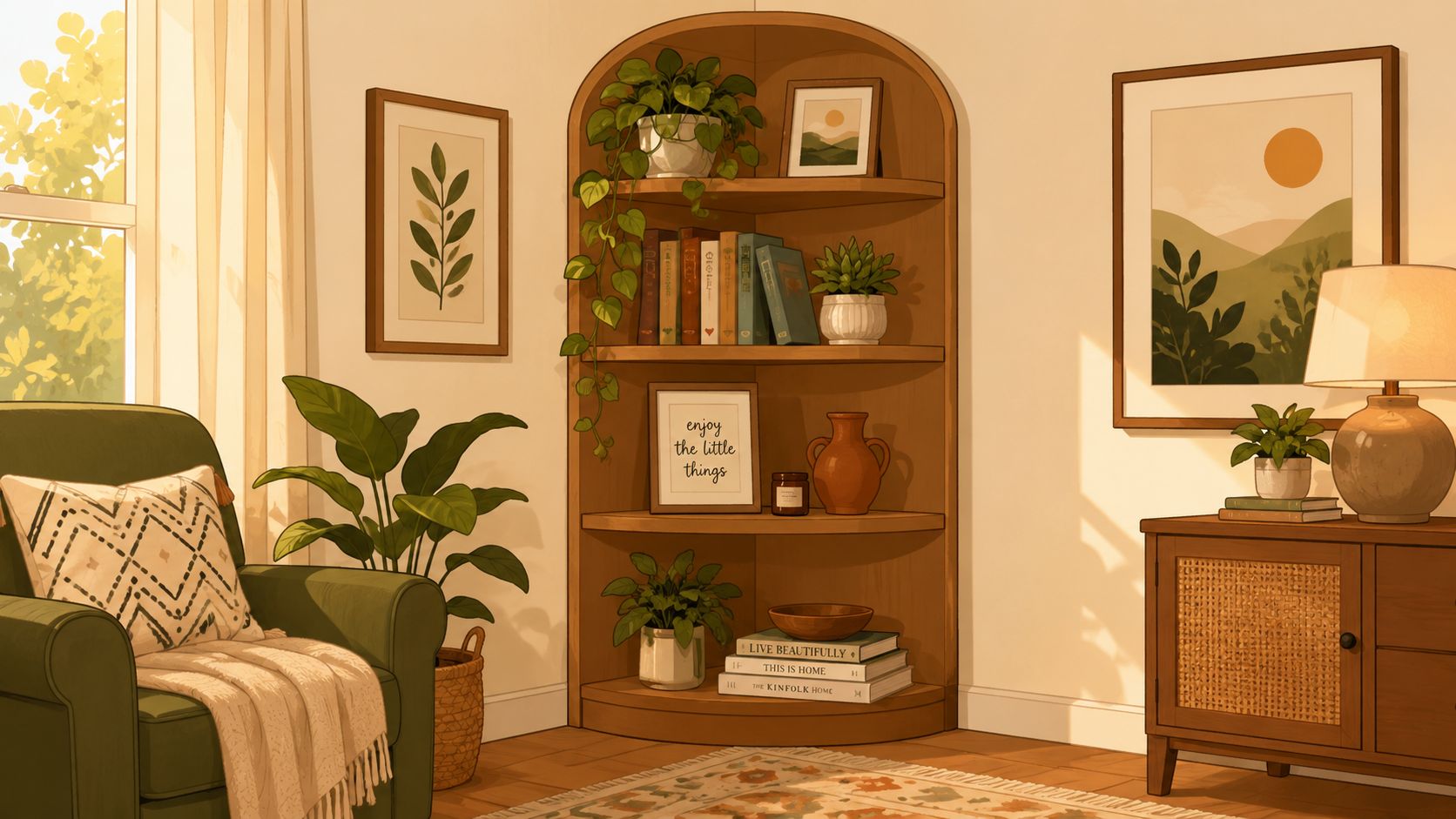
The bottom shelf should carry the heaviest suitable objects. Books, a sturdy basket, or a substantial planter can visually anchor the unit, while lighter frames and small decor can move upward. Uneven loading increases the overturning moment, so the safest arrangement also tends to look balanced.
Build an easy visual rhythm
A useful arrangement mixes height, texture, and empty space:
- Begin low: Place the heavier approved items on the lowest tier.
- Vary the levels: Combine horizontal book stacks with upright frames, plants, or sculptural objects.
- Leave breathing room: Roughly a third of each shelf can remain open so the display doesn't feel crowded.
- Repeat a finish: Echo a wood tone, metal color, or fabric texture already present in the room.
- Keep daily items reachable: Frequently used reading material shouldn't be placed where reaching becomes awkward.
Plants can soften a hard corner, especially beside a sofa or in a bedroom. For ideas about choosing plant sizes, grouping greenery, and caring for display plants, readers can explore Little Green Leaf's plant decor tips. The shelf still needs protection from standing water, damp soil, and spills.
Protect the structure through ordinary use
Weight should be distributed across multiple shelves rather than concentrated on one tier. Items should be lifted or slid carefully instead of dragged across finished surfaces, and visible hardware deserves an occasional check for looseness, especially after the unit has been moved or assembled.
In a living room, a few books and a plant may be all the shelf needs. In a bedroom, folded accessories can fill baskets on lower tiers while personal items remain within reach. In a small office, papers and supplies belong in containers that keep individual shelves organized instead of turning the unit into a leaning stack.
A well-styled shelf is easier to use because every object has a place, and a well-loaded shelf is easier to trust because the weight is intentional.
Construction also influences care. Product guidance commonly points to reinforced frames, fixed or adjustable shelves, clearly stated weight limits, powder-coated metal, and water-resistant engineered wood as useful features, especially in moisture-prone rooms. A kitchen or bathroom placement calls for particularly careful attention to cleaning products, splashes, and ventilation.

For room-by-room ideas, this guide to decorating shelves in any room can help a household adapt the same principles to living areas, bedrooms, offices, and dining spaces.
Bringing It Home with a Little Local Help
A corner shelf doesn't become useful when the box reaches the porch. It becomes useful when the piece arrives intact, reaches the intended room, sits level, and works with the household's traffic patterns.
A tall, narrow unit can be more awkward to carry than a low side table. Delivery crews may need to protect floors, manage stairs and doorways, place the shelf in the selected corner, and remove packaging. That practical help matters when the unit is top-heavy, when a hallway turns sharply, or when a homeowner shouldn't be lifting furniture alone.
Setup can solve small but important problems
Professional setup can help with:
- Uneven flooring: Leveling feet or careful placement can reduce rocking on carpet or imperfect floors.
- Wall proximity: A crew can position the shelf properly against an adjacent wall without forcing it into trim.
- Safety hardware: Staff can explain where an anti-tip strap or optional anchor belongs.
- Room balance: The shelf can be assessed beside existing furniture rather than judged in isolation.
- Packaging removal: The household doesn't have to manage cardboard and protective materials after delivery.
Guynn Furniture & Mattress provides free in-home delivery and setup within 60 miles. The service is relevant for residents in Galax, Independence, Hillsville, and the wider Southwestern Virginia and Northern North Carolina region, where a local delivery team can connect the purchase to the actual home.
A design consultation can be just as practical as delivery. Debra Williams or the expert design staff can review room photographs, discuss traffic flow, consider nearby furniture, and help coordinate wood tones, finishes, and display proportions. That service is useful for an aspiring remodeler who can see the empty corner but has trouble visualizing the finished room.
Guynn's showroom also gives shoppers a no-pressure atmosphere for comparing finishes, gently testing stability, and asking about per-shelf limits in person. The store carries La-Z-Boy as a Showcase dealer, along with Ashley and Bassett furniture, plus Sealy and Therapedic mattresses, so a corner shelf can be considered alongside the room's broader comfort and furnishing plan. Guynn has served the community since 1902, and its local approach includes a large in-stock selection for immediate delivery rather than asking every customer to wait on an online-only order.
Financing can help a household choose a preferred material or finish without stretching the budget all at once. When price is part of the decision, Guynn's Low Price Promise matches local competitors and includes a 30-day price guarantee. The important step is to compare the complete purchase, including delivery, setup, and the shelf's intended daily use.

Households can bring room photos, a rough floor sketch, and the measurements recorded before shopping. Questions about shelf depth, load limits, anchoring, and placement are easier to answer when the corner is treated as part of the home rather than as an isolated product listing. Details about furniture installation services can help clarify what support is available after purchase.
Visit Guynn Furniture & Mattress to explore free standing corner shelves and related home furnishings in a no-pressure atmosphere. Visit the showrooms in Galax, Independence, or Hillsville to test finishes and stability, schedule a consultation with the design team to plan the corner, and ask about free in-home delivery and setup within 60 miles.