
Best Sofa for Back Support Guide for Pain-Free Comfort

A long evening on a sofa can reveal a problem that a quick showroom test misses. The seat feels soft at first, but after an hour, the pelvis rolls backward, the lower back loses contact with the cushion, and standing up becomes the least comfortable part of relaxing. For families in Galax, Independence, Hillsville, and the wider Southwestern Virginia and Northern North Carolina region, choosing the best sofa for back support means looking beyond a plush first impression.
The right sofa combines supportive geometry, dependable cushion construction, and a backrest that keeps the lumbar curve supported. Guynn Furniture & Mattress has helped local households furnish their homes since 1902, with a no-pressure atmosphere, free in-home delivery and setup within 60 miles, and furniture available to experience in person rather than judged from a screen. Readers planning a warm, practical home can also find useful style inspiration in this guide to creating a modern farmhouse living room.
Introduction to Choosing the Best Sofa for Back Support
A homeowner may start shopping after noticing the same pattern every night. The sofa looks attractive, fits the room, and feels inviting when first tested. Yet the lower back aches during a movie, the feet slide forward, and the sitter eventually adds pillows to fill a gap behind the waist.
That problem usually comes from poor proportions rather than firmness alone. A cushion can feel comfortable while allowing the pelvis to rotate backward, which leaves the spine rounded and the lumbar area unsupported. Seat depth, seat height, back pitch, cushion resilience, armrest position, and lumbar contour all shape the way the body rests.
A 1999 review of sitting biomechanics found that supported backrest angles between 110° and 130° were associated with the lowest intervertebral disc pressures and the lowest spinal muscle electromyography readings when adequate lumbar support was present (review of sitting biomechanics). That doesn't mean every household needs a reclining sofa. It does mean a slightly reclined, supportive back often works better than a rigid upright cushion.
Practical rule: The best sofa for back support should let the sitter keep the lower back against the backrest while both feet remain comfortably supported.
Guynn's ultimate sofa buying guide can help with broader room planning, while this guide focuses on the features that matter most for prolonged sitting, family use, and long-term cushion performance.
| Sofa priority | What to look for | Main trade-off |
|---|---|---|
| Upright sitting | Moderate depth, clear lumbar contour, supportive seat core | Less room for sprawling |
| Reclined comfort | Slightly pitched back or adjustable recline | Requires careful head and lumbar alignment |
| Long-term support | Dense foam or a well-designed support system | May feel firmer at first |
| Family flexibility | Resilient cushions, durable upholstery, sturdy frame | The softest styles may be less suitable |
| Easier standing | Supportive seat height and firm edge | Very low lounge styles become less practical |
The following recommendations are designed to make sofa shopping calmer and more specific. Instead of asking whether a sofa feels soft, shoppers can ask whether it holds the body in a position that remains comfortable after sustained use.
Understanding Key Sofa Features for Back Support
The best sofa for back support starts with geometry. Cushion material matters, but even excellent foam can't correct a seat that's too deep for the person using it.
Seat depth and back pitch
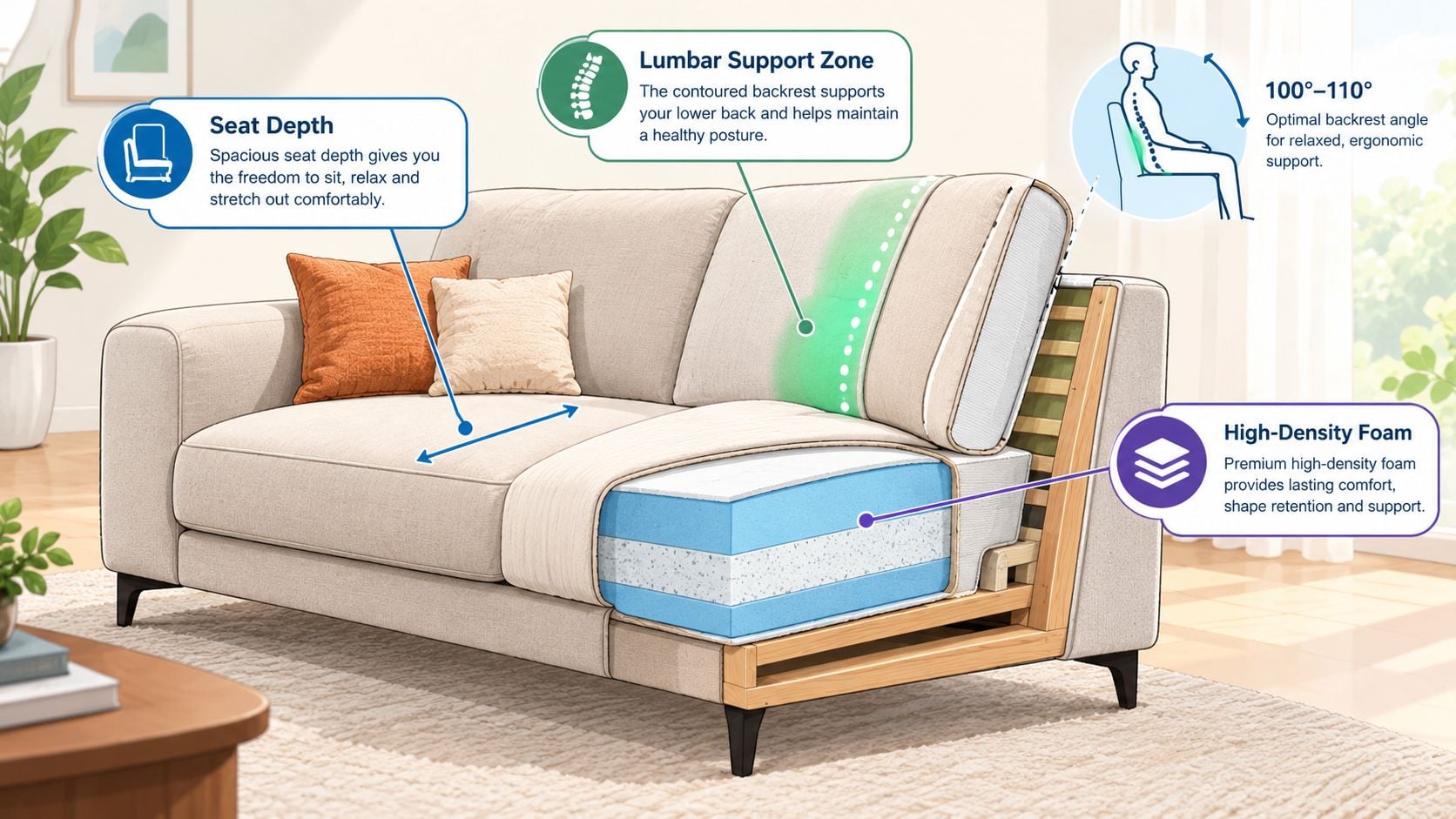
Ergonomic guidance generally places usable seat depth around 18 to 22 inches, with a back pitch near 100° to 110°. Lumbar support should fill the lower-back curve instead of leaving a hollow gap. One practical benchmark places lumbar support 14 to 16 inches above the seat base, while another recommends a depth of 20 to 22 inches and back cushions reaching at least mid-back height (sofa geometry guidance).
A deeper seat can work for lounging, but only if the cushion arrangement lets the sitter stay in contact with the backrest. If the feet reach the floor only after sliding forward, the sofa is effectively too deep for upright support.
Foam density and firmness
For a seat core intended to resist bottoming out, a strong technical target is about 2.4 to 2.8 lb/ft³ with firmness around 30 to 44 ILD. Higher-density foam is less likely to collapse under daily use, helping the seat preserve its original support. Guidance for everyday cushions also places density around 2.5 to 2.9 lb/ft³, with 2.8 lb/ft³ at approximately 44 ILD identified as a long-wear support target (cushion foam guidance).
That doesn't mean the hardest cushion is automatically the right choice. A supportive sofa should feel stable without creating pressure at the hips or thighs. A structured foam core, quality wrapping, and a properly supported frame matter more than a hard surface.
Lumbar support and the frame
A shaped lumbar contour is more useful than a decorative back cushion that leaves the waist unsupported. Adjustable lumbar systems can help households with different body sizes, especially when paired with an adjustable headrest or recline function.
The frame and suspension deserve equal attention. Shoppers should ask how the seat is supported beneath the foam, whether the cushions can be rotated or replaced, and whether the back maintains its shape when someone leans into it. Those details often determine whether the sofa continues to feel balanced after regular family use.
For readers comparing supportive recliners or mobility-oriented seating, Top Mobility's MVP 502 P2030 offers a useful example of how specialized seating can combine positioning, support, and powered adjustment. Guynn's sofa and chair buying tips provide another practical checklist for evaluating construction before purchase.
Comparing Top Back Support Sofa Designs
There isn't one universal sofa style for every back concern. A reclining sofa may suit someone who needs frequent position changes, while a traditional stationary sofa may provide the cleanest upright posture. A household with children and pets may need durable, resilient cushions more than a delicate sink-in feel.
The table below is a design comparison, not a list of measured specifications for individual products. Brand collections and configurations vary, so shoppers should confirm the actual floor model's dimensions and cushion construction before ordering.
| Brand model | Seat depth (in) | Foam density (lb/ft³) | Backrest angle (°) | Lumbar support | Price range |
|---|---|---|---|---|---|
| La-Z-Boy Showcase reclining styles | Confirm in showroom | Confirm model specification | Adjustable by model | Often available through reclining configuration | Confirm current price |
| Ashley medium-firm series | Confirm in showroom | Confirm model specification | Confirm model specification | Model-dependent | Confirm current price |
| Bassett customizable options | Selected by configuration | Selected by configuration | Selected by configuration | Can vary by design | Confirm current price |
| Therapedic pressure-relief couches | Confirm in showroom | Confirm model specification | Confirm model specification | Support-focused configuration | Confirm current price |
La-Z-Boy reclining styles
As a La-Z-Boy Showcase dealer, Guynn can help shoppers compare reclining sofas with adjustable positioning. The main advantage is flexibility. A sitter can change the back angle and leg position instead of remaining fixed in one posture throughout an evening.
The trade-off is that a reclining mechanism doesn't automatically guarantee lumbar support. The lower back should remain in contact with the backrest when the seat is upright and when it reclines. Power lumbar and adjustable headrest features are worth testing rather than assuming they'll fit every body.
Ashley and Bassett options
Ashley's medium-firm designs may appeal to families who want a stable everyday seat without an overly formal appearance. The important checks are seat depth, edge support, cushion rebound, and whether the back cushions hold the lumbar area at the correct height.
Bassett's customizable approach can be helpful when the room or the household requires a more specific fit. Customization is valuable only when shoppers use it to solve a real ergonomic need, such as reducing excess depth or selecting a more supportive cushion. Extra options shouldn't distract from the basic posture test.
Therapedic and pressure relief
Pressure distribution matters because the body shouldn't carry all its weight through a small area of the backrest or seat. A 2009 biomechanical study found that reduced ischial support combined with enhanced lumbar support lowered lumbar muscle activity and reduced sitting load on the lumbar spine. The setup also increased backrest contact and shifted pressure toward the thighs (biomechanical sitting study).
That study also reported that a supplementary backrest reduced peak back pressure by 35% and average back pressure by 20%. These findings support a simple buying principle: backrest design can relieve pressure without relying only on cushion firmness.
The same research reported sofa backrest pressure recommendations of no more than 0.4 N/cm² for maximum pressure and about 0.15 N/cm² for average pressure, with approximately 0.2 N/cm² and 0.1 N/cm² described as optimal levels (pressure distribution research). Most shoppers won't measure pressure in a showroom, but they can notice whether the back feels evenly supported or whether one area takes all the load.
For a focused look at reclining configurations, Guynn's guide to reclining sofas for back pain can help households compare adjustable and stationary designs. The strongest choice is the one that preserves lumbar contact, supports the thighs, and remains comfortable after extended sitting.
Buyer Profiles and Sofa Selection Criteria
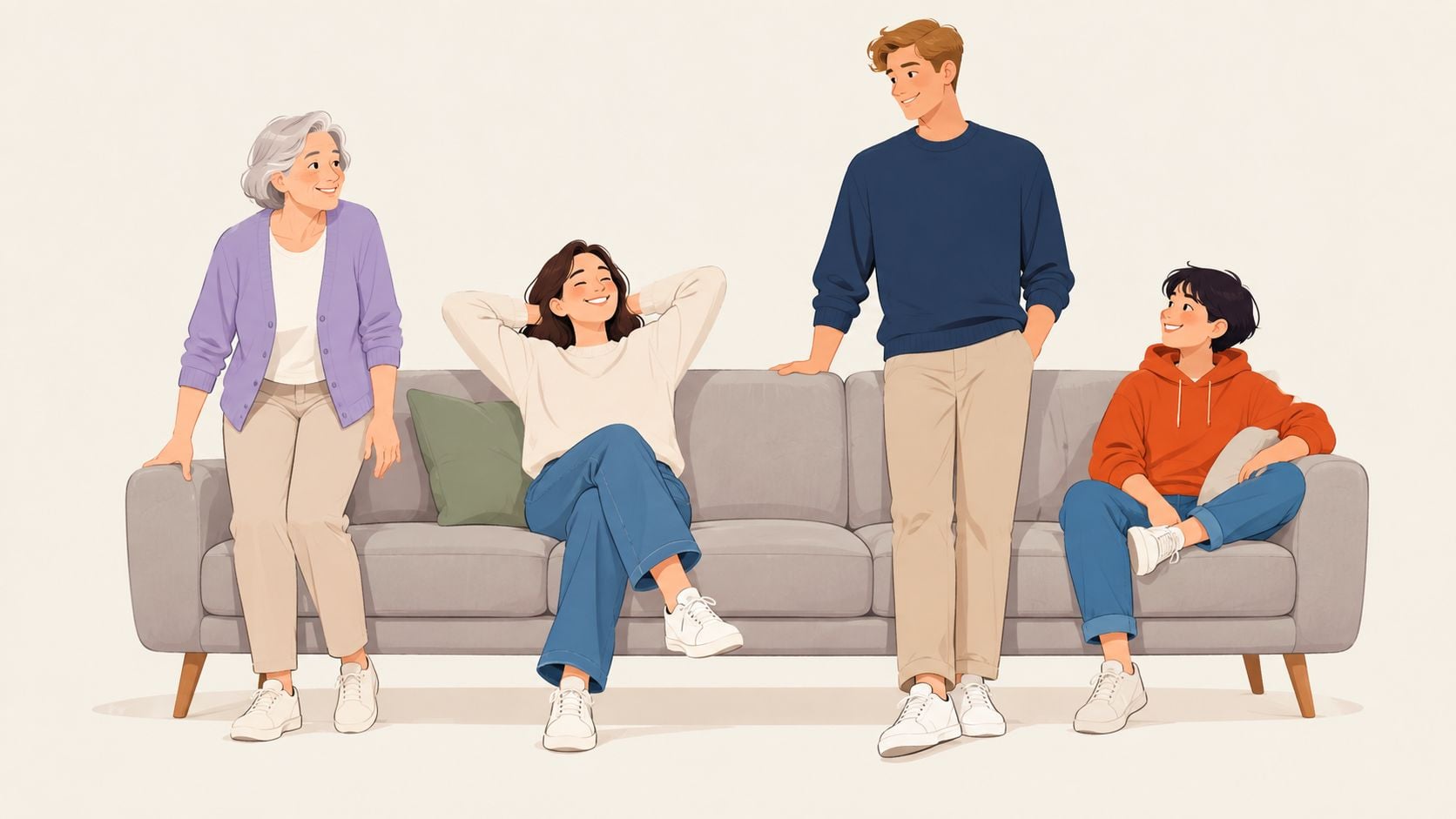
A sofa should fit the people who use it, not an imaginary average shopper. A compact, upright design may suit a shorter adult perfectly but feel cramped to a taller person. A deep sectional may delight a household that lounges sideways while frustrating anyone who needs upright lumbar contact.
The older adult
Older shoppers often benefit from a seat that feels stable when standing up. A supportive edge, moderate seat height, firm lumbar contour, and easy-to-use recline or lift function can reduce the effort involved in changing position.
The sofa shouldn't swallow the sitter. A low, soft cushion may look relaxed but can make standing harder and may allow the pelvis to roll backward.
The person with recurring back discomfort
This shopper should prioritize consistent lumbar contact and a controlled back angle. A cushion that feels plush for a few minutes can become problematic if it permits sliding or sinking. Adjustable lumbar support is particularly useful when different household members have different body shapes.
A sofa isn't a substitute for medical care. Anyone dealing with persistent or severe pain should seek appropriate professional guidance, then use that information when selecting daily seating.
Taller and shorter users
Seat depth needs to match leg length and sitting habits. Guidance commonly places usable depth around 20 to 22 inches for upright sitting, while 23 to 25 inches may work better for lounging if the lower back remains against the backrest (seat-depth guidance).
Very deep seats can reduce lumbar contact. One cited fixed-seat benchmark is 16.5 inches, with adjustable seat depths ranging from 14 to 18.5 inches in a more compact seating context. These figures aren't a universal sofa specification, but they reinforce the need to test the actual sitting position.
The active family
Families with children, pets, or frequent visitors need cushions that recover their shape and upholstery that tolerates daily activity. A performance-oriented sofa with removable or serviceable cushions may be more practical than a delicate style that demands constant reshaping.
Guynn's guide to sofas for pet owners can help families consider upholstery and maintenance alongside posture. The most suitable family sofa balances lumbar support with snacks, naps, climbing, and everyday messes.
Using a Back Support Sofa Decision Matrix
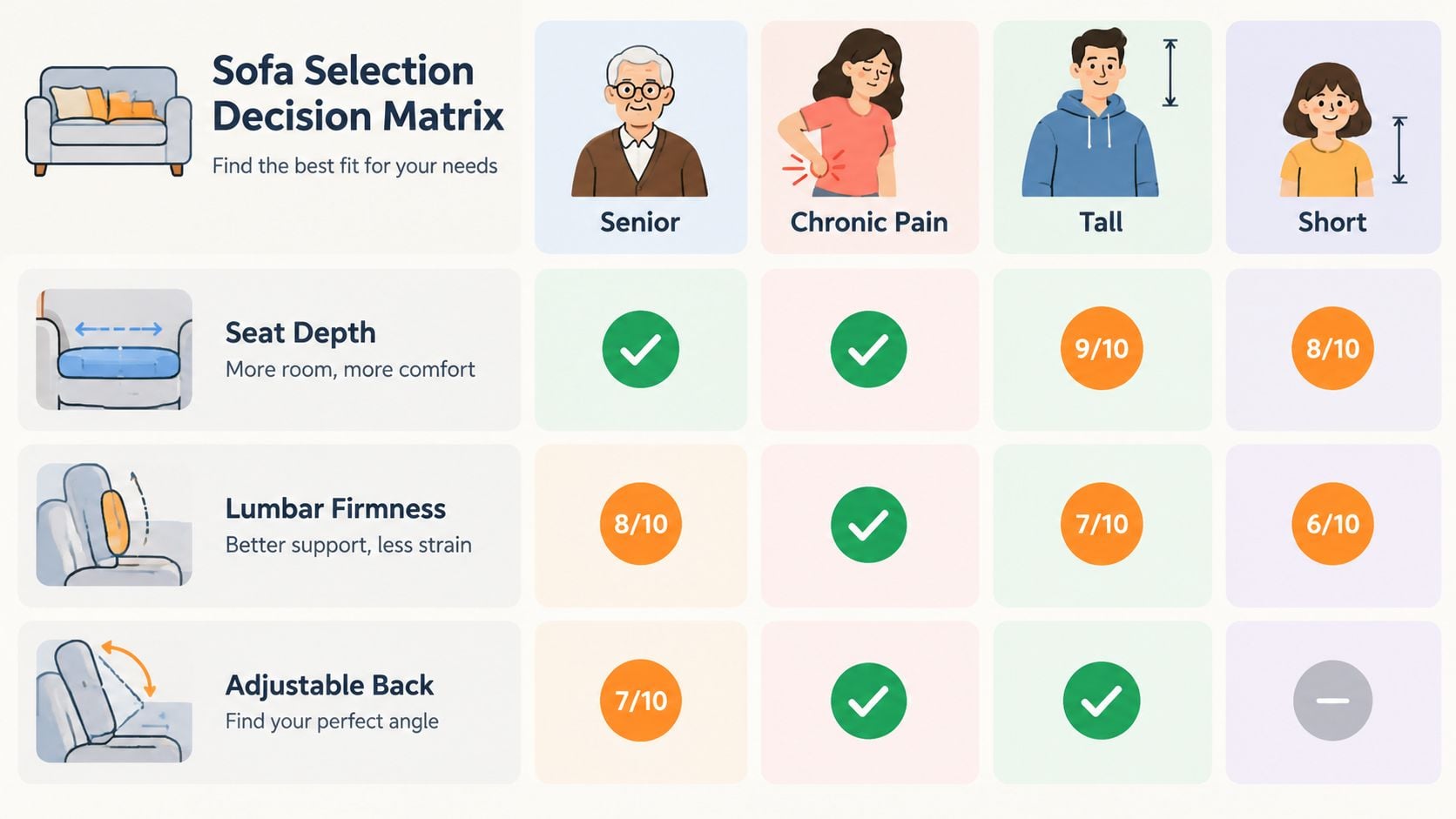
A decision matrix keeps shoppers from choosing a sofa based on one attractive feature. The method is simple: identify the body and lifestyle requirements first, then eliminate models that fail the essentials.
Step one, define the main use
A sofa used mostly for upright reading needs different proportions from one used for reclining television sessions. Write down the dominant activity before testing models.
- Upright sitting: Favor moderate depth, mid-back contact, and a clear lumbar contour.
- Mixed sitting and lounging: Consider adjustable recline, but confirm that lumbar support remains connected to the body.
- Frequent standing: Give extra weight to seat stability, edge support, and a height that doesn't force a deep squat.
- Family lounging: Choose resilient cushions and practical upholstery without sacrificing the basic posture fit.
Step two, score the physical fit
Use a simple three-level rating for each sofa:
- Strong fit: The lower back contacts the lumbar area, feet feel supported, and the sitter can rise without fighting the cushion.
- Acceptable fit: The sofa works with a small adjustment, such as a supportive lumbar pillow or a different cushion position.
- Poor fit: The sitter slides forward, loses back contact, or feels pressure concentrated in one area.
The decision matrix should give the highest priority to lumbar contact and usable depth. A beautiful fabric or attractive arm shape can't compensate for a sofa that consistently rounds the lower back.
Step three, verify construction
Ask about the seat core, cushion replacement, suspension, and mechanism warranty. For back-support goals, the technical target remains about 2.4 to 2.8 lb/ft³ foam density and 30 to 44 ILD firmness, as discussed earlier. A showroom associate should be able to explain whether the displayed model meets that target or uses a different support system.
Research on supplementary backrests found measurable reductions in peak and average pressure, supporting the matrix's emphasis on backrest contact rather than softness alone (backrest pressure findings). The winning model is not the one with the highest score in every category. It's the one that passes the essential criteria for the person who'll sit there most.
How to Test Sofa Comfort In Store
A showroom test should imitate real use, not a quick sit followed by an immediate decision. Bring the shoes normally worn at home, sit in the position used for reading or watching television, and stay long enough to notice whether the body starts sliding forward.
A practical test sequence
- Check the feet: Both feet should rest comfortably on the floor in the preferred upright position.
- Check the knees: The legs should feel supported without the seat edge pressing sharply behind the knees.
- Check the lumbar curve: The lower back should meet the cushion without a large gap or a forced rounded posture.
- Check the back angle: A slightly reclined back often feels more natural than a rigid upright back, but the head shouldn't tip forward.
- Check the cushion recovery: Stand up, press the cushion, and ask how the material is expected to perform after regular use.
- Check adjustment: On a recliner, test upright, partially reclined, and fully reclined positions. Lumbar contact should remain deliberate rather than disappearing as the mechanism moves.
A 2025 to 2026 buyer test cited in the research brief found that only 3 of 8 sofas still felt supportive after 90 days, highlighting why day-one softness isn't enough. Families should ask about cushion maintenance, rotation, replacement availability, and expected support retention.
Look past the first five minutes. The better question is whether the sofa will still hold the lower back after months of ordinary sitting, not whether it feels plush at the start.
Seat height affects how easily people sit down and stand up. Shoppers can use Guynn's guide to average couch height as a reference, then confirm the actual floor model with the person who'll use it most.
Final Recommendations for Your Home
The best sofa for back support is usually a moderately firm, properly proportioned design with clear lumbar contact. For older adults, a stable seat with supportive edges and optional lift or recline assistance makes practical sense. For recurring back discomfort, adjustable lumbar support and a controlled recline are stronger choices than a deep, sink-in cushion. Taller shoppers should test back height and depth together, while shorter shoppers should be especially cautious with oversized seating.
Active families need a sofa that preserves its shape and stands up to real household use. La-Z-Boy reclining styles, Ashley's medium-firm options, Bassett configurations, and Therapedic seating can all be worth testing, provided the specific model passes the posture and durability checks.
Guynn Furniture & Mattress offers a large in-stock selection for immediate delivery, unlike online-only shopping that prevents a proper sit test. The store's expert design staff, including Debra Williams, can help coordinate a supportive sofa with the room, while the Low Price Promise matches local competitors and includes a 30-day price guarantee. The company serves Galax, Independence, Hillsville, and the wider Southwestern Virginia and Northern North Carolina region, with free in-home delivery and setup within 60 miles.
Visit Guynn Furniture & Mattress to test supportive sofa designs in person at the Galax, Independence, or Hillsville showrooms. Schedule a consultation with the design team, including Debra Williams, or browse the selection online to start planning a comfortable room with confidence.

