Hybrid Mattress vs Memory Foam: A 2026 Buyer’s Guide

A lot of mattress shoppers start in the same place. One browser tab says memory foam is the answer. Another says hybrid is the smarter buy. A third promises luxury sleep in a box, and by the end of the evening, every mattress starts sounding the same.
That confusion makes sense. A mattress isn't just another household purchase. It affects how a bedroom feels, how easily someone falls asleep, and how rested they feel the next morning. For households in Galax, Independence, Hillsville, and across Southwestern Virginia and Northern North Carolina, the decision often feels bigger because nobody wants to spend good money on the wrong comfort.
That's why an in-person approach still matters. Since 1902, Guynn family stores have helped local households sort through comfort choices in a no-pressure atmosphere. A shopper comparing foam and hybrid models can learn a lot from specs, but the difference becomes apparent when someone lies down, rolls to one side, sits on the edge, and notices how the mattress feels. For readers dealing with sleep discomfort tied to jaw tension or nighttime clenching, this guide to assessing sleep for TMJ patients can also be a helpful extra layer of context.
Table of Contents
- Finding Your Perfect Mattress In a Sea of Choices
- What Is Inside a Hybrid and a Memory Foam Mattress
- Comparing the Feel Support and Temperature
- Durability and Long Term Value
- Which Mattress Is Best For Your Sleep Style
- The Guynn Furniture Advantage In Your Search
- Our Family's Recommendations and Your Next Step
Finding Your Perfect Mattress In a Sea of Choices
A common local story goes like this. A couple spends days reading reviews, comparing firmness charts, and trying to decode words like “responsive,” “supportive,” and “pressure relief.” Then they walk into a showroom, try two beds for ten minutes, and suddenly understand more than they did after hours online.
That happens because mattress shopping is tactile. The body notices things a product page can't explain well. One mattress lets the shoulders settle in gently. Another keeps the hips more level. One feels still and cocooning. Another feels easier to move around on.
For many households, the biggest relief is having somebody slow the process down. Instead of guessing, they can compare materials, ask plain-language questions, and connect comfort to real life. A guest room may need something different from a primary bedroom. A hot sleeper may need something different from a side sleeper. Someone furnishing a first home may care most about affordability, while another shopper may care more about long-term durability.
A mattress choice gets easier once the shopper stops asking, “What's the most popular?” and starts asking, “What does this feel like for the way this person actually sleeps?”
That's also why a practical guide can help before the showroom visit. Readers who want a broader local overview can start with this mattress buying guide, then use the article below to narrow the choice between hybrid and memory foam.
What Is Inside a Hybrid and a Memory Foam Mattress
Before discussing comfort, it helps to look under the cover. The reason these beds feel different is simple. They're built differently.

Memory foam construction
A memory foam mattress is made primarily from foam layers. Near the top, the comfort layers are designed to contour around the body. Beneath that, denser foam supports the sleeper and helps the mattress hold its shape.
A simple way to think about memory foam is a custom-molded cushion. It responds to body weight and shape, then gently cradles pressure points like shoulders and hips. That's why many people describe memory foam as a “hugging” feel.
This construction often appeals to shoppers who want:
- Closer contouring for pressure relief
- Less bounce when they move
- A quieter feel with less noticeable movement across the bed
Hybrid construction
A hybrid mattress combines foam comfort layers with a coil support system underneath. Those coils are often individually wrapped, which helps cut down on the old-fashioned springy feel many people remember from older beds.
A useful analogy is a car's suspension. The foam layers handle cushioning, while the coils do the heavier support work underneath. That balance is why hybrids often feel both cushioned and easier to move on.
Shoppers who want a construction overview before visiting a store can also read this explanation of what a hybrid mattress is.
Why the inside changes the feel
Construction affects several parts of the sleep experience, but one of the clearest differences is temperature. Hybrid mattresses consistently sleep cooler with an average cooling score of 8.8 compared to 8.2 for pure memory foam mattresses, a difference confirmed by testing data from over 290 mattresses according to cooling comparison testing.
That cooler feel makes sense once a shopper understands the build. Coils create open space inside the mattress, and that space allows more airflow. Foam-only designs don't have the same internal air channels.
Practical rule: If a shopper tends to throw off blankets at night or wakes up feeling warm, construction matters just as much as firmness.
In stores, this difference becomes obvious fast. A person lying on memory foam often notices that slow, body-conforming feel. A person trying a hybrid often notices that the bed pushes back a little more and feels less closed-in.
Comparing the Feel Support and Temperature
The hybrid mattress vs memory foam decision usually comes down to what the body notices in the first few minutes. Does the mattress allow the sleeper to sink into it, or does it hold them more on top of the bed? Is it easy to turn over? Does the edge feel stable when sitting down?
Hybrid vs. Memory Foam At a Glance
| Feature | Memory Foam | Hybrid |
|---|---|---|
| Feel | Close contouring, slower response | More responsive, a little bouncier |
| Pressure relief | Strong contouring around shoulders and hips | Balanced contouring with pushback from coils |
| Temperature | Can feel warmer for some sleepers | Usually sleeps cooler because of coil airflow |
| Motion isolation | Strong at absorbing movement | Good, but depends on coil design |
| Edge feel | Often softer at the perimeter | Usually sturdier along the edge |
| Ease of movement | More sink-in feel | Easier to change positions |
| Best fit | Sleepers who want a body-hugging feel | Sleepers who want support, airflow, and responsiveness |
Readers who want a foam-specific primer can explore this memory foam mattress guide.
What the showroom test reveals
A product page may call a mattress “plush,” but that word can hide very different sensations.
Memory foam usually feels slower and deeper. When someone lies down, the foam conforms around the body and softens the contact points. For side sleepers, that often means the shoulders and hips feel cushioned instead of pressed upward.
Hybrid mattresses usually feel more buoyant. They still have comfort layers on top, but the coils underneath create more pushback. In practical terms, that means many sleepers find it easier to roll, reposition, or get out of bed.
A short in-store test often helps shoppers notice these differences:
- Lie still for a few minutes: Memory foam often reveals its contouring best when the body has time to settle.
- Roll from back to side: Hybrids usually feel quicker and easier during position changes.
- Sit on the side: The edge feel becomes clear immediately.
- Notice shoulder and hip pressure: Side sleepers often recognize their preference quickly.
Where temperature and edge support stand out
Temperature is one of the biggest dividing lines in the hybrid mattress vs memory foam comparison. A shopper who sleeps comfortably on foam may never mind the warmer feel. A hot sleeper often notices it right away.
Edge support is another area where the difference feels very physical in a showroom. Hybrid mattresses provide significantly better edge support, measuring 3.75 inches for sitting comfort, whereas memory foam mattresses often compress at the perimeter, limiting usable surface area and reducing stability for edge sleepers according to mattress edge support testing.
That matters more than some shoppers expect. A stable edge helps when someone:
- Sits to put on shoes
- Sleeps near the perimeter
- Shares a smaller mattress with a partner
- Wants the full sleep surface to feel usable
For an older adult or anyone who sits on the side of the bed before standing, the edge feel can matter almost as much as the center feel.
Motion isolation rounds out the comparison. Memory foam is widely known for reducing the sensation of a partner's movement. Hybrids can still perform well, but their feel depends more on the coil system and comfort layers.
So the short version is this. Memory foam often wins the “quiet, close, cushioned” category. Hybrid often wins the “cooler, steadier, easier to move” category.
Durability and Long Term Value
A mattress doesn't need to be the least expensive option to be the better value. What matters is how long it keeps doing its job and whether the comfort still fits the household several years down the road.
What lasts longer in everyday use
Construction plays a major role here. High-density memory foam mattresses typically last 6 to 8 years, whereas hybrid mattresses have a superior durability lifespan of 8 to 10 years on average due to their coil-based support core according to industry durability benchmarks.
That doesn't mean every memory foam mattress wears out quickly, or that every hybrid automatically outlasts it. It means the support system matters over time. Coils tend to maintain structure differently than an all-foam base.
Shoppers who want more general guidance on replacement timing can review how long a mattress should last.
A household may notice durability in everyday ways such as:
- Surface consistency: Does the mattress still feel even from side to side?
- Body impressions: Are there visible or noticeable settling areas?
- Edge stability: Does sitting near the perimeter feel secure over time?
- Support under the hips and lower back: Does the sleeper still feel level?
How price and value work together
Price matters, especially for first homes, growing families, and guest rooms. Hybrid mattresses generally carry a higher average price point, ranging between $800 and $2,500, while memory foam mattresses are often positioned as a more budget-friendly option, according to mattress pricing guidance.
That higher hybrid cost usually reflects the more complex build. There are more components, including coil systems and layered comfort materials. For some shoppers, that extra cost makes sense because the bed may deliver a cooler and more supportive feel they'll appreciate every night.
For others, memory foam remains the practical fit. A quieter guest room, a smaller budget, or a strong preference for a slow, contouring feel can make foam the smarter choice.
Local value matters too. When price enters the conversation, a clear policy helps reduce second-guessing. Guynn Furniture & Mattress offers a Low Price Promise, matches local competitors, and includes a 30-day price guarantee, which helps value-focused shoppers compare with more confidence.
Which Mattress Is Best For Your Sleep Style
The best mattress isn't decided by trend. It's decided by the sleeper's body, habits, and comfort priorities.
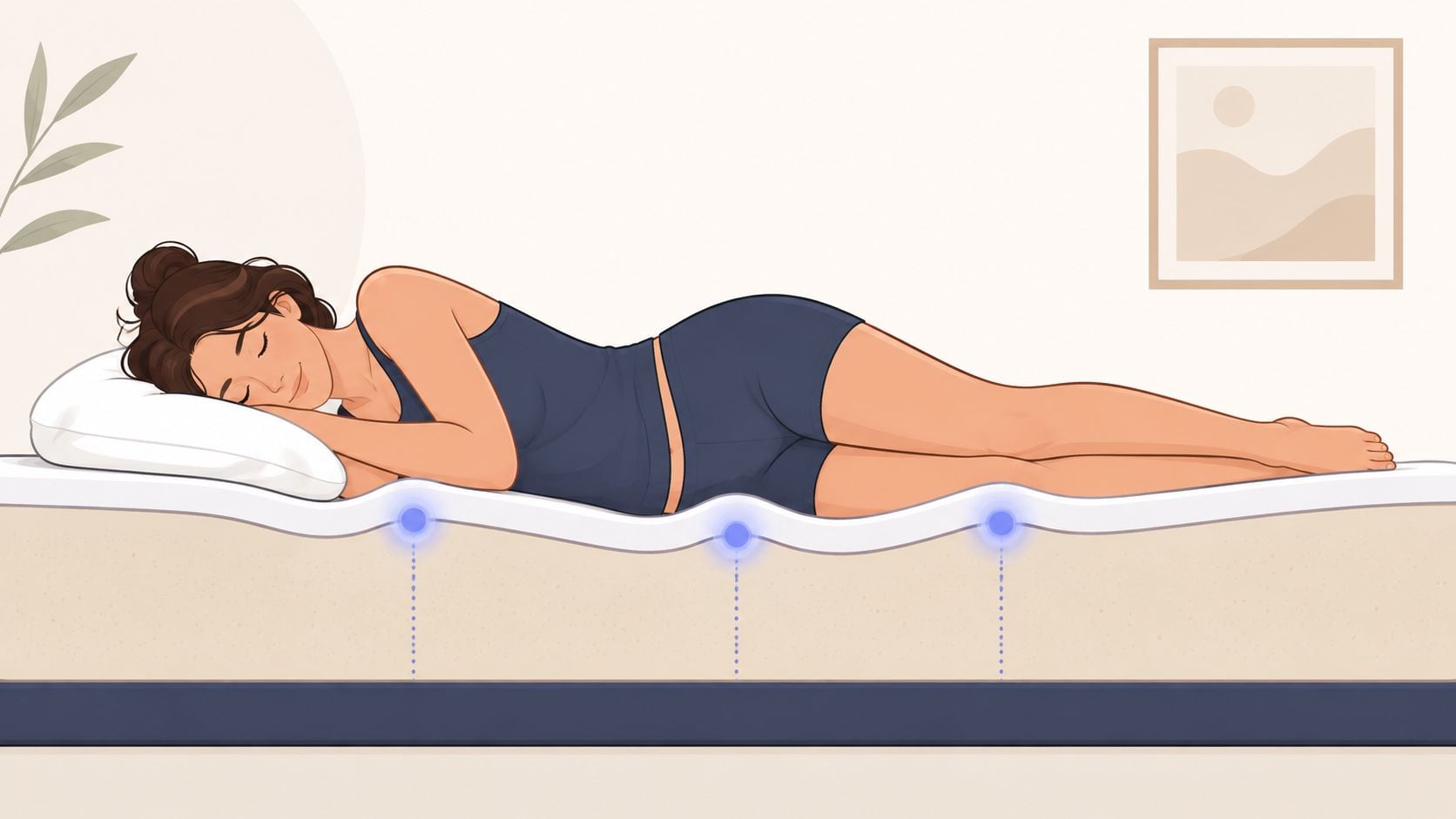
A useful starting point is choosing the right mattress for your sleeping style. From there, the hybrid mattress vs memory foam choice becomes much easier.
Side sleepers back sleepers and stomach sleepers
Side sleepers often pay the most attention to pressure relief. They usually notice whether a mattress cushions the shoulder and hip or pushes back too firmly. Many side sleepers enjoy memory foam because of that close contouring feel. Others prefer a softer hybrid that still gives some cushioning but feels easier to move around on.
Back sleepers often want a blend of comfort and level support. Too much sink can feel uncomfortable through the midsection. That's why many back sleepers like a hybrid, especially if they want a more balanced feel rather than a deep cradle.
Stomach sleepers often need a mattress that doesn't let the hips dip too far. For that reason, hybrids often appeal to this group, particularly shoppers who want a firmer and more responsive sleep surface.
Hot sleepers couples and mixed needs
Hot sleepers usually lean hybrid. As noted earlier, the airflow story is one of the clearest practical differences between these two mattress types. In a showroom, this often shows up as a more open, less enveloping feel.
Couples usually face a trade-off. One partner may want motion isolation. The other may want cooler sleep and stronger support. That's where details matter more than broad labels.
For couples where one partner weighs over 230 lbs, newer hybrid mattresses with 'zoned support' coils can reduce motion transfer by 40% compared to standard hybrids while maintaining critical airflow, solving the common 'motion vs. cooling' trade-off according to zoned coil hybrid guidance.
That's a meaningful point because many couples don't fit into a simple “foam for motion, hybrid for cooling” rule. Body size, sleep position, and sensitivity to movement all change the answer.
A couple shouldn't test a mattress by taking turns. They should lie down together, shift positions, and notice what happens when one person moves.
A practical matching guide looks like this:
- Choose memory foam when the sleeper wants a deeper hug, stronger motion isolation, and a softer, slower response.
- Choose hybrid when the sleeper wants easier movement, stronger perimeter support, and a cooler sleep environment.
- Test both if the household has mixed needs, especially couples with different body types or sleep temperatures.
The Guynn Furniture Advantage In Your Search
Reading specs is useful. Lying on the mattress is better.

Why testing in person changes the decision
A showroom visit solves the biggest problem in mattress shopping. It turns abstract words into physical feedback. “Pressure relief” becomes the feeling under the shoulder. “Support” becomes how level the hips feel. “Responsive” becomes how easily someone rolls from one side to the other.
That hands-on difference matters for every type of shopper:
- The Traditionalist: Wants a mattress that feels dependable and worth bringing home.
- The Aspiring Remodeler: Wants the bed to work with the rest of the bedroom, not just the sleep spec sheet.
- The Value Seeker: Wants comfort that fits the budget without gambling on an online guess.
- The Regional Neighbor: Wants practical service, not a complicated delivery story.
For households exploring Sealy and Therapedic options, trying both constructions side by side often clears up the decision quickly. Ashley and Bassett shoppers updating an entire bedroom also benefit from seeing how bed height, profile, and room scale work together. La-Z-Boy is better known for seating comfort, but that same comfort-first mindset matters in the sleep department too.
How local service removes the usual stress
The mattress itself is only part of the buying process. The rest is delivery timing, setup, budget, and whether help is available when questions come up.
For neighbors in Galax, Independence, Hillsville, and the wider Southwestern Virginia and Northern North Carolina region, local service makes that simpler:
- Free in-home delivery and setup within 60 miles
- A large in-stock selection for immediate delivery
- Flexible financing for budget planning
- A no-pressure atmosphere in the showroom
- Expert design staff, including Debra Williams, for broader bedroom planning
The easier the buying process feels, the easier it is to focus on comfort instead of logistics.
That's especially helpful for shoppers replacing an old mattress quickly, furnishing a new house, or coordinating a full bedroom refresh instead of buying one piece at a time.
Our Family's Recommendations and Your Next Step
For a shopper who wants the short answer, this is usually where the decision lands.
A memory foam mattress often fits the person who loves a deep, contouring feel and wants strong motion isolation. That can be a very comfortable choice for side sleepers, light sleepers, or anyone who wants the mattress to feel more cushioning than springy. In many bedrooms, a Therapedic foam model will appeal to that preference.
A hybrid mattress often fits the person who wants a balanced surface, easier movement, stronger support, and a cooler night's sleep. That can be especially appealing for back sleepers, hot sleepers, combination sleepers, and couples with mixed needs. In many cases, a Sealy hybrid model will line up with that feel.
For households shopping across Southwestern Virginia and Northern North Carolina, the clearest answer still comes from trying both. A few minutes of real testing usually says more than a week of scrolling. Since 1902, that simple, neighborly approach has helped local families feel more certain about what belongs in their home.
Visit our showrooms in Galax, Independence, or Hillsville to test the comfort for yourself. Schedule a consultation with our design team to start planning your dream room today. Browse our selection online at Guynn Furniture & Mattress.