Best Mattress for Motion Isolation: Top Picks 2026


A lot of couples know this moment. One person finally gets comfortable, drifts off, and then the whole bed seems to twitch because the other person rolled over, got up early, or let the dog jump up at the foot of the mattress. Sleep gets broken in small ways, but those small disruptions add up.
That's why so many shoppers start looking for the best mattress for motion isolation. They don't just want a softer bed or a firmer one. They want a mattress that keeps movement from spreading across the surface so one sleeper's restlessness doesn't become everyone's problem. For households across Galax, Independence, Hillsville, and the wider Southwestern Virginia and Northern North Carolina region, that question comes up all the time in the showroom.
Table of Contents
- An End to Restless Nights
- What Is Motion Isolation and Why It Matters
- How Different Mattress Constructions Handle Motion
- Key Features That Reduce Motion Transfer
- Finding the Right Balance Beyond Motion Isolation
- How to Test a Mattress for True Motion Isolation
- Find Your Perfect Mattress Here at Guynn
An End to Restless Nights
One common story sounds almost the same every time. A couple replaces pillows, adjusts the thermostat, maybe even changes bedtime routines, but one thing keeps happening. The lighter sleeper wakes up every time the other person turns, shifts, or climbs out of bed before sunrise.
That problem has a name. It's motion transfer, and the solution shoppers usually need is motion isolation. A mattress with strong motion isolation absorbs movement closer to where it starts, instead of letting it travel across the whole bed.
For couples, that can mean fewer midnight wake-ups. For parents with a child who occasionally crawls in, or for pet owners whose dog circles three times before settling down, it can also mean the bed feels calmer and steadier through the night.
A mattress can feel comfortable in the store and still be a poor fit at home if every little movement shakes the other side.
Sleep habits around the mattress matter too. Good bedding, room temperature, and winding down consistently all help create a quieter sleep environment. For readers who want a few simple bedroom habits to pair with a better mattress, SouthShore's tips for sleep offer practical ideas that fit easily into real life.
This matters even more in homes where schedules don't match. One partner may go to bed early, another may read late, and someone may be up before dawn for work. In those cases, the best mattress for motion isolation isn't a luxury feature. It's a sleep-saving feature.
Since 1902, families in this region have looked for practical comfort, not gimmicks. A mattress that helps one person sleep through another person's movement fits that goal perfectly.
What Is Motion Isolation and Why It Matters
Motion isolation is a mattress's ability to absorb movement so it doesn't spread across the bed. The easiest way to understand it is to compare two surfaces.
Drop a pebble into a pond, and ripples spread outward. That's what happens on a mattress with poor motion control. One sleeper moves, and the other side feels the effect. Drop the same pebble into sand, and the impact stays near the spot where it landed. That's what strong motion isolation feels like.

According to Sleep Foundation's mattress testing and reviews, motion isolation has become a major mattress-selection criterion because it directly measures how well a bed absorbs movement, and memory foam is consistently pointed to as the strongest material for this purpose because its dense, contouring structure absorbs movement before it travels.
Who notices motion transfer most
Not every sleeper reacts the same way to movement. Some people can sleep through almost anything. Others wake up when the mattress gives even a small nudge.
The people who usually care most include:
- Couples with different sleep schedules who don't want one person's bedtime routine waking the other.
- Light sleepers who notice every shift in the bed.
- Pet owners whose animals jump on and off during the night.
- Families with shared sleep space where a child may join the bed now and then.
Why it affects sleep quality
A mattress doesn't have to throw someone across the bed to interrupt rest. Small vibrations can be enough. The body may not fully wake up every time, but sleep can still become lighter and less settled.
That's why shoppers often get confused. They may think, “The mattress feels soft, so it should reduce movement,” or “The mattress feels firm, so it should be stable.” Motion isolation doesn't depend on feel alone. It depends on how the materials handle energy when someone moves.
Practical rule: If one partner can get in and out of bed without the other noticing much, the mattress is doing its job.
This is one reason the phrase best mattress for motion isolation shows up so often in mattress research. People aren't just chasing comfort in a general sense. They're trying to protect uninterrupted sleep.
How Different Mattress Constructions Handle Motion
The mattress type gives shoppers a strong first clue about how much movement they'll feel. Construction matters because each material responds differently when weight shifts on the surface. Around Southwestern Virginia and Northern North Carolina, this is often where mattress shopping starts to make more sense. Once shoppers know how the main categories behave, the choices narrow quickly.
| Mattress Type | Motion Isolation | Feel | Best For |
|---|---|---|---|
| Memory foam | Best | Contouring, close-hugging | Couples, light sleepers, people bothered by movement |
| Latex | Notable motion reduction | Buoyant, responsive | Sleepers who want less bounce without a deep sink |
| Hybrid | Middle ground | Balanced, supportive with some bounce | Shoppers who want reduced transfer with easier movement |
| Traditional innerspring | Least effective | Springy, more reactive | Sleepers who prefer a classic feel and don't mind more movement |
Memory foam
Memory foam usually leads the conversation for one simple reason. It absorbs movement well instead of sending it outward across the mattress.
When a sleeper rolls from one side to the other, the foam compresses around that body and contains more of the motion near that spot. That's why couples often notice a calmer surface on this type of bed. Anyone who wants a deeper look at how this material behaves can read Guynn's memory foam mattress guide.
Memory foam also creates a distinct feel. Some sleepers love the body-hugging comfort. Others feel it's slower to respond when they change position. That doesn't make it wrong. It just means the strongest motion isolation often comes with a more contouring surface.
Latex
Latex sits in a different lane. It can still reduce motion, but it usually feels more buoyant than memory foam.
That buoyant feel helps some sleepers move around more easily. A combination sleeper, for example, may like that quicker response. The trade-off is that it doesn't usually damp movement the same way dense memory foam does. It softens the disturbance, but it often won't erase it as completely.
Hybrid
Hybrid mattresses often make sense for households trying to balance more than one priority. They combine foam comfort layers with a coil support system, so they don't feel as enveloping as all-foam models.
The coil design is what matters most here. A key development in motion-isolation design has been the rise of individually pocketed coils, which move more independently than connected spring systems. That's why modern hybrids from lines such as Sealy and Therapedic are often built from layered engineering rather than just one material, as noted in this motion-isolation overview from Slumberland.
Traditional innerspring
Traditional innerspring mattresses usually transmit the most movement, especially when they use connected coils. If one side compresses, the effect can ripple outward and be felt across a wider area.
That doesn't mean every spring mattress is a poor choice. Some shoppers still prefer the classic support and bounce. But for someone specifically searching for the best mattress for motion isolation, this category usually isn't the first stop unless the design includes more advanced coil separation and cushioning layers.
The words “spring mattress” don't tell the whole story. The coil system decides whether movement spreads or stays contained.
For shoppers comparing brands carried in-store, real-life testing proves most helpful. A Sealy hybrid and a Therapedic model may both be designed to reduce partner disturbance, but the layers and feel can still differ in a way that only becomes obvious when two people try the bed together.
Key Features That Reduce Motion Transfer
A mattress category gives the big picture, but the specific parts inside the mattress decide how well it handles motion night after night. Two hybrids can look similar on a sales tag and feel very different once one partner starts moving.
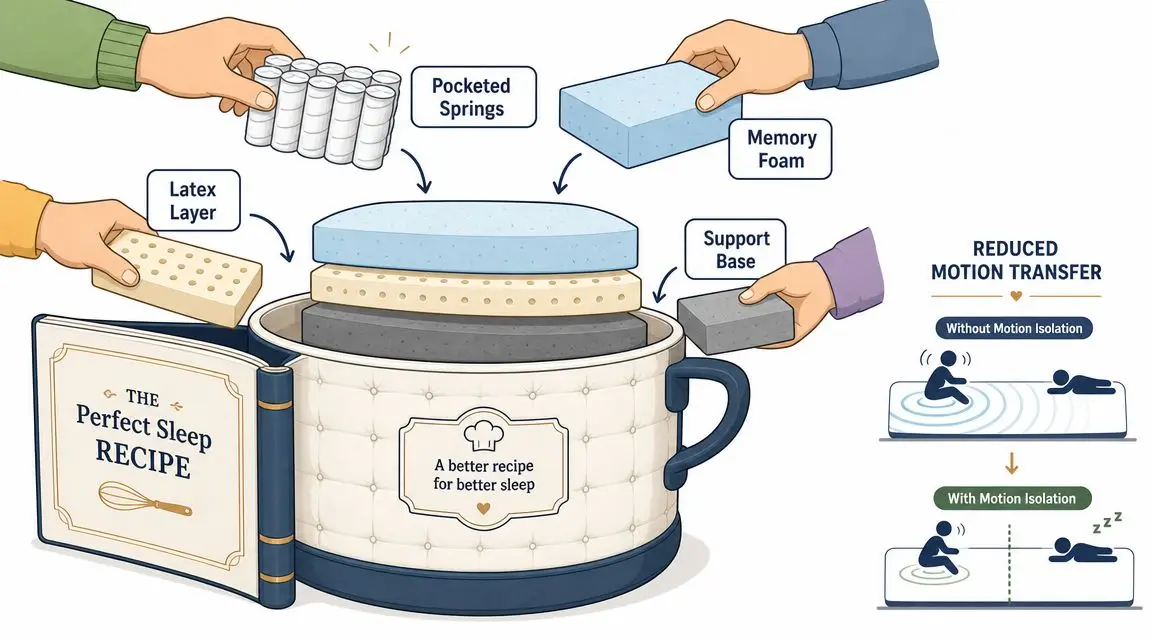
According to Sleep Foundation's motion-isolation methodology, all-foam mattresses generally provide the best motion isolation because dense foam layers absorb and localize movement, while hybrids improve when they use pocketed coils plus thick comfort layers to reduce transfer.
Comfort layers do most of the work
The upper part of the mattress is where motion first gets caught. Thick comfort layers help absorb the initial energy before it can move farther across the surface.
Shoppers usually want to pay attention to:
- Dense foam near the top because it helps localize movement where it begins.
- Multiple layers working together because one layer can cushion while another stabilizes.
- Enough depth to absorb pressure so the mattress doesn't feel lively or reactive when someone shifts.
For readers comparing mixed-material beds, this hybrid mattress overview from Guynn helps explain how foam and coils work together.
Coil design changes the outcome
In coil mattresses, not all springs behave the same way. Connected coils act more like one unit, so motion can travel farther. Pocketed coils act more independently, which helps reduce that ripple effect.
That's why many modern Sealy and Therapedic designs use pocketed coil systems under foam comfort layers. The support core still gives structure, but the surface doesn't feel as disruptive when a partner moves.
Firmness affects feel and movement
Firmness confuses a lot of shoppers. A firmer mattress may feel more stable at first touch, but a bed that's too firm can allow motion to skate across the surface instead of being cushioned. A softer surface can cradle movement better, but if it's too plush, some sleepers may feel less supported.
The sweet spot often depends on what the household values most:
- Stillness first means leaning toward denser foam and more contouring.
- Mobility first means looking for a design that's easier to move on, even if a little more motion comes through.
- Shared comfort usually points to balanced builds with pressure relief up top and steadier support underneath.
A mattress isn't one material. It's a stack of choices. When those choices work together well, movement gets absorbed early instead of echoing through the whole bed.
Finding the Right Balance Beyond Motion Isolation
The strongest motion control isn't always the right final answer. Some shoppers lie down on a mattress that barely transfers movement, then realize they don't love the temperature, edge feel, or ease of repositioning. That's where the buying decision gets more realistic.
Many mattress guides treat motion isolation like the only thing that matters. In real bedrooms, people are balancing several needs at once. One partner may want a calmer sleep surface. The other may care more about cooler sleep or easier movement when changing positions.
When stillness is not the only goal
Guidance on mattress trade-offs consistently notes that shoppers often need to weigh edge support, cooling, and ease of movement alongside motion isolation, and that the best choice depends on which priority matters most in real life, as discussed in this motion isolation and mattress comfort guide.
That trade-off shows up in a few common situations:
- Hot sleepers may prefer a design that feels more breathable, even if it allows a bit more movement.
- Combination sleepers may want a mattress that's easier to turn on and doesn't create a “stuck” sensation.
- Couples using the full bed width may need stronger edge support so the perimeter feels secure.
For households trying to sort through those trade-offs together, this guide on choosing a mattress for two sleepers can help frame the discussion.
Why in-person testing matters
These trade-offs are hard to judge from product descriptions alone. A mattress might sound ideal online and still feel wrong once two people lie on it at the same time.
Cleanliness and care matter too, especially for shared sleep spaces. For anyone maintaining a protected sleep surface while testing comfort preferences at home, Hiccapop mattress cover washing instructions offer a useful refresher on caring for removable covers.
Some shoppers need the quietest mattress possible. Others need the best compromise between quiet, cool, and easy movement. Both are valid choices.
That's why the best mattress for motion isolation is often the one that solves the right problem, not just the one with the most dramatic motion-control feel in a quick test.
How to Test a Mattress for True Motion Isolation
Online research helps narrow the field, but motion isolation is easier to judge in person than almost any other mattress feature. A shopper can read descriptions all day and still not know how a mattress feels when a real partner climbs in, shifts around, and gets back out.
A simple showroom test
The most useful test is straightforward:
- Bring both sleepers so the mattress gets tested under real conditions.
- Have one person lie down normally in a relaxed sleeping position.
- Ask the other person to get on and off the bed the way they would at home.
- Repeat with rolling and repositioning rather than just sitting still.
- Switch sides because each sleeper notices different things.
A broader shopping checklist can help with the rest of the decision too, and Guynn's mattress buying guide gives shoppers another way to organize what they're feeling in the store.
What to notice besides the obvious bounce
Shoppers often focus only on big movements, but small signals matter more. The question isn't just whether the bed shakes dramatically. It's whether the resting partner feels subtle pulling, vibration, or a rolling sensation.
A useful checklist includes:
- Entry disturbance when one person gets into bed later than the other.
- Turning disturbance when a partner changes sleep position.
- Edge disturbance when someone sits briefly before standing up.
- Base stability because a shaky foundation can add movement of its own.
If the still partner can close their eyes and barely notice the other person changing position, that mattress deserves a closer look.
For an existing mattress that otherwise feels comfortable, some households also try a memory foam topper to soften movement transfer. It won't change the core construction underneath, but it can help reduce some surface disturbance.
Find Your Perfect Mattress Here at Guynn
Knowing the materials is helpful. Feeling the difference is what closes the gap between research and confidence. That's where a local showroom becomes useful, especially for shoppers who want to compare how motion isolation, edge support, and overall comfort come together in real time.
Guynn Furniture & Mattress serves Galax, Independence, Hillsville, and the wider Southwestern Virginia and Northern North Carolina region with a no-pressure atmosphere, a large in-stock mattress selection, and brands relevant to this search including Sealy and Therapedic. For shoppers thinking about budget as well as comfort, Guynn's mattress financing options outline ways to make the purchase more manageable.
A few practical advantages stand out for local shoppers:
- In-stock availability means many mattresses are ready for immediate delivery instead of requiring a long wait.
- Free in-home delivery and setup within 60 miles makes the process easier from start to finish.
- Low Price Promise means local competitor pricing is matched, with a 30-day price guarantee.
- Expert design staff can help coordinate the mattress with a full bedroom refresh, including support from Debra Williams for broader room planning.
That combination matters for different kinds of shoppers. Traditionalists often care about trust and longevity, and this business has served the region since 1902. Value seekers want straightforward pricing and financing. Families want practical help, not pressure. Shoppers updating a whole room may also want help pairing the bed with pieces from Ashley, Bassett, or La-Z-Boy for the rest of the home.
The best mattress for motion isolation still has to feel right to the people sleeping on it. Reading helps. Testing confirms it.
Visit the Guynn Furniture & Mattress showrooms in Galax, Independence, or Hillsville to test the comfort for yourself. Shoppers across Southwestern Virginia and Northern North Carolina can also browse the selection online at guynnfurniture.net or schedule a consultation with the design team to start planning a dream room today.