Best Mattresses for Comfort: A 2026 Buying Guide

A lot of folks start mattress shopping after the same kind of morning. You wake up, swing your feet onto the floor, and your back feels older than the rest of you. Your shoulder is sore. Your partner slept fine, but you tossed around half the night. By breakfast, you’re wondering if the problem is stress, age, or just that mattress you’ve been meaning to replace for years.
That’s where mattress shopping gets tricky. Comfort sounds simple, but it isn’t one-size-fits-all. One person wants a soft, tucked-in feel. Another wants a bed that feels steady and easy to move around on. Add in online reviews, confusing material names, and firmness labels that don’t always match reality, and it’s no wonder people feel stuck before they even start.
Around Southwestern Virginia and Northern North Carolina, we’ve seen that same look on a lot of faces over the years. Since 1902, families in Galax, Independence, Hillsville, and the surrounding region have counted on local stores to help sort out home comfort in plain English. Mattress shopping should feel more like getting advice from a neighbor and less like cramming for a test.
Your Journey to Finding the Best Mattress for Comfort
A good mattress doesn’t fix every bad night, but it can remove one big obstacle. If your bed leaves you achy, overheated, or rolling toward the middle, your body notices. That’s why the search for the best mattresses for comfort usually starts with one simple question: “What will feel good for me night after night?”
The answer is more practical than most ads make it sound. Recent expert testing points in a clear direction. Extensive 2026 lab tests by sources like NapLab and Sleep Foundation consistently show that hybrid and memory foam mattresses with medium-firm profiles dominate comfort ratings in broad testing categories such as pressure relief, motion control, and overall sleep feel, according to NapLab’s 2026 mattress testing roundup. That doesn’t mean every sleeper needs the same bed, but it does give you a solid starting point.
Why the search feels so confusing
Most shoppers come in thinking they need the softest mattress in the building. Then they lie down on something extra plush and realize it feels nice for two minutes but not necessarily supportive. Others assume firm means better support, only to find that too much firmness can create pressure at the shoulders and hips.
That’s why we always tell people to slow down and think about comfort in layers:
- Your body shape matters. A side sleeper usually needs different cushioning than a stomach sleeper.
- Your habits matter. If you sleep hot, motion control alone won’t make you comfortable.
- Your household matters. Kids, pets, and partners change what “comfortable” really means over time.
Comfort isn’t just how a mattress feels when you first sit on it. It’s how your body feels the next morning.
Some families also build a bedtime routine around sleep comfort as a whole, not just the bed itself. If you’re trying to create a calmer wind-down routine, these DIY bath salts recipes offer a simple idea that pairs nicely with a better sleep setup.
Start with a simple buying path
A mattress purchase gets easier when you stop trying to compare everything at once. A better path is:
- Learn the main mattress types
- Match firmness to your sleep position
- Test for real-life comfort in person
- Think about durability for your household
If you like having a little structure before you shop, our guide to understanding the furniture buying journey from first research to final decision walks through that process in a straightforward way.
Decoding Mattress Comfort Beyond Just Softness
The word “comfortable” often refers to a mix of several things. Softness is only one piece of it. A mattress can feel soft at first touch and still leave you sore by morning. It can also feel a little firmer at first and end up being much more comfortable over a full night.
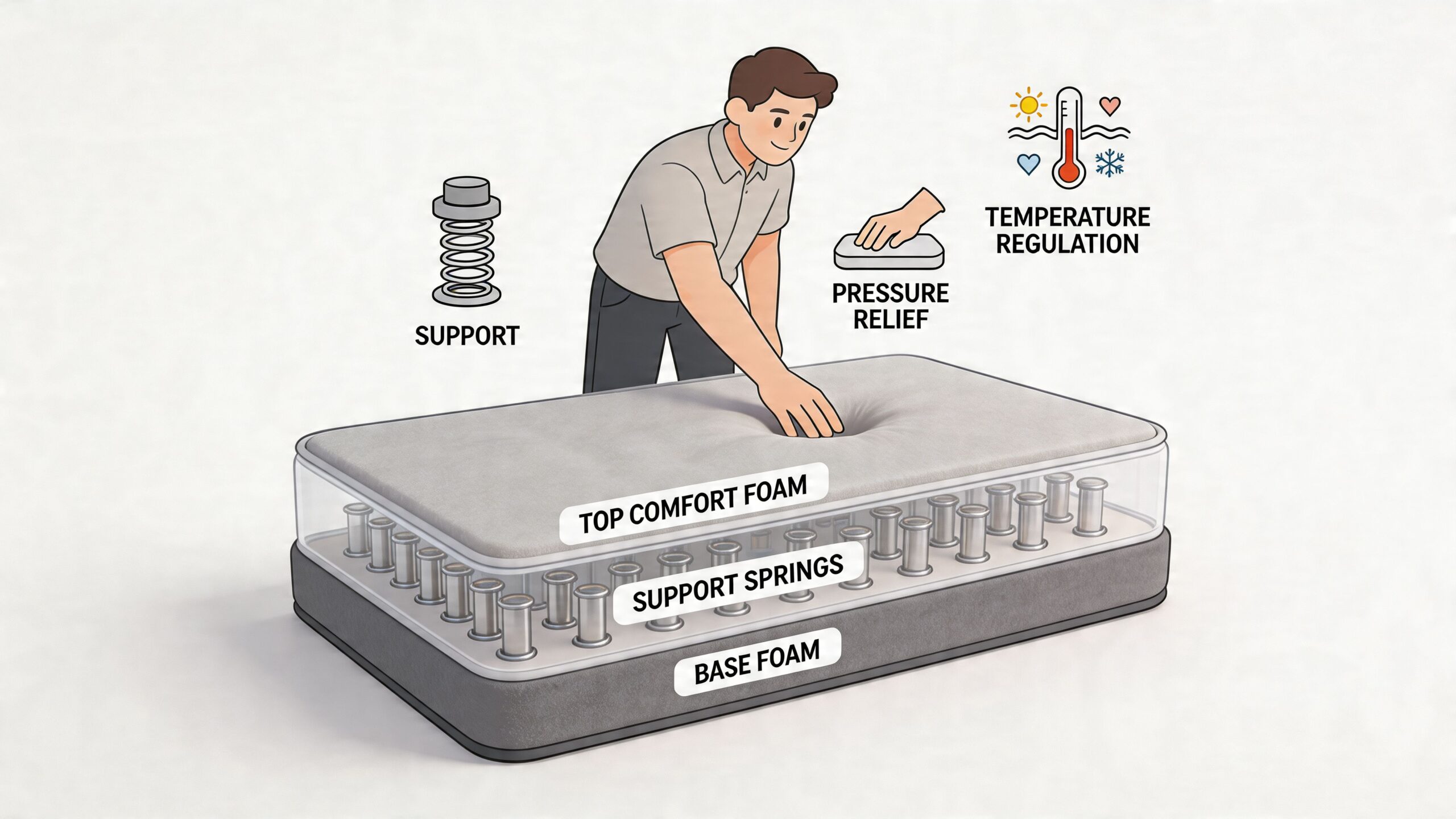
Here’s the easier way to think about it. Real comfort has three main parts: pressure relief, spinal alignment, and support.
Pressure relief
Pressure relief is what keeps your shoulders, hips, and lower back from feeling jammed into the mattress.
Imagine lying on a hardwood floor: all your weight pushes into a few sharp contact points. A mattress with good pressure relief spreads that weight out. It cushions the spots that stick out most, especially for side sleepers.
Memory foam usually does this well because it contours around the body. Some hybrids do it nicely too, especially when they use softer comfort layers on top.
Spinal alignment
Your spine should stay in a fairly neutral line while you sleep. Not ruler-straight like you’re standing at attention, but not bowed or twisted either.
A mattress that’s too soft can let your hips sink too far. A mattress that’s too firm can push up against your shoulders and leave your waist unsupported. Either way, your back works all night instead of resting.
Practical rule: If a mattress feels great on your shoulder but leaves your lower back hanging, it isn’t truly comfortable.
Support
Support is the part underneath the comfort layers that keeps everything steady. In many mattresses, that comes from coils, dense foam, or a mix of both. Support is what prevents the sagging, hammock-like feeling that can sneak up over time.
Shoppers often get mixed up on this point. Support does not mean rock hard. A mattress can be supportive and still feel cushioned on top.
How layers work together
A top-rated hybrid gives a good example of this balancing act. According to Mattress Clarity’s review of the most comfortable mattresses, a mattress like the Helix Midnight Luxe creates comfort through layering: a plush pillow-top adds initial soft sinkage, responsive memory foam underneath helps reduce pressure at the hips and shoulders, and a zoned coil system distributes weight more evenly while improving motion transfer and edge support.
That layered design helps explain why some beds feel inviting without swallowing you whole.
- Top layer: gives that first “ahh” feeling when you lie down
- Middle layer: contours around pressure points
- Core layer: keeps your body from dipping out of alignment
If you already use a topper, keeping it clean matters too, because trapped moisture and buildup can change how a bed feels over time. This guide on how to wash a mattress topper is a useful refresher.
The comfort extras people forget
Shoppers usually notice softness first, but a few “secondary” features often decide whether they love a mattress after a month.
- Motion isolation: If your partner rolls over, you don’t want the whole bed to react.
- Edge support: If you sit on the side to put on socks or get up slowly in the morning, this matters a lot.
- Temperature regulation: Hot sleepers often blame themselves when the mattress is part of the problem.
- Ease of movement: Some people love a body-hugging feel. Others hate feeling stuck.
A comfortable mattress is one that handles all of those together. That’s why the best mattresses for comfort are rarely just the softest models on the floor.
Choosing Your Foundation Innerspring vs Foam vs Hybrid
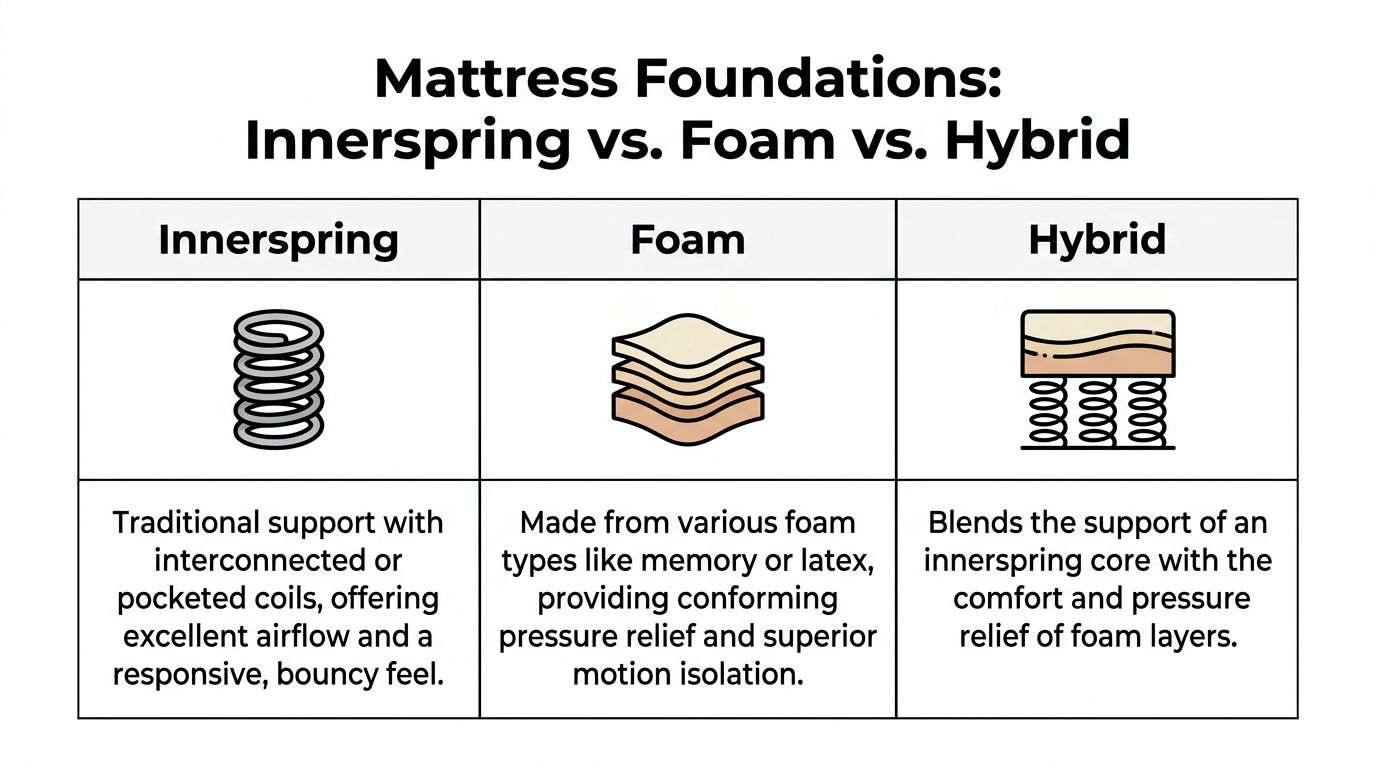
Once you know what comfort means, the next question is simple. What kind of mattress creates that comfort? Most shoppers end up comparing three main categories: innerspring, memory foam, and hybrid.
Each one can work well. The trick is matching the material to the way you sleep, not just the trend of the moment.
A broad snapshot of the market shows how varied preferences are. In a 2024 survey from The Sleep Doctor, 34.7% of U.S. adults reported sleeping on foam mattresses, 30.3% on innerspring, and 7.6% on hybrids, as shown in The Sleep Doctor’s mattress statistics page. That spread tells you something important. There isn’t one universal winner. There are different comfort paths for different sleepers.
Traditional innerspring
An innerspring mattress is the classic bed many of us grew up with. Its support comes mainly from coils.
What people tend to like about innerspring models:
- Responsive feel: You don’t sink in much, so it’s easy to roll over or get up.
- Airflow: Coils leave more open space for heat to move.
- Familiar comfort: Many people like that traditional, buoyant feel.
Common drawbacks:
- Less contouring: Pressure relief may feel lighter than on foam-heavy designs.
- More motion transfer: Depending on construction, you may notice a partner’s movement more.
These can suit back sleepers, stomach sleepers, and anyone who says, “I don’t want to feel trapped in my mattress.”
Memory foam
Memory foam mattresses are built to contour more closely to the body. They usually give a quieter, more cushioned feel.
Why shoppers choose them:
- Pressure relief: Helpful for sore shoulders and hips
- Motion control: Often a strong fit for couples
- Close contouring: Many people like that hugged, cradled feeling
Possible tradeoffs:
- Less bounce: Some sleepers find movement harder
- Heat retention: Some foam beds sleep warmer than coil-based options
- Different feel: If you love a springy bed, foam may feel unfamiliar
These often make sense for side sleepers or anyone who wants more body-conforming comfort.
Hybrid
A hybrid combines foam comfort layers on top with a coil support core underneath. For many shoppers, that mix feels like the middle ground.
Hybrids often offer:
- Balanced comfort: More contour than a classic innerspring, more pushback than all-foam
- Better edge support: Many models feel steadier around the perimeter
- Broader appeal: Good for couples with different preferences
Things to keep in mind:
- Feel still varies a lot: One hybrid can feel plush and another can feel firm
- Not automatically cooler or softer: Construction matters more than the label
If you want a clearer explanation of what sets this category apart, our overview of what is a hybrid mattress breaks it down in everyday language.
Mattress Type Quick Comparison
| Feature | Innerspring | Memory Foam | Hybrid |
|---|---|---|---|
| Feel | Bouncy and traditional | Contouring and close-fitting | Balanced, cushioned with pushback |
| Pressure relief | Moderate | Strong | Strong to moderate |
| Motion isolation | Lower to moderate | Strong | Moderate to strong |
| Ease of movement | Strong | Lower | Strong |
| Cooling feel | Often good | Varies | Often good |
| Good fit for | Back, stomach, traditional-feel sleepers | Side sleepers, couples, pressure-sensitive sleepers | Mixed needs, combination sleepers, many couples |
What this means in a local showroom
In real life, many shoppers in our part of Virginia don’t walk in asking for a material category. They say things like:
- “I wake up with my hip hurting.”
- “I sleep hot.”
- “I need something supportive, but I don’t want a board.”
- “My husband likes firm and I don’t.”
That’s where trusted lines from Sealy and Therapedic can be useful, because they offer options across these feel categories instead of forcing you into one kind of bed.
Some people find their match in five minutes. Others need to compare an innerspring, a foam model, and a hybrid back to back before their body tells them the truth.
The best mattresses for comfort aren’t always the most expensive or the most talked about online. They’re the ones that match your body, your sleeping style, and your daily life.
Finding Your Perfect Firmness for Your Sleep Position
Firmness is where many shoppers get turned around. One brand’s “medium” can feel like another brand’s “firm,” and your body weight changes how any mattress feels once you lie down on it. Still, there’s a helpful way to narrow the field.
It helps to think in three broad groups: soft, medium-firm, and firm. If you sleep in one main position most nights, that position usually points you toward the right starting range.
Side sleepers
Side sleepers usually need more cushioning at the shoulders and hips. Those are the parts pressing deepest into the bed, so if the surface is too firm, pressure builds up fast.
A softer to medium-firm feel often works better here because it allows some give where your body needs it most. The goal is comfort with enough support underneath so your waist and lower back don’t sag.
Signs your mattress may be too firm for side sleeping:
- Shoulder soreness in the morning
- Hip pressure after lying in one spot
- Numbness or frequent tossing
Back sleepers
Back sleeping usually works best with a mattress that keeps your hips from dipping too low while still cushioning your lower back and shoulders.
That’s why medium-firm is such a common comfort zone. It tends to offer a steadier balance between surface comfort and spinal support.
If you sleep on your back and your mattress is too soft, your hips may sink and pull your spine out of neutral. If it’s too firm, your lower back may feel unsupported because the surface doesn’t contour enough.
A back sleeper usually does well on a mattress that feels level and steady, not stiff.
Stomach sleepers
Stomach sleeping often needs the firmest feel of the three main positions. The biggest issue is hip sink. When the middle of your body drops too much, the lower back can bow into an uncomfortable angle.
A firmer mattress helps keep the torso lifted and the spine more aligned. Stomach sleepers usually don’t need as much plushness on top as side sleepers do.
Combination sleepers
If you switch positions through the night, aim for balance. This is one reason medium-firm hybrids are so widely appealing. They often give enough pressure relief for side sleeping without becoming too soft for back or occasional stomach sleeping.
If you want a deeper look at how firmness categories line up with different sleepers, our mattress firmness guide is a practical next step.
A simple matching guide
- Mostly side sleeping: Start softer or medium-firm
- Mostly back sleeping: Start medium-firm
- Mostly stomach sleeping: Start firmer
- A mix of positions: Start with medium-firm and adjust from there
The biggest mistake is choosing firmness with your hand instead of your whole body. Pressing down on a mattress in a showroom tells you almost nothing. Lie down in your actual sleep position and let your spine, shoulders, and hips do the talking.
Finding Comfort for Couples Kids and Seniors
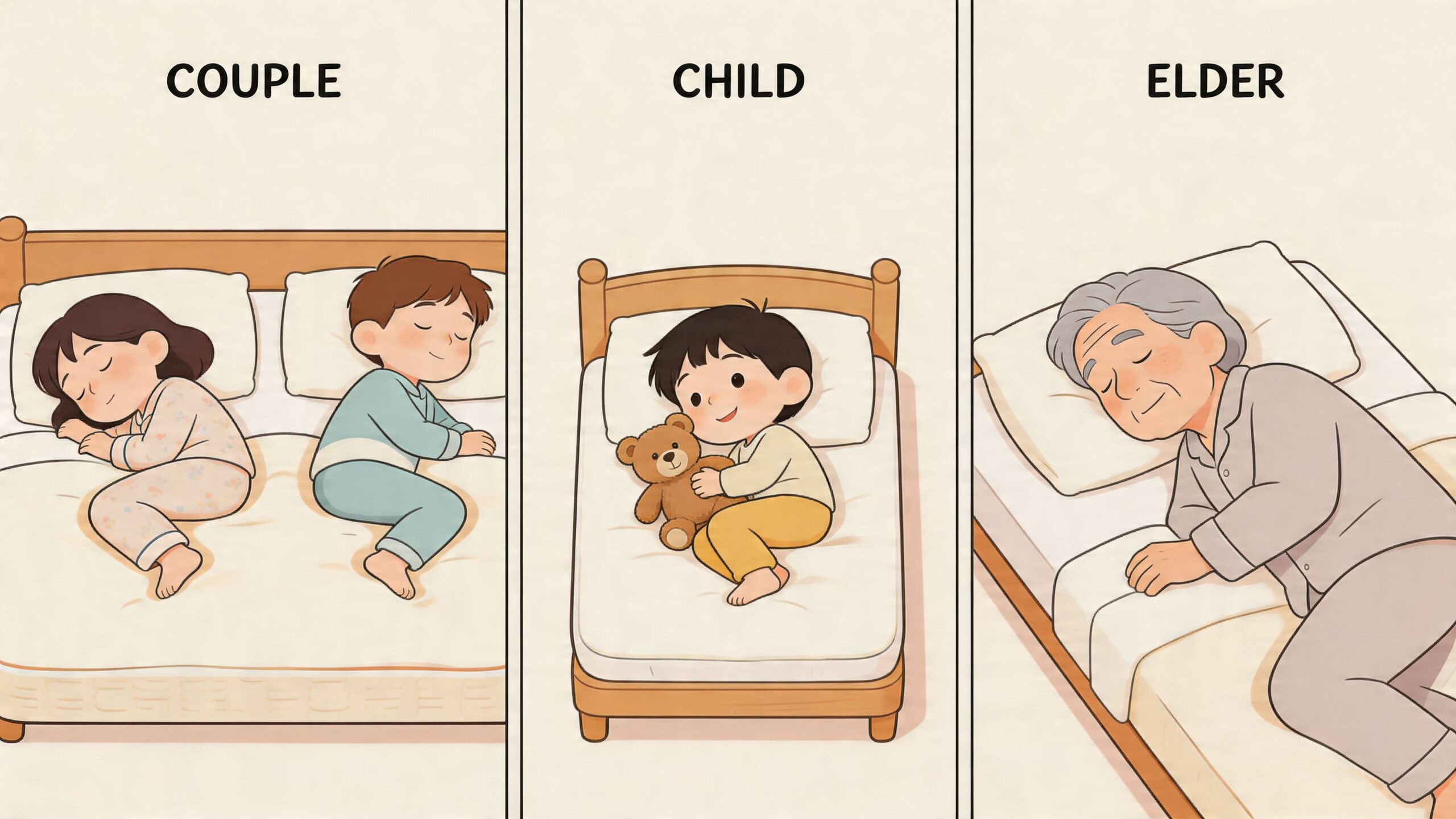
Saturday morning is a common time for this kind of mattress shopping. One partner says the bed feels too firm. The other says it sinks too much. A parent wants something that can hold up to kids jumping during story time. A senior wants a bed that feels comfortable at night and steady when getting up in the morning. Mattress comfort gets more complicated when more than one person, age, or routine is involved.
That is one reason shopping in person helps so much. At Guynn Furniture, families can compare beds side by side, ask practical questions, and feel the difference between a mattress that seems nice for thirty seconds and one that fits real life at home.
For couples
A shared mattress has to do two jobs at once. It needs to cushion one sleeper without letting the other feel every turn, stretch, or late-night trip out of bed. That balance is hard to judge from product descriptions alone.
Two features usually matter most here. Motion isolation helps keep movement from traveling across the bed. Edge support lets both sleepers use more of the mattress without feeling like they have to crowd the middle.
If one person likes a softer feel and the other wants more support, a hybrid often gives both sleepers a fair middle ground. Our guide to the mattress that works for two sleepers explains those tradeoffs in plain language.
For heavier sleepers
Heavier bodies put more demand on the support system underneath the comfort layers. The mattress has to hold the spine in a steady line instead of letting the midsection dip too far.
Mattress Nerd’s guide to comfortable mattresses notes that heavier sleepers often do better with hybrids that use reinforced coils and cooling materials. That advice lines up with what many shoppers notice in a showroom. A stronger coil unit usually feels more stable through the center of the bed and holds its shape better over time.
For seniors
Older adults often describe comfort a little differently. They may care just as much about getting in and out of bed easily as they do about softness.
A good fit for many seniors includes:
- Dependable edge support for sitting and standing
- Pressure relief around shoulders and hips
- A surface that responds quickly so turning over does not feel like climbing out of a hole
Softness can be pleasant, but too much sink can make a mattress harder to use every day. In the showroom, this is easy to check. Sit on the edge, stand up, lie down, and roll once or twice. That tells you more than a spec sheet ever will.
For kids and pet-friendly homes
For families, comfort and durability usually go together. If the mattress surface starts sagging, bunching, or wearing out early, it stops feeling comfortable long before anyone planned to replace it.
That is why parents often ask about washable covers, stronger edges, and materials that recover their shape after everyday wear. Those questions are smart. Kids sit on beds to read, pets claim their corners, and accidents happen.
For younger children moving into a more independent sleep setup, some parents also explore low-to-the-ground options that support children's independence with floor beds.
Practical questions that help families choose well
A mattress tag can tell you what is inside. It cannot tell you how the bed will handle your household. Ask questions like these instead:
- Will this mattress keep its shape with daily use?
- Is there a cover or protector option that makes cleanup easier?
- Does the edge stay supportive when someone sits there often?
- If two people share the bed, how much movement carries across the surface?
Those are the kinds of details that are easier to sort out in a local showroom, where you can try the mattress for yourself and talk with someone who has helped many families make the same decision.
How to Test a Mattress in Our Showroom
You drive over after work, try two beds for 30 seconds each, and both seem fine. Then you come back a week later because you still are not sure. That happens all the time. Mattress shopping can feel fuzzy until you know what to look for with your own body, in your usual sleep position, with someone nearby who can answer questions without rushing you.
That is why an in-person showroom visit helps so much. A product page can list foam layers and coil counts. It cannot show whether your shoulder settles comfortably, whether your lower back stays supported, or whether the edge feels steady when you sit down to put on your shoes.
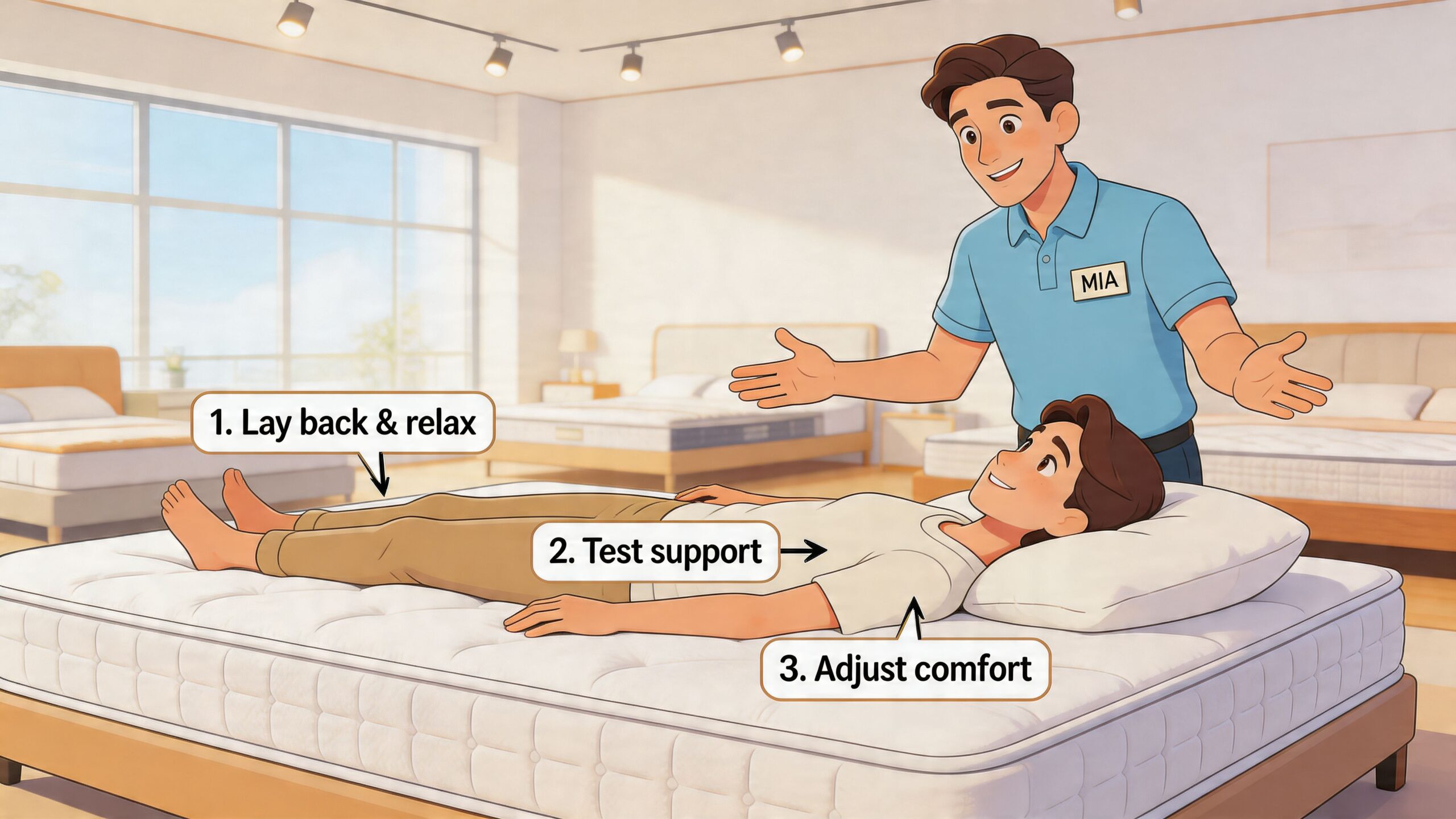
A better way to test in the showroom
Treat the mattress the way you will use it at home. If you only perch on the corner for a few seconds, you miss the parts that matter.
Try this simple routine:
- Wear comfortable clothes. A stiff belt, heavy jacket, or tight jeans can change what you feel.
- Lie down in your normal sleep position first. Side sleepers should start on their side. Back sleepers should start on their back.
- Stay there for a few minutes. Mattresses are a little like shoes. Its true feel shows up after your body settles in.
- Change positions once or twice. Notice whether you can roll easily or whether the surface fights you.
- Sit on the edge like you do at home. That helps you judge stability, especially if you sit on the bed to dress or read.
- If you share a bed, test it together. A mattress can feel different once both sleepers are on it.
What your body should notice
Good comfort usually feels quiet. You are not searching for a dramatic wow moment. You are checking for the absence of strain.
Look for signs like these:
- Your shoulders loosen up instead of feeling jammed upward
- Your hips stay supported instead of dipping too far
- Your spine feels fairly level in your usual sleep position
- You can move without effort instead of feeling stuck
- The edge feels dependable if you sit there often
Families should also ask about practical protection. Kids sprawl, pets jump up, and daily life is hard on a mattress. In the showroom, it is easier to compare edge support, ask about washable covers or protectors, and get honest guidance about which models tend to hold up better in busy homes.
Why local testing makes the choice clearer
Seeing several mattresses in one room helps you compare comfort the same way you would compare recliners or sofas. You notice differences faster when you can lie on one model, stand up, and try the next right away. Brands like Sealy and Therapedic often give shoppers a useful side by side comparison between a more traditional supportive feel and a more contouring one.
At Guynn Furniture & Mattress's mattress buying guide, shoppers can review the basics before visiting. In the store, those basics become real. You can ask questions, test what you learned, and get advice from someone who has helped families around Galax, Independence, Hillsville, and nearby communities sort through the same confusion.
A good showroom visit should feel calm and practical. No pressure. No guessing from photos at midnight. Just a chance to let your back, shoulders, and hips give you a clear answer.
If a mattress feels good only while you are standing beside it, keep looking. The real test starts when you lie down.
There is also a simple local advantage. If the mattress you like is in stock, you may be able to start sleeping better much sooner than you would with an online-only order and a long shipping wait.
Our Promise for a Simple and Confident Purchase
Buying a mattress is a big household decision. It affects your sleep, your budget, and your day-to-day comfort. People deserve clear information and straightforward policies, especially when they’re comparing several options at once.
For families around Galax, Independence, Hillsville, and the wider Southwestern Virginia and Northern North Carolina region, a good buying experience usually comes down to a few basics.
What people want from the purchase
- Clear value: If price comes up, people want to know they’re being treated fairly.
- Delivery help: Mattresses are awkward, heavy, and not much fun to move.
- Options without pressure: Nobody enjoys feeling rushed into a bed they haven’t fully tested.
What that looks like in practice
At our stores, that means keeping the process simple and transparent:
- Low Price Promise: We match local competitors and offer a 30-day price guarantee.
- Flexible financing: Helpful for shoppers balancing comfort needs with a household budget.
- Long local history: Since 1902, families in this region have known where to go for practical home comfort advice.
- Free in-home delivery and setup within 60 miles: That includes many customers across Southwestern Virginia and nearby Northern North Carolina.
- In-stock selection: Some shoppers want to improve sleep now, not weeks from now.
For more complex home projects, our expert design staff, including Debra Williams, can also help tie the bedroom into the rest of the space. That matters when a mattress purchase is part of a larger room update that includes bedroom furniture, lighting, and layout decisions.
A simple purchase feels better because it removes second-guessing. You should be able to focus on the mattress itself, not on whether the process is going to become a hassle.
Your Mattress Comfort Questions Answered
A few practical questions come up in nearly every mattress conversation. Here are the ones we hear most often.
How often should I replace my mattress
There isn’t one perfect calendar answer. Replace it when it no longer supports you well, feels uneven, sags, or leaves you waking up sore more often than not. If you sleep better somewhere else than you do in your own bed, that’s worth paying attention to.
Is there a break-in period
Usually, yes. New mattresses can feel a little different for the first several nights as the comfort layers loosen slightly and your body adjusts. Give it a little time, but pay attention to whether it’s moving toward comfort or away from it.
Do I need a box spring
Sometimes, but not always. It depends on the mattress and the bed base you’re using. Many newer mattresses work best on a supportive platform, foundation, or compatible adjustable base rather than an old box spring.
How do I make a new mattress last longer
A few habits help a lot:
- Use a mattress protector
- Rotate when the manufacturer recommends it
- Make sure the base is supportive and in good shape
- Clean bedding and removable layers regularly
- Don’t ignore early signs of sagging or wear
What size should I choose
Choose the biggest size that fits your room and your real sleeping habits. If you share the bed, stretch out, or sleep with a child or pet climbing in, more space usually feels more comfortable over time.
Finding the best mattresses for comfort doesn’t have to be a guessing game. Once you understand materials, firmness, and how your household uses the bed, the decision gets much clearer.
Visit Guynn Furniture & Mattress to explore mattress options for homes across Galax, Independence, Hillsville, and the wider Southwestern Virginia and Northern North Carolina region. Test the comfort for yourself in our showrooms, enjoy a no-pressure atmosphere, and ask about free in-home delivery and setup within 60 miles. You can also schedule a consultation with our design team to start planning your dream room today or browse our selection online at guynnfurniture.net.