Standard Rectangle Table Size: Complete Seating Guide


A standard rectangular dining table is typically 36 to 42 inches wide, 28 to 30 inches high, and 48 to 96 inches long depending on seating capacity. That simple range can save a lot of second-guessing when a table looks perfect in the showroom but may feel too tight, too long, or just awkward once it reaches your home.
People get stuck at the same moment, the tape measure is out, the room is clear, and the actual question isn't style at all, it's fit. A standard rectangle table size works best when it matches both the people at the table and the space around it, and that balance matters just as much as the wood, finish, or price tag.
Why Standard Rectangle Table Sizes Matter for Your Home
A dining table can feel perfect in an empty showroom and awkward the moment it reaches your home. The tabletop may fit the room on paper, yet the chairs stop short, elbows bump, or the main path through the room turns into a squeeze. That is why standard rectangle table size should be treated as a guide for fit, not as a guarantee that a table will work in every room.
A common modern standard for a rectangular dining table is 36 to 42 inches wide and 28 to 30 inches high, with lengths that rise with seating capacity, about 48 inches for 4 people, 60 to 72 inches for 4 to 6 people, and 78 to 96 inches for 6 to 8 people. Industry sizing guides reflect the same pattern across modern dining furniture, width stays fairly steady while length changes with the number of seats. For a helpful starting point on how to plan the room around the table itself, designing a dining room where to start can make the first pass feel more concrete.
Why this formula works
That width range makes sense because each person at the table usually needs about 24 inches per seat along the edge. That space gives room for a plate, a drink, elbows, and a little breathing room between place settings. A table that is too narrow starts feeling crowded quickly, even in a room with plenty of square footage.
A good rule of thumb is simple, a table can be standard and still be a poor fit if the chairs cannot move in and out without clipping walls or blocking a walkway.
The pattern is useful because it turns shopping into a fit check. A household that seats four can often work with a roughly 48-inch rectangle, while homes that regularly host six or eight need more length before they need more width. Once you start measuring the room, the question becomes less about the size tag and more about how people will sit, stand, and pass behind the chairs. For a quick visual reference on footprint and flow, kitchen island visualization ideas can help homeowners think in terms of usable space instead of just furniture names.
Standard Dimensions for Every Type of Rectangle Table
A rectangle isn't just a dining-room shape. The same straight-sided silhouette shows up in entryways, living rooms, family rooms, and home offices, and each version serves a different job. The dimensions change because the function changes.
The quick mental map
- Dining tables: commonly 36 to 42 inches wide and 28 to 30 inches high, with length tied to seating capacity. That range keeps place settings usable without crowding the people across from one another.
- Console tables: usually slimmer and narrower than dining pieces, because they need to fit behind sofas, in hallways, or near an entry without blocking movement. A narrow profile matters more here than surface area.
- Coffee tables: should sit low enough to relate to the sofa, not tower over it. The useful test is visual harmony with seat cushions and enough surface space for everyday items.
- Desks: need a stable work surface and enough legroom, so a rectangle often works well when the goal is a clear boundary for laptop, papers, or task lighting.
If the room layout feels abstract, a visual planning tool such as kitchen island visualization ideas can help homeowners think in footprints and flow instead of just furniture names. That same mindset works for tables, because a rectangle's edges define traffic just as much as its top defines use.
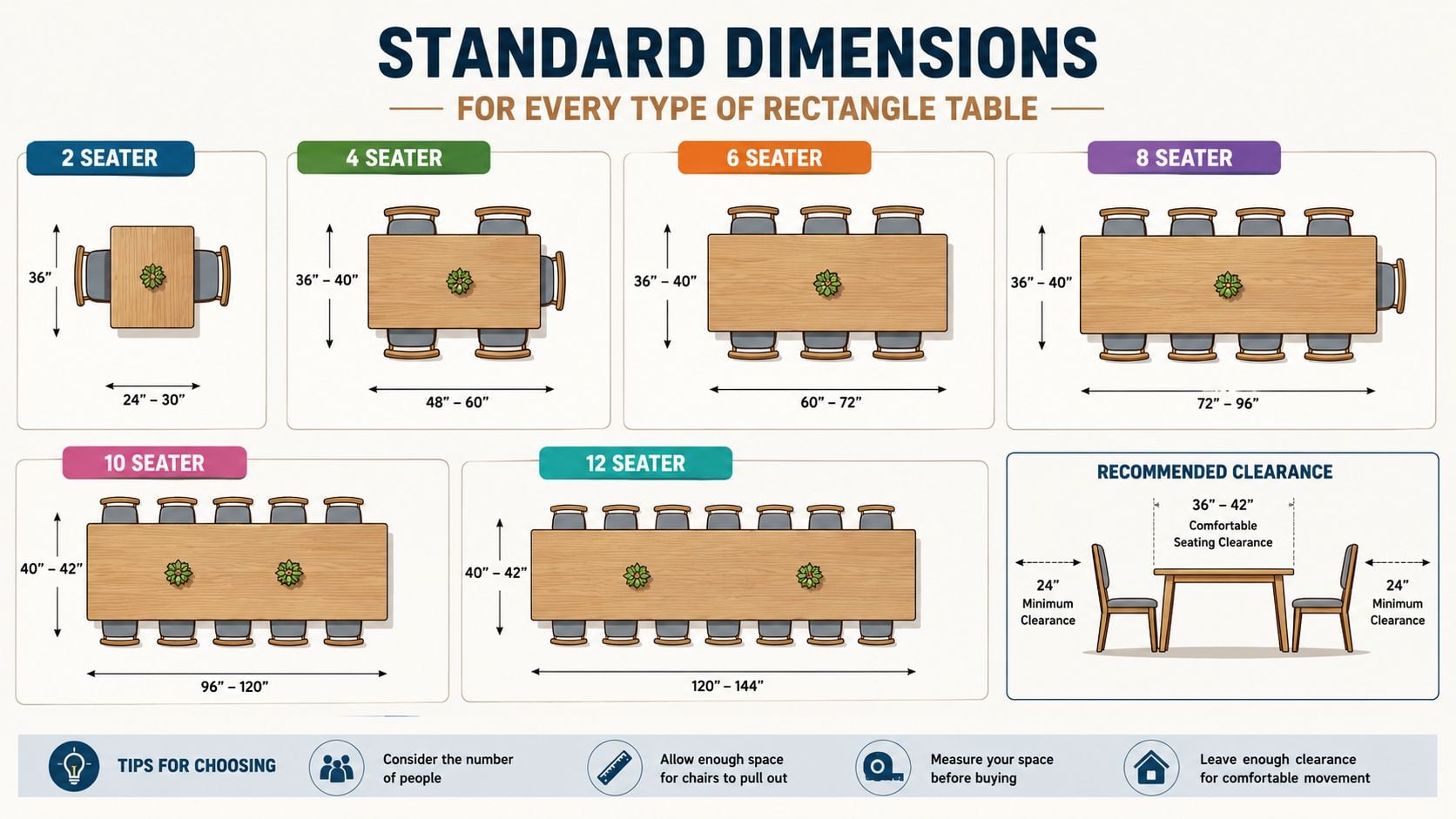
For shoppers comparing room types, the most important idea is this, a standard rectangle table size is really a family of sizes shaped by purpose. A narrow entry table solves one problem, a long family table solves another, and a desk solves another still. The shape stays the same, but the footprint has to respect the room around it.
Seating Capacity and the 24-Inch Rule
A rectangle table can look roomy in a showroom and still feel cramped at home if the seating math is off. The useful question is not just how long the top is, but how many chairs can sit around it without elbows colliding and plates crowding each other.
Dining-table sizing guides consistently recommend 24 inches of space per seat. That rule helps explain why a rectangular table has to grow as the guest count grows, because each person needs room to sit naturally, eat comfortably, and shift a chair without bumping the next place setting.
A practical comparison is 6ft rectangular table guest count, which shows how a common rental-style length translates into real seating. For a home dining room, that same kind of thinking helps you picture whether the table is meant for daily family meals or for a room that hosts larger gatherings.
Rectangle Table Seating Capacity Chart
| Table Length | Seating Capacity | Best For |
|---|---|---|
| 48 inches | 4 people | Small families, compact dining nooks |
| 60 inches | 4 to 6 people | Everyday meals with occasional guests |
| 72 inches | 6 people | Regular family dining |
| 78 inches | 6 to 8 people | Larger households, holidays |
| 96 inches | 8 people | Bigger gatherings and entertaining |
| 120 inches | Up to 12 people | Extended hosting spaces |
The chart is a guide for comfort, not a hard set of rules. A 60-inch table can handle 4 to 6 seats, but it feels easier to use for four when everyone wants a little more elbow room. A 78-inch table often works well for 6 to 8 seats because the added length gives place settings and serving dishes more breathing room.
Seating comfort also depends on what is happening around the table. If the dining area needs a rug under the table, the rug should extend far enough that chairs stay on the surface when people pull them out, which is why a guide to choosing a dining room rug size under the table can help with the whole setup, not just the table itself.
For a table used in a more formal setting, the spacing between guests matters as much as the total count. A long table can make a room feel generous, while a shorter one can feel cozier and more relaxed. The right choice depends on whether the table needs to support everyday meals, holiday dinners, or a mix of both.
A longer table helps only when the chairs, place settings, and walking paths still leave the room feeling easy to use.
Once the seating count is clear, the table length becomes much easier to narrow down. That is the point of the 24-inch rule, it turns a vague guess into a layout you can picture in your dining room.
Room Clearance and Layout Planning
A rectangle table can look perfect on a floor plan and still feel awkward once chairs are pulled out and people start moving through the room. That usually happens because the table size was measured, but the space around it was not. The table, the chairs, and the walk paths all have to work together.
A good starting point is to leave at least 36 inches of clearance around the table so chairs can move without scraping walls or catching on nearby furniture. Main walkways usually need more space, often 42 to 48 inches, so traffic can pass through without squeezing behind seated diners. In practical terms, the room has to hold the table and the everyday movement that happens around it, not just the tabletop itself.
Open-plan rooms and eat-in kitchens can make this part feel tricky, because one corner may serve as a dining zone while the rest of the room still has to function as a passage. In those spaces, a table may fit by measurement but still interrupt how the room feels in use. A simple ai outdoor patio design can also help readers see how clear pathways and furniture spacing work in a shared layout, even outside the dining room, because the same planning idea applies, leave room for movement before you commit to the furniture footprint.
How to measure the room
Start with the table area itself. Measure the full length and width of the table top, then add the space needed for chairs to slide back and for people to stand up without bumping into a wall. If a hallway, doorway, or kitchen route cuts through the dining area, give that path extra attention, since a room can feel tight even when the table dimensions look reasonable on paper. A sideboard, hearth, or open door can also change the way the space works, so check the edges as carefully as the center.
Good fit means movement, not just placement. If a chair cannot slide back without hitting something, the room is working against the table.
For households planning the whole space, how to plan room layout is a helpful companion reference. It can make the difference between a room that only holds a table and one that still feels easy to use day after day.
Choosing Materials and Finishes for Your Lifestyle
A table can fit the room and still feel wrong in daily use. A house with kids, pets, and busy weeknight meals usually needs a different surface than a dining area that only sees guests now and then. The best material is the one that matches how the table will be used, cleaned, and lived with.
Material choice also changes how a table feels in the room. Some finishes make a piece look warmer and more grounded, while others keep the space feeling lighter and less crowded.
Common rectangle table material choices
- Solid wood: gives a classic look and long-term durability, along with a warmth that suits traditional rooms. It may show wear over time, and many homeowners appreciate that lived-in character.
- Engineered wood: offers a more budget-conscious path into a finished dining space and works with many styles. It is often chosen when the goal is a clean look without the weight of a heavier piece.
- Metal: brings a sturdier, more contemporary feel and can suit homes that prefer cleaner lines. It usually pairs with other surfaces instead of standing alone in a formal room.
- Glass: creates a lighter visual footprint, which can help a room feel more open. It also asks for more upkeep because fingerprints and smudges are harder to ignore.
A quick way to narrow the choice is to picture the table on an ordinary Tuesday, not just at a special dinner. If homework, snacks, and pet paws all share the same surface, rounded edges, scratch-resistant finishes, and easy-to-clean tops matter more than a showroom-perfect appearance.
Humidity and temperature swings can matter in Southwestern Virginia, especially for wood furniture placed near windows, vents, or exterior walls. A stable room helps any table age better, and the right finish can make seasonal movement less noticeable.
A wood guide like choosing the right hardwood for longevity and style can help shoppers think through grain, finish, and daily use without getting lost in jargon. The goal is simple, choose a surface that fits the way the household eats, hosts, and cleans.
For active homes, the prettiest table is the one that still looks good after the week gets messy.
Material choice and sizing work together. A table that is easy to clean and forgiving to use can make the whole dining area feel easier, while a surface that needs constant care can make even a well-sized table feel like extra work.
How Guynn Furniture Makes Table Shopping Easy
A dining table feels like a simple purchase until you start matching it to the room. The table needs to fit the chairs, leave space for people to pass behind them, and still feel comfortable on an ordinary night at home. Guynn Furniture & Mattress helps with that part of the process by looking at the room as a whole, not just the tabletop.
Furniture shopping feels calmer when the budget, the layout, and the delivery details are handled by people who know local homes. Guynn Furniture & Mattress has served the region since 1902, and that long history shows up in the way the team talks through comfort, fit, and everyday use. The atmosphere stays low-pressure, which matters when a dining table is a big purchase and no one wants to feel rushed.
Debra Williams and the expert design staff can help turn a room into a scale plan, especially when the dining area sits inside a larger remodel or open layout. That help makes a difference for shoppers who can picture the style but need a clearer sense of how the table, rug, and chairs will work together in the actual room.
The store's Low Price Promise also helps reduce hesitation, because local competitor pricing is matched and the purchase carries a 30-day price guarantee. For value-minded households, that combination can make the decision easier without turning the experience into a stressful search for the lowest tag.
A few practical conveniences stand out. Free in-home delivery and setup within 60 miles is available through Guynn Furniture's delivery process, which helps with the last step after the table has been chosen. A large in-stock selection gives many families a better chance of finding what fits now instead of waiting through a long online shuffle. Financing options can also make a room upgrade more manageable when the timing matters.
Guynn Furniture & Mattress serves Galax, Independence, Hillsville, and the wider Southwestern Virginia / Northern North Carolina region, so the support stays local from the first measurement to the final setup. The showroom approach also lets readers compare scale and comfort in person, which is often the easiest way to tell whether a table will leave enough room to live around.
Your Next Steps to the Perfect Table
The safest path to the right table is straightforward. Measure the room, add clearance for chairs and walkways, decide how many people the table needs to serve, and then match the material to the way the household lives. That order keeps the purchase grounded in real use instead of a decorative wish list.
A standard rectangle table size gives a useful starting point, but it doesn't finish the job. The room still has to breathe around the table, and the family still has to live with it every day. A table that fits the people and the path around it will usually feel right much longer than one chosen for looks alone.
For households in the Galax, Independence, Hillsville, and Southwestern Virginia / Northern North Carolina area, local help can make the decision easier. The right table is out there, and the process doesn't have to feel complicated.
Visit Guynn Furniture & Mattress to see dining tables that fit real homes, real walkways, and real family routines. The showrooms in Galax, Independence, and Hillsville make it easy to compare sizes in person, and the design team can help turn a measurement into a room plan. Browse online at guynnfurniture.net, then stop in when it's time to test the comfort for yourself.