Dining Room Rugs Size Under Table: A Guynn Guide

You found the dining table. It fits the room, suits your style, and finally makes the space feel like a real dining room instead of a pass-through with chairs. Then comes the rug, and suddenly a simple finishing touch starts to feel like a measurement puzzle.
That’s a common spot to be in around Galax, Independence, Hillsville, and across Southwestern Virginia and Northern North Carolina. Older homes, open-concept remodels, farmhouse layouts, and compact breakfast areas all ask for slightly different decisions. The good news is that dining room rugs size under table doesn’t have to be guesswork. A few reliable measurements make the answer much clearer.
Families around here have been turning to local furniture guidance for generations, and that kind of practical thinking still matters. Since 1902, the best advice has usually been the simplest advice. Measure carefully, give the chairs room to move, and choose a rug that works for daily life instead of just looking good in a photo.
Finding the Perfect Rug for Your Dining Room
A common starting point is color or pattern. I get it. The rug is visible, it changes the whole mood of the room, and it’s easy to focus on what will look pretty under the table. But in real homes, size comes first.
The most common dining room area rug size purchased is 9' x 12', and designers also point to undersized rugs as the biggest mistake shoppers make according to Driven by Decor’s dining room rug size guide. That doesn’t mean every dining room needs a 9' x 12'. It means that many homeowners discover they need more rug than they first expected.
Why this decision feels harder than it should
A dining room rug has to do more than fill empty floor.
It has to:
- Handle movement: Chairs need to slide out for meals without catching.
- Support the layout: The rug should feel connected to the table, not like a small mat floating underneath it.
- Fit your room: In many Southwestern Virginia and Northern North Carolina homes, dining spaces share sightlines with kitchens, foyers, or living rooms.
That’s where people get tripped up. They choose a rug based on the tabletop alone, not on what happens when someone sits down.
A dining rug looks right when the chairs still sit comfortably on it after dinner starts, not just before anyone pulls them back.
What works in everyday homes
In a formal dining room, a slightly larger rug often gives the room the settled, finished look people want. In a smaller dining nook, the right rug still needs enough room for chairs, even if the footprint feels tighter overall.
This is one of those design choices where function and appearance are tied together. If the rug is too small, it won’t just look off. It will feel off every single day.
That’s why the safest approach is to start with real measurements and then compare them to common rug sizes. Once you do that, the decision usually gets much easier.
Why Rug Size Is the Foundation of Your Dining Space
A dining room rug is not decoration first. It’s a working surface.
When the size is right, the whole room feels calmer. The table looks grounded, the chairs move the way they should, and the dining area reads as one complete zone instead of several separate pieces.
If you’re still deciding on the table itself, this guide on how to pick the right dining room table helps you line up table scale and rug scale together, which is often the cleanest way to avoid mistakes.
What an undersized rug does wrong
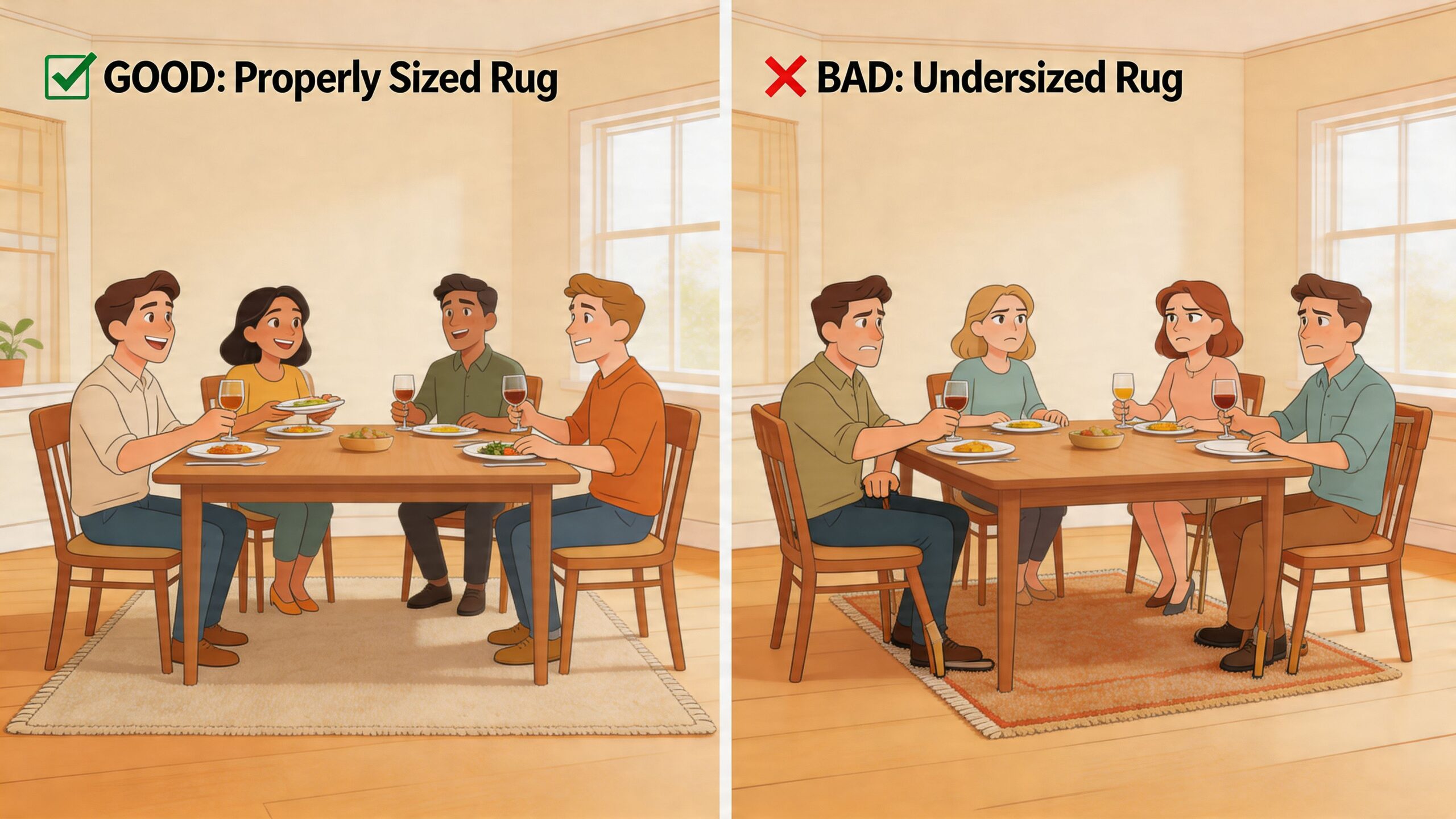
An undersized rug creates trouble in ways homeowners notice fast.
- Chair legs catch at the edge: Someone scoots back to stand up and the rear legs drop off the rug.
- Seating feels unstable: That little height change can make a chair feel uneven or wobbly.
- Floors take extra wear: Chair movement shifts from rug to exposed flooring over and over.
- The room looks skimpy: Even a nice table can feel undersized when the rug beneath it is too small.
Those problems show up in both formal dining rooms and everyday eat-in spaces. The setting changes, but the physics don’t.
What the right rug size adds
A correctly sized rug does more than prevent annoyance. It gives the room structure.
In open floor plans, the rug marks where the dining area begins and ends. In older homes with dedicated dining rooms, it softens the space and keeps the furniture grouping from looking scattered. It also adds color, pattern, and texture in a place that often has a lot of hard surfaces like wood, glass, and painted walls.
Practical rule: If the dining chairs only work smoothly when pushed in, the rug is too small for real life.
Why this matters in local homes
Around Hillsville, Galax, and nearby communities, dining rooms often do double duty. Some are used for holiday meals and homework. Others sit just off the kitchen and stay busy all day. In both cases, the rug has to support actual living.
That’s also why I usually tell homeowners to judge the rug with the chairs pulled out, not tucked in neatly. Tucked-in chairs make almost any rug look acceptable. Pulled-out chairs tell the truth.
The No-Mistake Method for Measuring Your Space
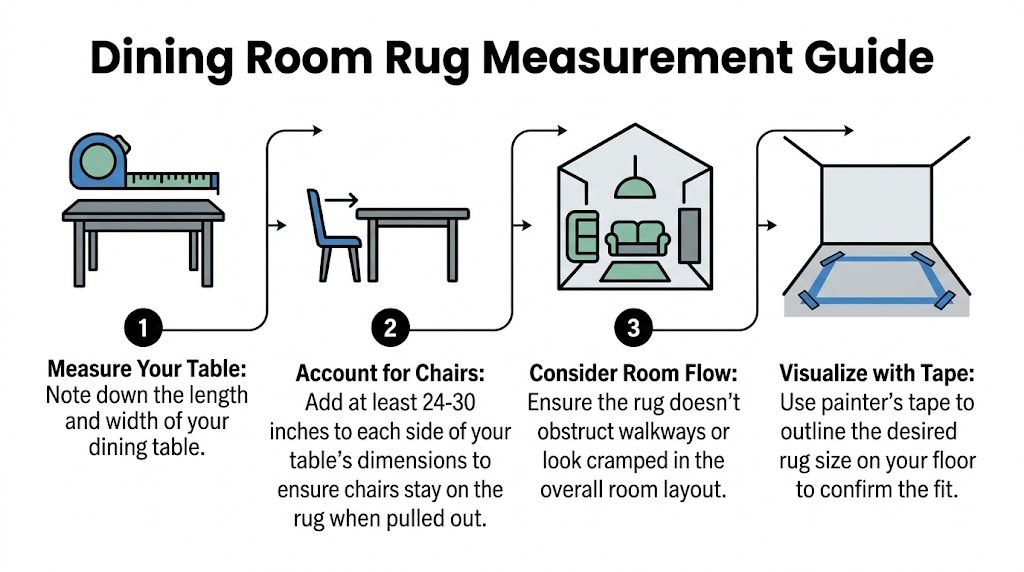
The simplest reliable method is the 24-inch rule. It’s the standard that keeps dining chairs usable and keeps the rug looking proportionate to the table.
According to Rug N Carpet’s dining room rug placement and size guidance, the formula is straightforward: add a minimum of 24 inches on all sides of the dining table, which means Rug Width = Table Width + 48" to 72" and Rug Length = Table Length + 48" to 72". The point of that extra space is simple. Chairs should stay fully on the rug when pulled out, which helps prevent wobble and edge wear.
If you want a second reference point for your room dimensions, Guynn’s page on how to measure for area rug is useful to keep open while you’re checking the floor.
Start with the real table footprint
Measure the tabletop length and width first. If your table has leaves, measure it in the size you use for gatherings. If it expands several times a year for family meals, size the rug for the table extended, not closed.
That choice saves a lot of frustration later. A rug that works only on ordinary weekdays often feels undersized the moment holiday seating comes out.
Use the formula, then test it in the room
Here’s the practical version:
- Measure the table: Get the full length and width.
- Add the border: Add at least 24 inches to each side.
- Compare to standard sizes: See which standard rug size covers that footprint.
- Favor larger when between sizes: A little extra rug usually works better than not enough.
For many homeowners, the math is the easy part. Visualizing the result is the harder part.
That’s why painter’s tape is one of the best no-cost tricks in the room. Tape out the proposed rug size directly on your floor. Then walk around it, pull chairs back, and look at the shape from the doorway and adjoining rooms.
The tape test catches mistakes early
Painter’s tape shows you things a product listing never will.
It helps you check:
- Chair travel: Pull each chair out like someone is sitting down.
- Traffic paths: Make sure the rug doesn’t crowd a doorway or pinch a walkway.
- Room balance: Look at how much floor remains visible around the rug.
- Furniture relationships: Notice whether a sideboard, cabinet, or nearby bench sits awkwardly at the rug edge.
Don’t buy based on the table alone. Buy based on the table, the chairs in motion, and the room around them.
A local designer’s way to think about it
In smaller dining rooms common in our region, people sometimes worry that a larger rug will make the room feel cramped. Usually the opposite happens. A rug that properly supports the table and chairs makes the room feel more intentional. A too-small rug breaks the space into choppy pieces.
When you’re choosing between two sizes and both technically fit, I’d lean toward the one that gives the chairs more reliable landing space. That’s the choice people tend to appreciate long after installation day.
Rug Sizes for Common Dining Tables
General rules help, but most homeowners want examples they can picture in their own home. That’s where common table pairings make this easier.
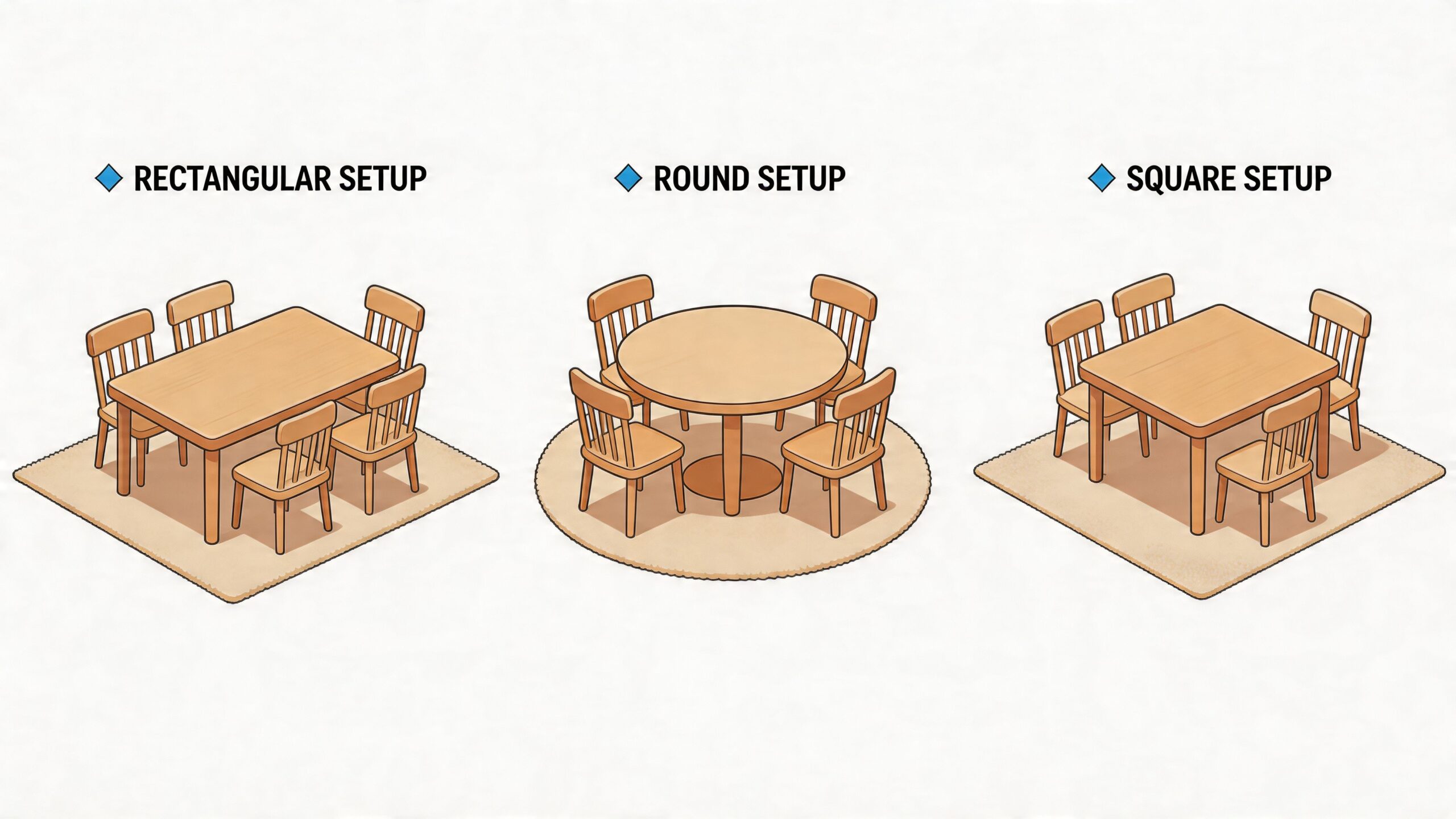
According to Slone Brothers’ dining room rug sizing guide, the 24-inch rule leads to a practical benchmark: a 6-seat rectangular table pairs with an 8' x 10' rug as a minimum, while an 8-seat table generally needs a 9' x 12' rug so chairs stay anchored on the rug when pulled out.
If you’re also weighing table proportions, this dining table size guide helps connect seating count to room scale before you choose the rug.
Rectangular tables
Rectangular tables are the most common setup I see in family dining rooms. They’re also the easiest to plan for because standard rug sizes line up neatly with standard table lengths.
Here’s a quick reference:
| Table setup | Rug size that usually works |
|---|---|
| 6-seat rectangular table | 8' x 10' minimum |
| 8-seat rectangular table | 9' x 12' |
This is especially helpful for shoppers looking at classic rectangular dining sets from lines like Ashley or Bassett. Those tables often sit right in the range where an 8' x 10' works for one layout and a 9' x 12' works much better for the next size up.
Round tables
Round tables bring a different feel. They soften the room and often work well in breakfast areas, square rooms, or homes where you want easier circulation.
The guidance from verified design sources is that round tables typically need an 8-foot to 10-foot diameter rug depending on chair count, and a 48-inch round table pairs well with a 6-8' round rug according to the verified data set drawn from major rug-sizing guidance. In practice, I’d still test chair movement carefully because round table bases and chair styles can change how much room the setup needs.
A round rug under a round table usually feels the most natural. A square rug can also work if the room shape supports it.
Square tables
Square tables can be a smart choice in smaller dining rooms or square breakfast rooms. They create a tidy footprint, but they still need enough rug around them for chairs.
Verified guidance notes that a 3' x 3' square 4-seater works with an 8' square or round rug in standard planning. That often surprises people. The rug sounds large until you remember it has to hold the chairs too, not just the tabletop.
What to do in tighter rooms
Not every dining room in Southwestern Virginia or Northern North Carolina has generous margins. Some homes have narrower rooms, corner hutches, or traffic lanes that reduce flexibility.
When space is tight, focus on these priorities:
- Protect chair function first: The chairs need room to move without catching.
- Keep the rug centered on the dining set: Don’t shift it awkwardly just to satisfy one edge of the room.
- Check wall clearance visually: A little breathing room around the rug helps the room feel framed rather than crowded.
- Avoid letting other furniture sit on the border: That almost always makes the setup feel accidental.
If a room forces compromise, keep the compromise at the perimeter of the room, not at the chairs.
That’s the point where local, in-person planning can be valuable. A dining room with a vent, built-in, or unusual traffic path may need a more custom layout than a generic chart can give.
Beyond Size Choosing the Right Material and Style
Once the measurements are right, material becomes the next decision that affects how happy you’ll be with the rug a month from now.
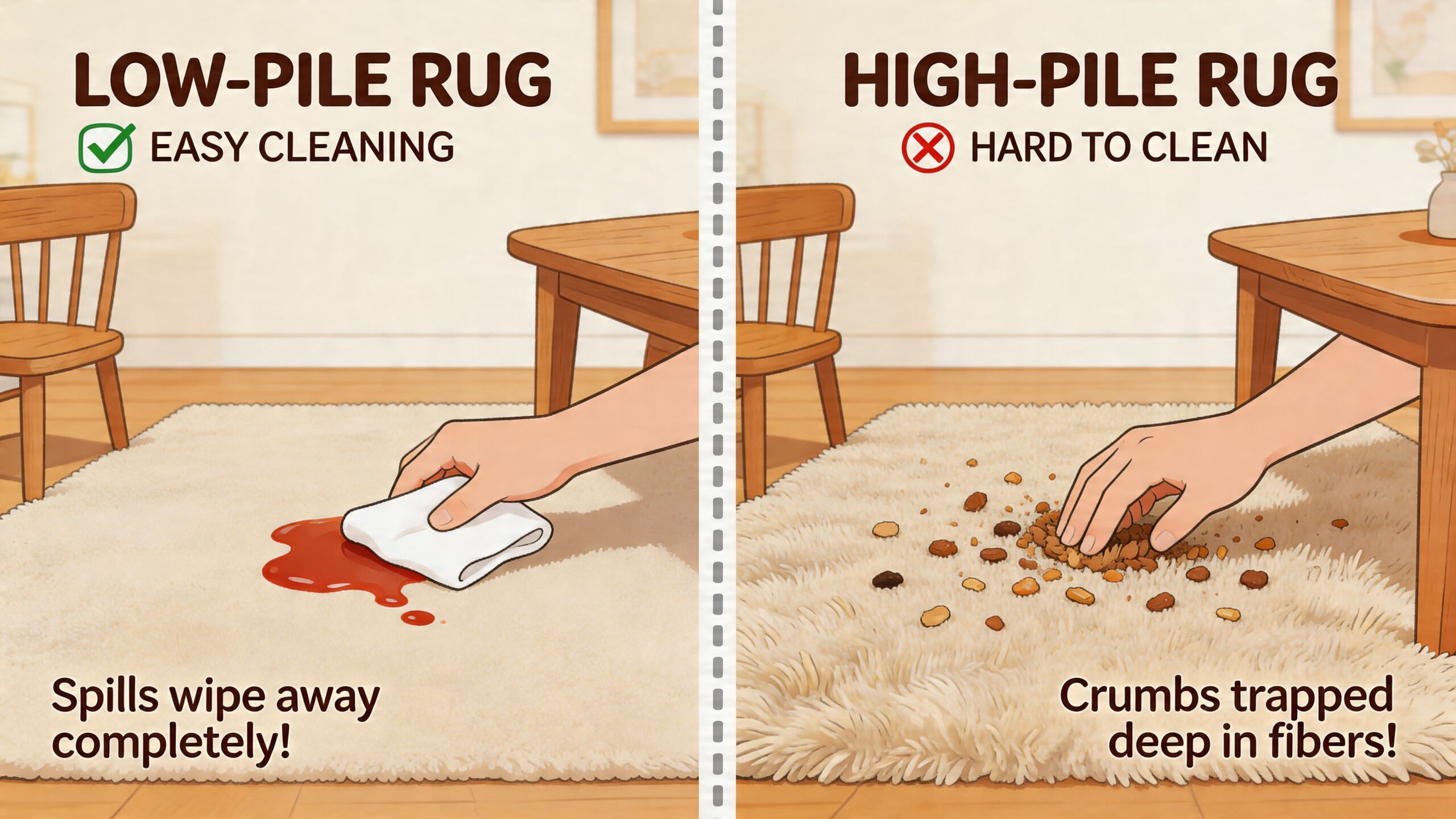
According to Jaipur Rugs’ dining room rug guide, low-pile rugs at approximately ¼ inch height are the recommended choice for dining areas because they help chairs glide more smoothly and make cleanup easier.
If your dining area sits on wood flooring, this guide on how to protect your hardwood floors is worth reading alongside your rug search because dining chairs and repeated movement can be tough on finished surfaces.
Why low pile wins in a dining room
This is one of the few rug decisions that’s almost always practical, not personal.
Low-pile rugs work better because:
- Chairs move more easily: Less drag when people sit down or get up.
- Crumbs stay manageable: Debris sits closer to the surface instead of disappearing into thick texture.
- Spills are easier to address: Faster cleanup is a real advantage in dining spaces.
- Edges hold up better in use: Less bulk means less resistance from constant chair movement.
High-pile and shag rugs may feel cozy elsewhere, but under a dining table they create friction. Chairs don’t glide well, and small messes become harder to deal with.
Matching style to the table
Style still matters. It just works best after the practical choice is made.
A few pairings tend to hold up well:
- Simple table, patterned rug: Good if the room needs energy or color.
- Detailed table, quieter rug: Lets the furniture stay the focus.
- Neutral room, textured low-pile rug: Adds depth without visual clutter.
- Busy household, forgiving pattern: Helps everyday wear blend in more gracefully.
For readers gathering ideas, this page of dining room decorating ideas can help you decide whether the rug should lead the room or support the rest of it.
What I’d skip
I’d be cautious with anything too plush, too delicate-looking, or too light if your dining room sees regular use. Formal looks can be beautiful, but dining spaces ask for durability.
One practical option in the region is Guynn Furniture & Mattress, which offers dining furnishings, in-stock selections, and access to design help for local homeowners who want to coordinate rug scale with the rest of the room. For many households, seeing the materials in person makes it easier to judge what will wear well.
Let Your Neighbors at Guynn Make It Simple
Even when you know the rules, the final choice can still feel stressful. A rug is a visible purchase, and it affects how the whole room works. Therefore, individuals typically want to get it right the first time.
That’s where local help makes a difference. Across Galax, Independence, Hillsville, and the wider Southwestern Virginia and Northern North Carolina region, homeowners often bring in room measurements, table details, and a few photos before making a final decision. That usually clears up the last bit of uncertainty fast.
The kind of help that matters
For a more complex room, expert design staff can help you think through scale, layout, and material together instead of treating them like separate decisions. Guynn’s design services, including support from Debra Williams, are especially useful when the dining room connects to a larger remodel or open living area.
A few details also matter for practical shoppers:
- Free in-home delivery and setup within 60 miles
- A large in-stock selection for immediate delivery
- A low price promise with local competitor matching and a 30-day price guarantee
- Established service in the region since 1902
That combination tends to matter to different kinds of households for different reasons. Some want design reassurance. Some want value. Some want the room finished without waiting on a long online order cycle.
Good design help doesn’t pressure you. It helps you avoid the purchase you’d regret once the chairs start moving.
Brands and room planning
If you’re building the whole dining room, not just adding a rug, it also helps to see how the rug will live alongside familiar brands such as La-Z-Boy, Ashley, Bassett, Sealy, and Therapedic elsewhere in the home. Even though those names cover more than dining, they reflect the kind of long-term comfort and livability many regional homeowners care about when furnishing a house room by room.
Create Your Perfect Dining Space Today
A well-sized dining rug changes the whole room. Chairs move easily, the table feels grounded, and the space looks settled instead of slightly off every time you walk past it.
That matters in the homes we see across Southwestern Virginia and Northern North Carolina. Some dining rooms sit right off the front entry. Others open into the kitchen or share space with the living room. In those layouts, the rug does more than sit under a table. It helps the dining area feel intentional and finished, especially in houses where one room has to do several jobs well.
Good results also last longer than people expect. The right rug makes weeknight meals easier, holiday seating less awkward, and the room more comfortable to live with year after year. If maintenance is part of your decision, this guide on whether you can wash a rug is a useful place to start before you commit.
If you want a second set of eyes, Guynn Furniture & Mattress can help you sort through practical questions that come up in local homes, from open floor plans to older dining rooms with tighter clearances. Visit Guynn Furniture & Mattress in Galax, Independence, or Hillsville, or schedule time with the design team to plan a dining space that feels right in your home, not just on paper.