How to Test a Mattress in the Showroom and at Home


A mattress feels wonderful for the first thirty seconds. You walk into the store, press a palm into the surface, sit on the corner, and inside a minute you're fairly sure you know what you're dealing with. Then it arrives home, and by the third night the shoulder you sleep on is aching and you're wondering what changed.
Nothing changed. The five-minute impression and the eight-hour reality are two different measurements, and only one of them matters. A bed is the single piece of furniture in the house that has to hold the heaviest parts of your body, in the exact position you sleep in, for hours at a stretch. Testing it properly doesn't require a laboratory. It takes about twenty minutes, a pillow from your own bed, and enough patience to stay still long enough to notice something.
Step-by-Step Showroom Routine for Testing a Mattress
A typical showroom visit can go like this. A shopper presses a palm into the middle of the bed, sits on the corner, lies back for thirty seconds while holding a coat, and forms an opinion. That test mainly reads the cover fabric and the top inch of foam. It says little about how the surface behaves once your body heat softens it, or how a shoulder feels at minute twelve.
A structured test replaces that guesswork. A biomechanical review of mattress testing methods sets out three positions that matter, seated, supine and side-lying, and notes that studies of the same mattresses track peak pressure and contact area by body region rather than one overall impression. Shoulders and hips get checked one at a time, and the midsection is not allowed to sag while you are busy admiring how soft the top feels.
Ask the salesperson for a pillow, a few quiet minutes, and permission to use a phone timer. Then leave the coat aside, remove your shoes, and treat the bed as a surface you will occupy, not a display piece. If the store offers a room-planning tool such as Visualize Your Room, use it before or after the physical test to place the size you are considering in your own layout.
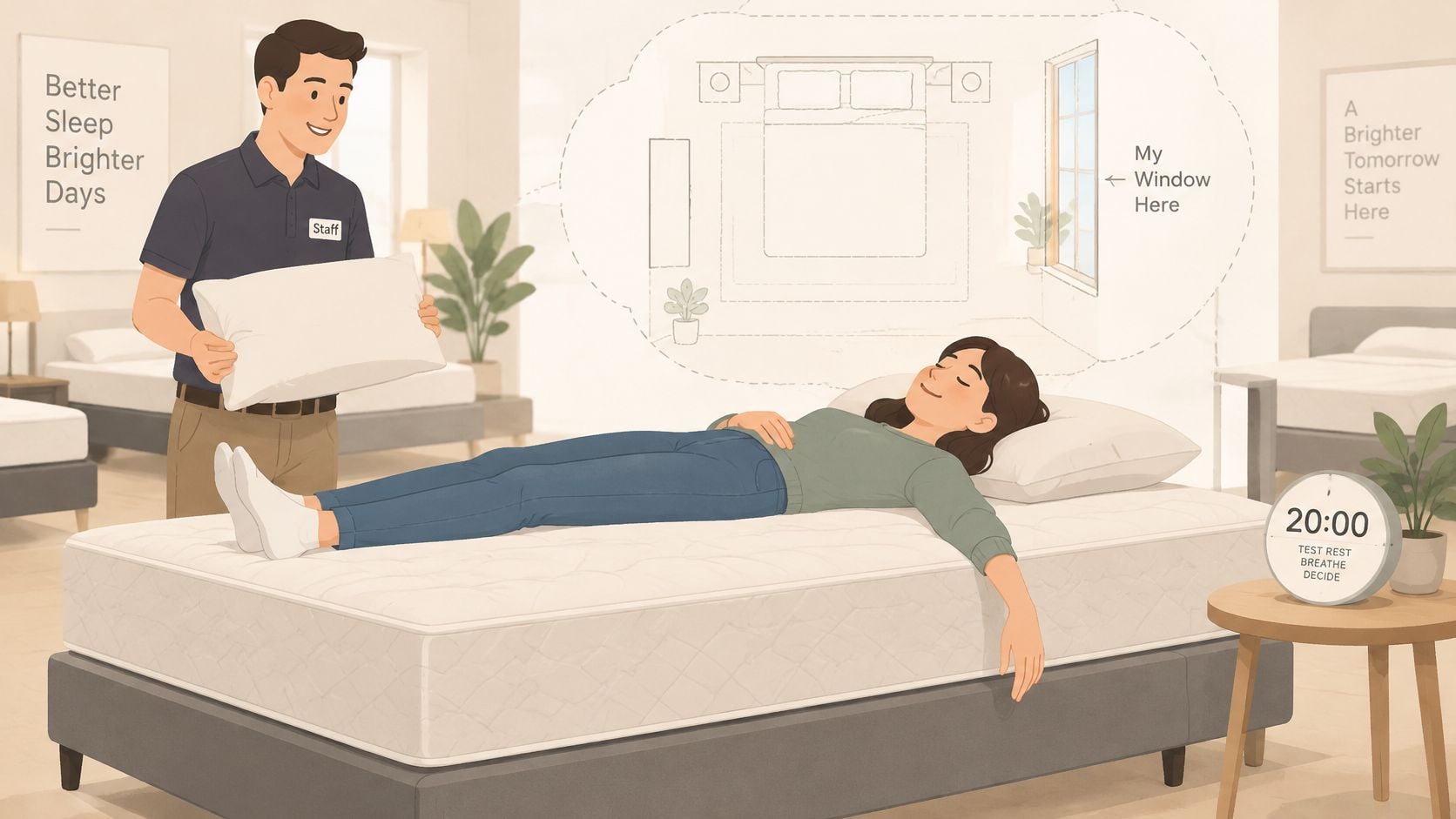
Run this sequence, in this order, on every model you are serious about.
Sit on the edge with your shoes off. This is the position you are in each morning before your feet touch the floor. A firm edge holds you up without a hard stop. If you slide forward or the border rolls under your weight, that is a warning sign, and it is worth reading about edge support before you go further.
Lie on your back for at least 10 to 15 minutes. That is the minimum window a repeatable showroom protocol allows for the primary position, according to the practical guidance around the ASTM F1566 mattress firmness test, which also recommends repeating the same check in your secondary position and noting shoulder and hip pressure, alignment and ease of turning. Set a timer on your phone rather than trusting your sense of time.
Let the mattress settle instead of bouncing. Foam and fiber need a minute or two to compress under your weight. Bouncing resets the surface every time and teaches you nothing about minute eight.
Roll onto your side and stay several minutes, then switch sides. You may favor one side, but the other side tells you whether the tension is even across the whole surface.
Turn over and get up without pushing off the edge. Rising from a low, soft border is harder than it looks, particularly with a sore knee or hip.
Repeat the entire sequence on a second model or firmness level. Same pillow, same twenty minutes, same order. Firmness labels are not standardized between brands, so compare two beds carrying the same label first, then step up or down a level.
Write down your two finalists and a note for each. Three mattresses in, the details blur into a fog of beige. Record what changed when you rolled over, where pressure built, and whether getting up felt easy.
The order carries most of the value. Seated, then back, then side runs roughly from least to most demanding on the surface, and the settling time between shifts lets the layers respond the way they will at home. That gives two models fairer terms rather than judging one warm and the other cold. Couples should repeat the back and side checks with both sleepers, because a bed that supports one body can feel very different when weight, height and turning habits change. Body type changes the pressure map, and a quick lie-down cannot show how that map evolves overnight.
Practical rule: Judge a mattress after your body has warmed it, not before.
What to Feel For in Each Sleep Position
A bed can feel pleasant under the hand and still be wrong for your body. The difference shows up in specific places, and it shows up over minutes rather than seconds. Use the table below as the checklist while you're lying there.
| Check | Good sign | Warning sign |
|---|---|---|
| Shoulder pressure | Shoulder sinks slightly and feels relieved | Sharp pressure at the shoulder or numbness in the arm |
| Hip and pelvis settling | Hips settle without dropping far below the rib cage | Pelvis sinks well below the shoulders |
| Spinal alignment | Spine looks reasonably straight from the side when a companion checks | Dip at the waist or upward bend at the hips |
| Lower back support | Lumbar area is supported with no gap underneath | Gap under the lower back or a building ache |
| Edge support | Edge stays firm when you sit on it | Edge collapses or rolls under your weight |
| Ease of turning | You roll over with little effort | Mattress grabs or resists movement |
| Motion transfer for couples | Your partner's movement barely reaches you | Every shift wakes the other sleeper |
Two rows need a second person. Nobody can judge their own spinal alignment from inside the bed, so bring someone who will crouch at eye level and tell you whether your spine looks level or your hips are sitting in a hollow.
Pressure is a time problem, not an instant one. Calibrated pressure-mapping studies place a sensor mat between sleeper and mattress and record readings separately in supine, lateral, and prone positions, and one peer-reviewed protocol captured each posture for six minutes at 4 Hz, as described in research on mattress firmness and pressure distribution. Six minutes is a fair benchmark for a store visit. If a shoulder starts complaining in three, another nine won't fix it.
That same research is careful about numbers, and shoppers should be too. Peak pressure, average pressure, and contact area by body region aren't interchangeable, and a lower peak reading can sit alongside poor support or excessive sinkage.
A gentle reading at the shoulder proves nothing if your hips are buried. Judge the whole body, not one point on it.
Because position, body shape, clothing, and adaptation time all shift what you feel, a single snapshot isn't a verdict. Run the same checks twice, once in the first few minutes and again near the end of your time on the bed, and compare the two. If you're unsure which position counts as your primary one, the guide to choosing a mattress for your sleeping style is worth five minutes before you shop.
Then keep score the simple way. Count the warning signs for each mattress and treat the one with the fewest as the leading contender.
Matching Firmness to Your Body and Sleep Style
You and your partner try the same mattress. One calls it comfortable; the other feels barely any cushioning. Both reactions matter. Body weight, shape, and sleep position change how you settle into the layers, so a firmness label is only a starting point.
Choose the feel that works under your body, then check whether it still works with your partner beside you.
What the standard numbers actually measure
Hardness testing measures how a mattress responds to controlled loading. Under ISO 23769:2021, hardness comes from a load-and-deflection curve and is expressed on a 1.0-to-10.0 scale, using a 355-millimeter loading pad, equipment capable of applying up to 1,000 newtons, and a travel speed of 90 ± 5 millimeters per minute.
Those measurements describe the mattress under a particular test. Your shoulders, waist, and hips apply pressure differently. Use firmness labels to narrow your choices, and compare models within the same brand or testing system when specifications allow. Then judge how each surface accommodates your shape.
What body type changes
A heavier sleeper compresses the layers differently from a lighter sleeper. Body shape matters too: waist and hip proportions affect where the mattress meets you and where you need support. Findings in research on mattress firmness and body measurements support considering body measurements when assessing firmness rather than choosing from a label alone.
Use these starting points to organize your comparison. Each row gives you something specific to check, rather than a fixed prescription.
| Sleeper type | Test first | Watch for |
|---|---|---|
| Heavier sleeper | Firmer option, compared with a second level | Deep settling that makes changing position awkward |
| Lighter sleeper | Softer option, compared with a firmer level | Shoulder pressing hard into the surface |
| Side sleeper | Side-lying on each side | Shoulder and hip pressure building over time |
| Back sleeper | Your usual back-sleeping position | Lower back feeling unsupported |
| Couple | Each partner alone, then together | Motion transfer and rolling toward the center |
| Older shopper or limited mobility | Sitting up and standing from the edge | Edge height that makes getting out hard |
Keep the comparison fair. Use comparable foundations under both mattresses, since a flexible base can change the feel. Lie down before forming a verdict. Keep pillow height consistent too, because changing it alters your position and can make a mattress seem better or worse for reasons unrelated to its firmness.
Couples should record their preferences separately before discussing them. That keeps one partner's first impression from becoming the shared verdict. Then lie down together: check whether movement travels across the surface, whether both edges feel usable, and whether either person rolls toward the other. A quick shared test can expose a mismatch, but it cannot establish how often you will disturb each other over several nights.
For older shoppers or anyone with joint trouble, getting out deserves its own test. Sit up from lying down, then stand using the edge as you would at home. Comfort while lying still is only part of the choice. Use the mattress firmness guide to narrow the levels you want to compare, while keeping ease of movement and each partner's needs in the decision.
Using a Home Trial Period to Confirm Your Choice
A showroom test captures first feel. Sleep quality takes nights to reveal itself, and short tests miss changes that build over time. Research on mattress firmness, sleep quality, and back comfort found that lower-back muscle activity differed across firmness conditions, with pressure rising and contact area falling as firmness increased, while medium firmness produced the lowest discomfort ratings and performed best on sleep quality for participants with moderate BMI. Those were controlled conditions. Your bedroom is not.
So keep a log for about two weeks, writing in it every morning before you get out of bed. A mattress that feels right at minute ten can feel wrong at hour six, and the log separates the two.
- Morning pain or stiffness. Note where it sits and whether it fades within twenty minutes.
- Nighttime awakenings. Count them, and note whether you woke from pressure, heat, or nothing identifiable.
- Overheating. A warm sleeper on a heat-trapping surface notices within three nights.
- Ease of turning. If rolling over takes effort, the surface is fighting you.
- Partner disturbance. Any night one sleeper wakes the other is worth recording.
- Edge stability. Sit on the edge in the morning and see whether it still holds.
If you share the bed, keep two logs rather than one. A surface that suits the lighter side sleeper can still fail the heavier back sleeper, and a single averaged log hides that until the return window closes.
Three points cause most of the confusion at the end of a trial. Body impressions on bedding with multiple layers of padding are normal and are not a defect. Bedding that is soiled or damaged may not be returned to Guynn Furniture & Mattress, which is why a mattress protector from day one makes sense. Structural failures such as broken wood frames, springs or border wires are covered, because mattresses and box springs are warranted against exactly that kind of defect.
Before you buy: ask for the exchange window and the return conditions in writing, and read them while you're still in the store.
If back discomfort is part of why you're shopping, test the mattress on the base you plan to use. On an adjustable base, raising the head and knees changes where the surface flexes and how the spine sits, and sleepers who use them often describe better sleep and less back pain than sleeping flat. Treat that as a strong hint rather than a promise, and try the position yourself before you pay for it. If back pain is driving the decision, the guide on how to pick a mattress for back pain narrows the field before you commit.
When the home trial contradicts the showroom, believe the log. First impressions are the least reliable data you'll collect.
Confirm Your Choice and Book a Test Visit
The decision rule is short. Pick the mattress with the fewest warning signs on your checklist, the best stretch of nights in your trial log, and a comfortable fit for both sleepers if you share a bed. If two models tie, the one that made turning over easier wins, because you will do it a dozen times a night for the next decade.
Guynn Furniture & Mattress has been furnishing homes in the region since 1902, when the family ran a country store where locals traded butter and eggs for supplies. Today the showrooms in Galax, Independence and Hillsville serve Southwestern Virginia, northern North Carolina and southern West Virginia, and every purchase comes with free in-home delivery within 60 miles. Items arrive assembled and set up with the packaging materials removed, so the only thing left to do is sleep on the mattress and keep logging.
Arrive with a shortlist rather than a blank page. The online catalog lets you add mattresses to a wishlist and compare models side by side before you ever leave home, and a quick tool can help you find your ideal sleep solution by narrowing feel and support level to suit your sleep habits. If you want a sense of the visit before you go, this guide to choosing the best mattress store near you lays out what a useful showroom stop looks like.
Bring your own pillow, your checklist notes, your trial log if you are replacing a bed you already own, and your partner if you have one. Two sleepers should test together, because a mattress that isolates movement well for one person can still feel wrong once a second body is on it. If you spot the same model for less at a local competitor, the store will match that price on the spot, and special financing is available with approved credit.
After a purchase, questions can go through the service request form or a text to the store at 276-236-6691, and customer pick-ups are available by appointment if you would rather collect a smaller item yourself.
You now have a shortlist, a scoring routine and a way to read the results after real nights of sleep. The rest is a lie-down and a log. When you are ready to put the method to work, visit Guynn Furniture & Mattress and let the mattress make its case.